Rocks from Pompeii suburb tells a story of destruction—that could help us today
Two-thousand years ago, a Roman author and lawyer named Pliny the Younger wrote an account of one of the most destructive disasters in human history. He chronicled Mount Vesuvius’ eruption and the subsequent burial of Pompeii, which killed his uncle Pliny the Elder and about 2,000 others. The detail in Pliny the Younger’s account and the inferred eruption date of August 24, 79 CE has provided scientists and archaeologists with a benchmark method for dating not only Vesuvius’ eruptions, but other volcanic events as well.
A new study published today in the journal Science Advances reports that the argon-argon dating method calibrated with that August 24, 79 CE is now even more precise. Argon-argon dating measures the ratio of atoms with the same numbers of protons and neutrons (called isotopes) inside of the element argon to determine the ages of rocks, minerals, and volcanic materials.
Improvements in this kind of dating allows scientists to attach more accurate dates to past eruptions of volcanoes that still threaten cities including Mexico City, Mexico; Naples, Italy; and Yogyakarta, Indonesia.
“If you want to put together the eruptive history of a volcano in relatively recent time, precision and accuracy really count,” Paul Renne, a study co-author and geochronologist at the University of California, Berkeley, said in a statement. “The study shows that you can achieve that kind of highly useful precision and accuracy into the historical realm.”
Suburban pumice
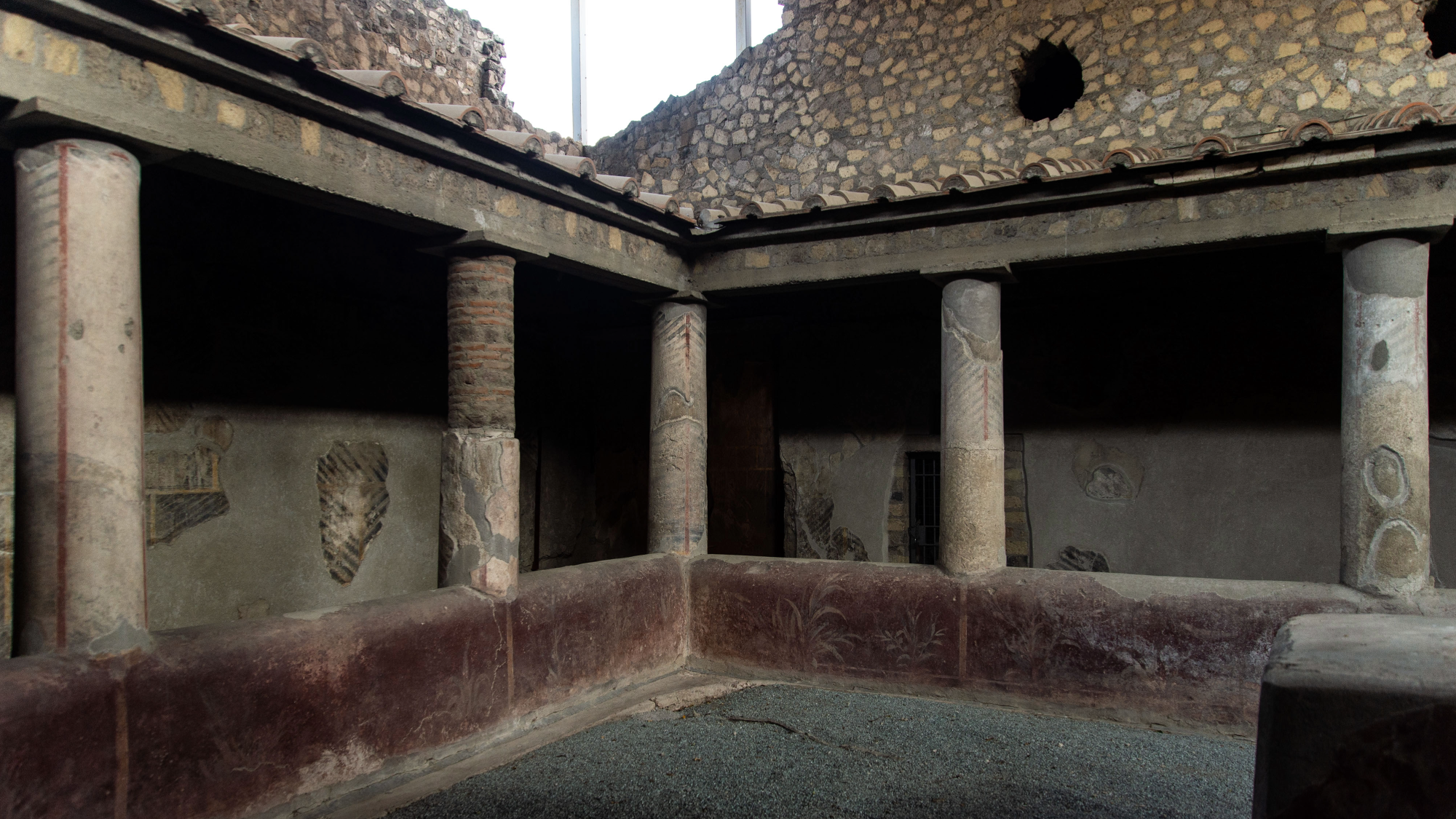
In 1998, study co-author Andrea Marzoli of the University of Padua in Italy took new, more potassium-rich pumice samples from Oplontis. This suburb of Pompeii was also buried in ash during the eruption. Unlike previous samples, these came from the earliest stage of the Vesuvius eruption. The magma chambers under stratovolcanoes like Vesuvius tend to stratify, so the iron and magnesium is concentrated at the bottom of the chamber, and soluble elements like potassium end up at the top. This means that the potassium-rich magma comes out first, and ends up at the bottom of ash and pumice deposits. The pumice Marzoli sampled 28 years ago came from these bottom deposits.
However, the samples were placed on a shelf and never analyzed. Several years ago, graduate students Caroline Hasler, Anthony Fuentes, and Andy Tholt suggested pulling out Marzoli’s 30-year-old samples.
Accuracy vs. precision
Though often used as synonyms, there is a difference between accuracy and precision. Accuracy refers to whether a result is correct. Precision measures how reproducible that result is. For example, if a basketball player shoots with accuracy, their aim will always take the ball close to or into the basket. If the player shoots with precision, their aim will always take the ball to the same location—which may or may not be close to the basket.
To test this accurate and precise argon-argon dating method in the new study, the team used eight samples of a potassium-containing volcanic mineral from Vesuvius called sanidine. When this sanidine sample was first analyzed last year, scientists put the eruption at roughly 1,938 years ago. Based on the new dating method and mixed with Pliny the Younger’s writings, the actual age of the volcanic minerals is 1,946 years. This estimate is equivalent to a precision of 0.7 percent and an accuracy of 0.4 percent.
“This lets us more precisely infer causality between events in the geologic record, for example a meteor impact structure and a mass extinction,” Renne said.
Hasler also did a deep dive into the recorded history of Vesuvius’ eruption and Pliny the Younger’s writing. This helped the team validate the August 24 eruption date to within two months and twice as precise as the previous estimates.
According to the team, more accurate and precise argon-argon dating like this will be invaluable in calibrating radiocarbon dating. This method is currently the dominant method of attaching dates to materials younger than roughly 55,000 years.
“We’re hoping to really unify as many geologic dating methods as we can by using the same mathematics, the same Bayesian approach, and just bringing more data, more raw observations into that mix,” Renne said. “But argon-argon dating is always going to be a standard—it’s going to be an important calibrant in that sense.”
KioskNews shows a cleaned-up reading view extracted from the publisher’s page — the original always lives on their site, not ours.