Nifty Fell 10% In 2 Years, But This Rs 1 Crore Portfolio Grew By Rs 16 Lakh. Here's How

Stock Market Analysis: For Indian investors, keeping most of their money in India is easy to understand. Their income is earned here. Their financial goals are here. And they are more familiar with Indian companies.
But there is a difference between being bullish on India and putting almost all your equity exposure in India.
The past two years offer a useful example. FOLLOW LIVE UPDATES
Also Read | Layoffs Are Rising In Tech, But These Skills Are Helping People Unlock Better Pay
The Nifty 50 closed at 25,939 on September 23, 2024. By September 28, 2026, it stood at 22,780, a decline of over 10 per cent. The Nifty 500 also fell by over 6 per cent over the period.
For investors who remained heavily invested in Indian equities, it meant waiting for the market cycle to turn. But what if a part of the portfolio had been invested overseas?
What A 30% Global Allocation Could Have Changed
Consider a Rs 1 crore equity portfolio.
In one scenario, the entire portfolio is split equally between the Nifty 50 and Nifty 500.
In the second, India still remains the dominant part of the portfolio. But 35 per cent is allocated to the Nifty 50, 35 per cent to the Nifty 500, 15 per cent to the S&P 500 and another 15 per cent to the Nasdaq-100. That means 70 per cent remains invested in India and 30 per cent is spread across US markets.
According to Ajay Kumar Yadav, CFPCM, Group CEO & CIO, Wise Finserv Private Wealth, the point of such diversification is not to predict which market will perform better. "It is to avoid making the entire portfolio dependent on one market cycle," Yadav told NDTV.
During the period under consideration, the S&P 500 gained around 35.8 per cent in dollar terms, while the Nasdaq-100 rose around 53.5 per cent. The rupee's weakness against the dollar also increased the rupee value of unhedged US investments.
Based on these price movements and the assumptions in the illustration, the Rs 1 crore India-only portfolio would have been worth roughly Rs 92 lakh. The 70:30 India-global portfolio could have been around Rs 1.08 crore, before expenses, taxes, dividends and tracking differences.
The difference is about Rs 16 lakh. But Ajay Kumar Yadav cautions that this should not be read as evidence that international markets will always beat India.
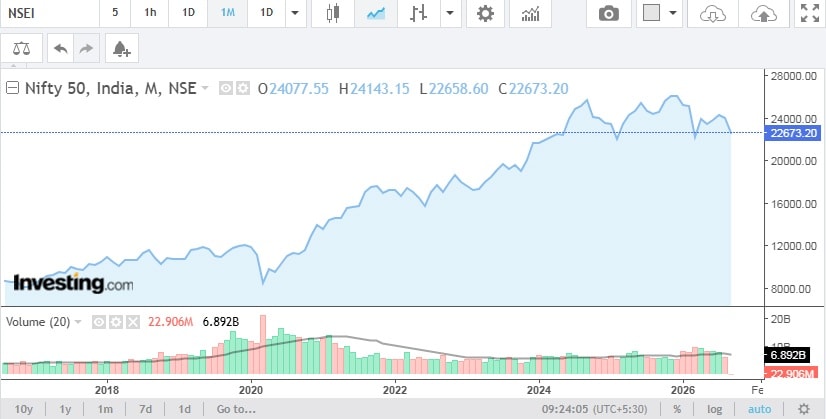
Nifty50 Fall Over 1 Month
Global Does Not Have To Mean Only US Stocks
The S&P 500 and Nasdaq-100 make the comparison easy to understand. But global diversification does not necessarily mean putting money only into the US.
Investors can also get exposure to other developed and emerging markets. Japan, Taiwan and broader emerging-market indices can provide different sector mixes, currencies and sources of corporate earnings.
“The idea is not to replace India concentration with US concentration,” says Yadav. A portfolio that moves from being heavily concentrated in India to being heavily concentrated in US technology stocks has not solved the diversification problem completely.
Global Markets Can Also Fall Hard
There is another side to the story. In 2022, the Nasdaq-100 fell by roughly 33 per cent, while the Nifty 50 Total Return Index gained around 5.7 per cent.
In such a year, an India-heavy portfolio would have held up much better than one with a large US technology allocation. That is precisely why geographical diversification cannot be treated as a one-way bet.
There will be periods when India does better. There will be periods when US markets lead. Other developed or emerging markets may outperform both at different points. As Yadav explains, diversification is less about identifying the next winning market and more about reducing dependence on any one market being the winner.
The Problem With Investing Overseas
There is, however, a practical hurdle for Indian investors. Mutual funds face an industry-wide limit of US$7 billion for overseas securities. There is a separate US$1 billion industry limit for overseas ETFs. Each mutual fund can invest up to US$1 billion in overseas securities, while the individual mutual-fund limit for overseas ETFs is US$300 million.
These limits have affected the ability of some fund houses to accept fresh investments into international schemes. Several fund houses restricted or suspended fresh subscriptions in select overseas funds during 2026. This has also created another issue for some India-listed international ETFs. Recent reports have highlighted cases where such ETFs traded at substantial premiums to their underlying net asset values because of supply constraints.
So investors need to look beyond the headline return. The route used to invest overseas can affect costs, taxation, liquidity and the actual price paid. Resident individuals can also invest overseas directly under the RBI's Liberalised Remittance Scheme, subject to the applicable rules and annual limit. GIFT City is another route that has emerged for accessing international investment products.
The Bigger Question Is Asset Allocation
Investors often ask whether the Nifty will recover, whether Nasdaq valuations are too high or whether the rupee will strengthen.
These are difficult questions to answer consistently. Asset allocation addresses a different problem.
It reduces the need to get every market call right. There is nothing special about a 30 per cent overseas allocation. The appropriate level depends on an investor's goals, risk tolerance, existing assets and currency requirements.
For someone with future expenses in dollars, the need for foreign-currency exposure may also be different. But a very small overseas allocation may not materially change how a portfolio behaves.
A meaningful allocation can introduce a different source of earnings, currencies and market cycles. India can remain the core of an Indian investor's portfolio without being the entire portfolio.
“Geographical diversification is not about knowing which market will win next,” says Yadav. “It is about building a portfolio that does not require you to know.”
{Note: The Rs 1 crore portfolio comparison is an illustration of geographical diversification, not an investment recommendation. Actual returns can differ because of dividends, expenses, taxes, tracking differences and currency movements. The 70:30 allocation is illustrative and may not be suitable for every investor.}
KioskNews shows a cleaned-up reading view extracted from the publisher’s page — the original always lives on their site, not ours.