Philippines still among top countries in bullying – PISA 2025
Already have Rappler+?
to listen to groundbreaking journalism.
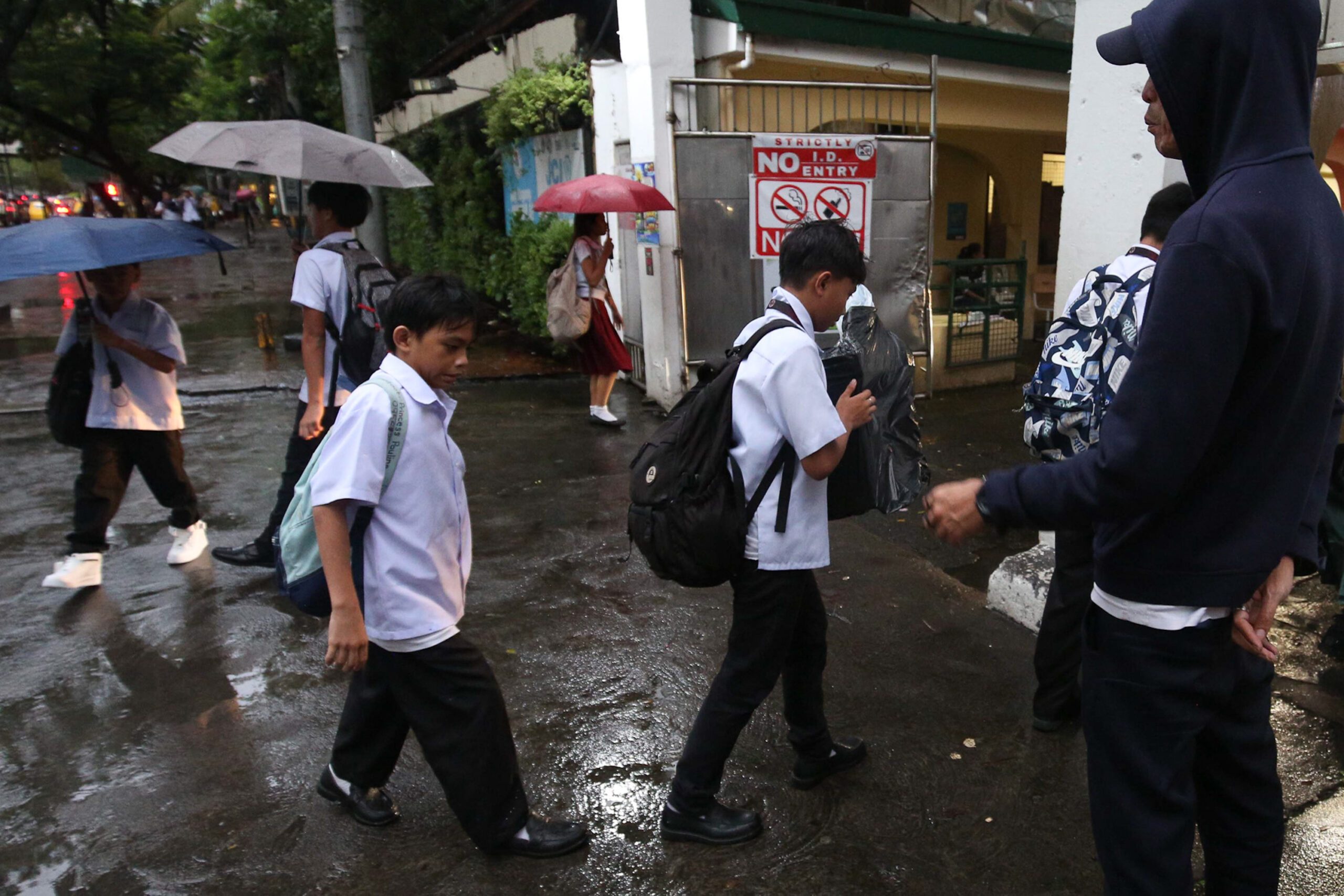
BAD WEATHER. Students go to school as it rains in Manila on August 3, 2026.
Rappler
No longer the world’s ‘bullying capital’? The Philippines’ bullying index is still higher than average in the latest Programme for International Student Assessment results.
AT A GLANCE
- In 2025, 47.2% of Filipino students reported experiencing bullying, according to the Programme for International Student Assessment.
- The Department of Education aims to improve school safety and mental health support, but faces challenges.
This is AI-generated. Read the article for full context. Report any errors.
MANILA, Philippines – The Philippines saw a lower bullying rate in 2025, but it continued to have one of the highest rates among participating countries in the latest edition of the Programme for International Student Assessment (PISA).
PISA data show that 47.2% or nearly half of 15-year-old Filipino students reported experiencing “at least one form of bullying a few times per month or more.”
It was more than double the 20% average rate of the Organisation for Economic Co-operation and Development (OECD), the institution behind PISA.
Around three out of 10 Filipino students or 31% were also considered “frequently bullied.”
Who are more likely to report being bullied in the Philippines? Here are the PISA 2025 results:
- Boys than girls
- Disadvantaged students than advantaged students
- From disadvantaged schools than socioeconomically average or advantaged schools
- Located in rural areas or villages than towns or cities
- From public schools than private schools
In 2025, the Philippines was no longer the country with the highest index of exposure to bullying, but it still ranked third, following Rwanda and Kenya. It was the first time the two African nations participated in PISA.
The Philippines had been dubbed the world’s “bullying capital”, as noted by observers including the Second Congressional Commission on Education (EDCOM 2), due to its results in global assessments like PISA.
Still, the Department of Education (DepEd) said “there are encouraging signs of improvement,” as it compared the findings from the country’s first PISA participation in 2018, rather than the COVID-19 pandemic era in 2022.
In 2018, 64.9% of Filipino students reported experiencing an act of bullying at least a few times a month or more.
Comparing the 2018 and 2025 PISA cycles, there were declines in reports of students being made fun of by other students, being hit or pushed, being threatened, and being victims of nasty rumors.
Threat of cyberbullying
PISA results also showed 13.9% of Filipino students reported being cyberbullied in 2025. It was the second highest among participating countries, just behind Rwanda’s 21.7%.
It was way beyond the OECD average of 3%.
PISA asked students if “upsetting” information about them had been published online, without their consent, at least a few times a month during the year prior to the exam.
The report also found that students who spend more time on digital devices are more likely to report incidents of cyberbullying.
“Although cyberbullying is less frequently reported than other forms of bullying, it often occurs in addition to other forms of bullying, and research suggests that it is associated with poorer well-being and mental health outcomes,” the OECD warned.
According to the assessment, cyberbullying victims also tend to experience significant achievement deficits.
In the Philippines, those who were cyberbullied scored 49 points lower in science than their peers, on average.

Cyberbullying is also being tracked by the DepEd in its anti-bullying campaign.
However, if the self-reported rates in PISA results are to be believed, the figures are quite distant from what the agency has recorded. Is bullying still “underreported” in the country?
What DepEd promised
The emphasis on mental health is even greater now following two fatal school shootings this year.
“The current goal of the DepEd is to…foster a more safe and welcoming environment for our students. It should not only be academic. They (the students) should look forward to school, to seeing friends and teachers, and look forward to that day’s lesson,” Education Secretary Sonny Angara said in a news conference after the PISA results announcement on September 8.
Education Undersecretary Carmela Oracion also said the DepEd does not want to be reactive when it comes to school violence.
“There are urgent things to do like [strengthening] the security measures. But apart from that, we want to bring this in through values education…. We are really strengthening that,” she told reporters.
As it stands, it would be an uphill battle for the DepEd amid lack of funding to address the shortage of security guards, CCTV cameras, and metal detectors in public schools.
The agency’s proposed 2027 budget also lacks allocations to train teachers in spotting red flags in student behavior, as well as to fully implement its mental health and counseling program.
The DepEd already signed the revised implementing rules and regulations of the Anti-Bullying Act of 2013 in August 2025, to provide clearer definitions of bullying, set the responsibilities of various sectors, and strengthen school-level response. Budget constraints, however, could be another obstacle. – Rappler.com
KioskNews shows a cleaned-up reading view extracted from the publisher’s page — the original always lives on their site, not ours.