How to find the best new tech on crowdfunding websites

Breakthroughs, discoveries, and DIY tips sent six days a week.
By signing up, you confirm you are 16+, will receive newsletters and promotional content and agree to our Terms of Use and acknowledge the data practices in our Privacy Policy. You may unsubscribe at any time.
If you want to find the most innovative and coolest new tech of the moment, you shouldn’t always automatically turn to familiar names like Apple, Google, and Samsung. You’ll find a whole host of smaller companies and start-ups testing out their ideas and prototypes—and looking to raise funds for the projects at the same time—over on Kickstarter and Indiegogo.
These two sites work similarly. Creators pitch their ideas and show you how far they’ve got in terms of prototyping and development. If you’re interested, you put down some money—usually less than you’ll pay if you wait until the finished product goes on sale—and this collected cash is then used to fund production.
From a quick scan at the time of writing, you’ll find portable wind turbines, retro game consoles, pocket cameras that turn into drones, and smart lunchboxes on these platforms. Whatever kind of tech you’re interested in, you’ll find there are plenty of products to browse through (and there’s lots more besides tech gadgets, too).
While there are no guarantees that these projects will actually turn into finished products, a good number of them do, and you can usually spot the ones that are less likely to succeed (as we’ll cover below). In the ideal scenario, you get yourself a new gadget you find useful, and save money at the same time by being an early backer.
Find the coolest tech being crowdfunded right now
Once you land on the Kickstarter or Indiegogo home pages, it’s not difficult to start browsing around for gadgets that might interest you: These platforms are built to make discovery as straightforward as possible, and you’ll immediately see some recommended crowdfunding projects on the front page that are proving popular with other people.
As well as highlighted listings, you get category links. These cover not just tech, but all sorts of other areas as well, including art, film, photography, education, design, journalism, travel, fashion, and community—so when you’ve exhausted all the cool hardware on these sites, there’s plenty more to look at.
If you’re looking for something specific, use the search function. Maybe you’re after a travel adaptor that doubles up as a USB hub, or a robot that can keep your pet company, or a smart suitcase designed to carry laptops, tablets, and cameras. Whatever you’re after, chances are someone is trying to get it crowdfunded on Kickstarter or Indiegogo.
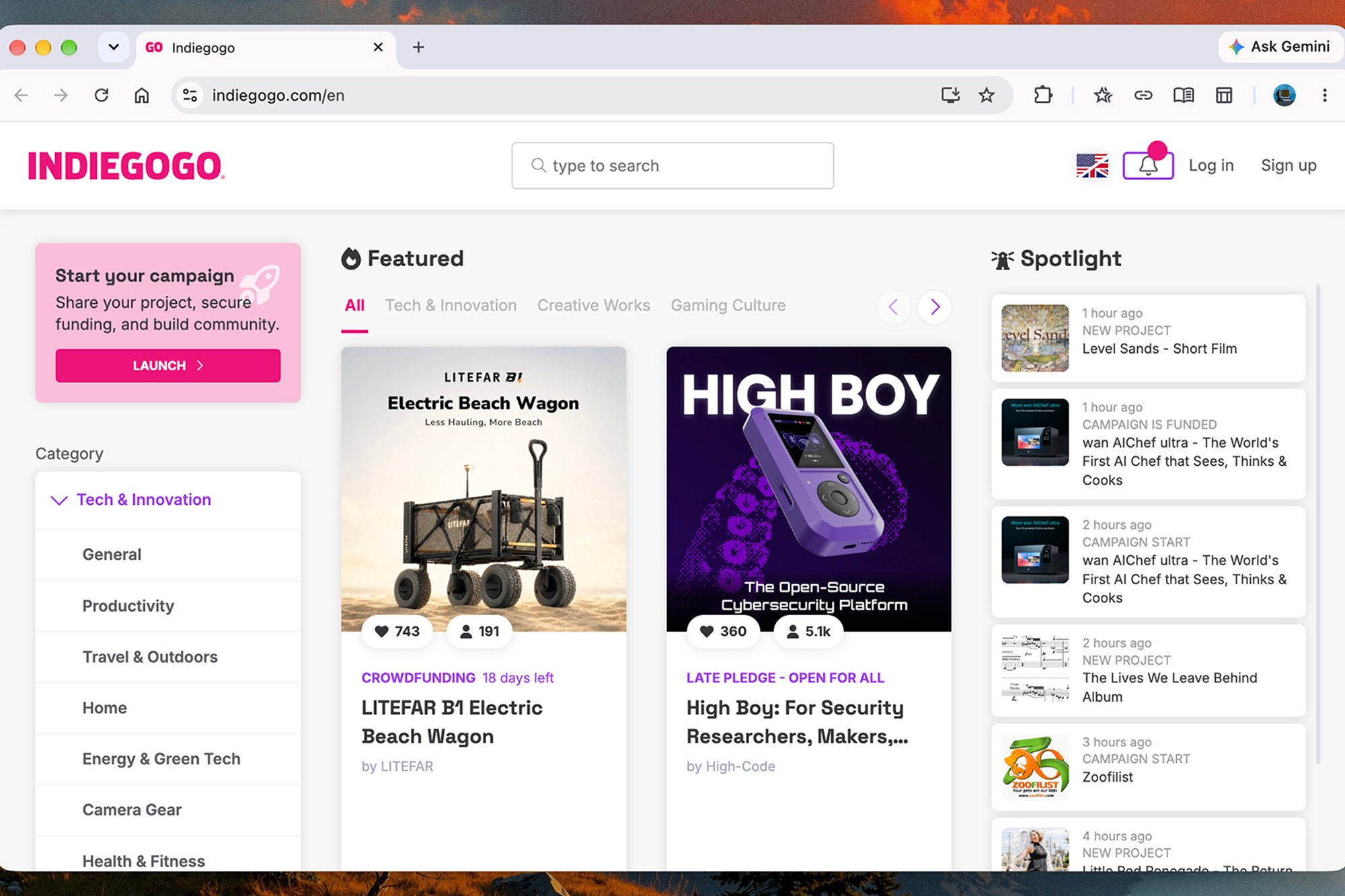
Click through to any of the project listings, and you’ll get a massive amount of extra information about what’s involved. Creators know that the more detail there is, the more likely they are to attract enough funding, and you’ll typically find product photos, videos, specs, and a schedule for bringing it to market.
There should also be details about the company making the product. Often these will be smaller start-ups (or even individuals), but you do occasionally see larger tech companies take the crowdfunding route as well: The Ultrahuman Ring Pro was recently crowdfunded on Kickstarter, for example.
The all-important financial information will be included here too: How much money has been raised so far, what the target is, and the various tiers at which you can contribute. As well as getting a discount on the finished product, backing a project usually means you’ll be able to access certain rewards, such as bundled accessories or even a say in how the product is developed going forward.
What to look out for on project listings
Both Kickstarter and Indiegogo have similar rules when it comes to backing projects: If the product doesn’t actually get funded, you don’t lose anything. However, if the funding goal is reached, your money is taken—and the responsibility shifts to the project creator rather than the crowdfunding platforms. If the gadget never materializes, that’s on the creator, not Kickstarter or Indiegogo.
At that stage you may get a refund or you may not, or you may get something different for your money. With that in mind, be careful about the projects you decide to back. As per figures quoted by Kickstarter, around 1 in 10 crowdfunded projects fail completely, so the vast majority succeed—but it’s still best to be wary.
To start with, look at the people behind the project. What’s their track record with launching products? Have they dealt with hardware manufacturing before? Has the company made any devices previously? Does it have a portfolio of other products you can check out and actually buy?

Then there’s the project itself: You should weigh up how realistic the project’s aims are, especially if nothing similar is on the market. Look for evidence of prototype gadgets that have already been tested and reviewed, as well as details on how the product will be made and how its parts will be sourced.
Rewards are something else to look at—do these seem reasonable and practical, or are the creators overreaching and promising too much? A crowdfunded project’s success isn’t solely down to the main product, since rewards that get too complicated or too costly can cause problems too.
There’s no magic formula for predicting whether a Kickstarter or Indiegogo project will be successful or not, but those pointers should give you a good idea. There’s also the question of the price contributors are being asked to pay: Don’t give more than you can afford, and if you have doubts, maybe wait until it’s actually on sale to everyone.
KioskNews shows a cleaned-up reading view extracted from the publisher’s page — the original always lives on their site, not ours.