Supreme Court questions Election Commission on use of Form 6, ‘logical discrepancy’ notices to voters amid SIR
The court made it clear that it had not upheld the Election Commission’s use of the “logical discrepancy” category to flag voters during the revision.

 Prefer HTon Google

The Supreme Court on Wednesday asked the Election Commission of India (ECI) not to require nearly 4.3 million Delhi residents – whose names were removed from the electoral rolls after they could not be found at their last known addresses – to reapply as new voters through Form 6 under the ongoing special intensive revision (SIR), provided they were on the 2026 rolls.
Instead, it suggested that such voters be permitted to restore their names through Form 8, which is intended for address-related changes, or through the enumeration process.
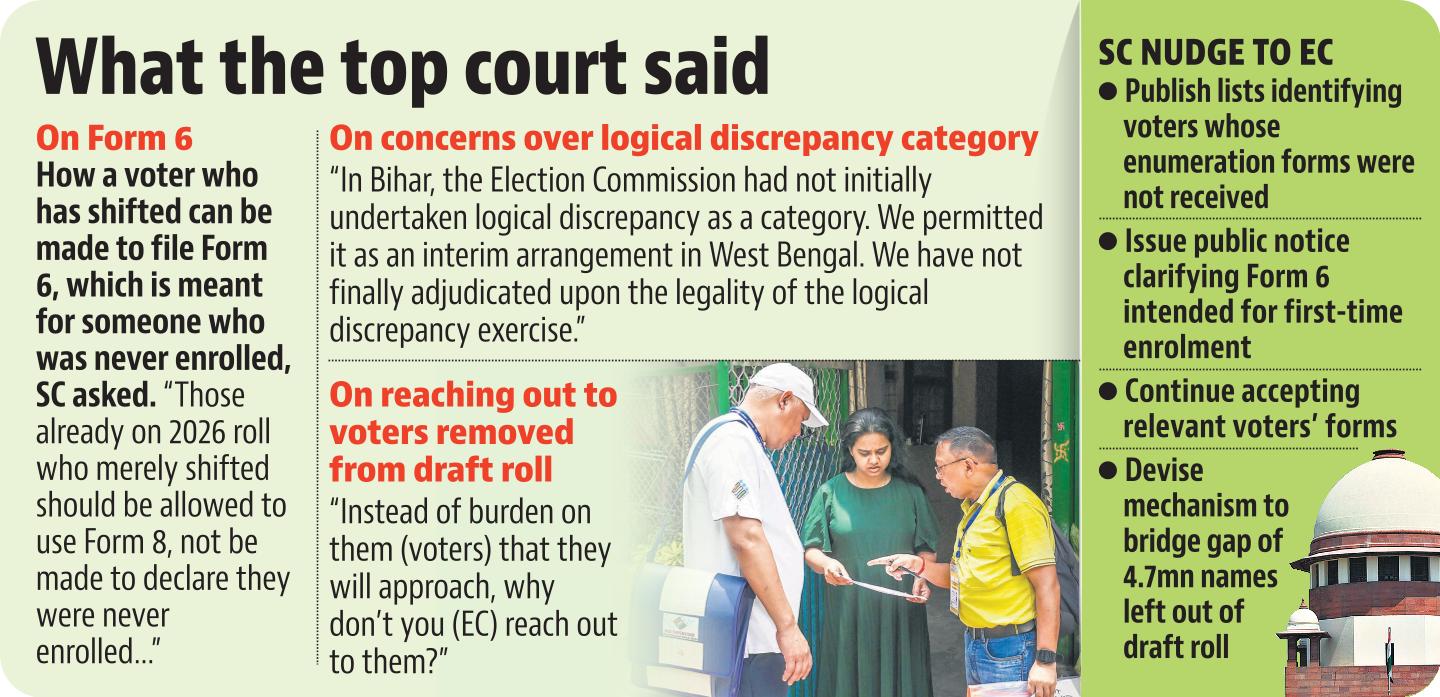
The court also made it clear that it had not upheld the Election Commission’s use of the “logical discrepancy” category to flag voters during the revision, saying the legality of the mechanism would have to be examined separately. It further questioned whether the criterion involved any meaningful human application of mind or was based on algorithm-driven patterns. The controversial category led to the disenfranchisement of 2.71 million people in West Bengal.
'Approach voters, instead of leaving burden on them'
A bench, comprising Chief Justice of India Surya Kant and justices Joymalya Bagchi and V Mohana, urged the poll panel to make the exercise more accessible and proactively reach out to voters who may have been left out of the draft electoral roll, rather than placing the entire burden on them to approach election officials.
“Instead of burden on them that they will approach, why don’t you reach out to them?” the bench asked senior advocate DS Naidu, appearing for ECI, pointing to Delhi’s large migrant population, which frequently moves between localities and cities for livelihood.
“Those already on the 2026 roll who merely shifted residence should be allowed to use Form 8, not be made to declare they were never enrolled. Temporary absence is not a shift of residence…Being away on work for a month or two does not make an elector ‘permanently shifted’…You have to search 43 lakh odd people that where have they gone?” the bench told Naidu, while further pointing out ECI’s procedure had no remedy for electors who never shifted but were never served the form.
Forms 6, 7 and 8, the court underlined, were “cast in stone”, clarifying the forms cannot be reworked and asking how a voter who has shifted can be made to file Form 6, which is meant for someone who was never enrolled. “This structural incongruity...will you say the person forever loses right to come in roll?” it remarked.
The bench also asked the commission to publish lists identifying voters whose enumeration forms were not received, indicating their previous electoral particulars and asking them to contact the nearest booth-level officer (BLO). It said the information should be readily available at polling booths and other accessible locations, enabling people to establish that they were already registered voters and had merely changed addresses.
Hearing a plea filed by transparency activists Anjali Bhardwaj and Amrita Johri, the court said the commission should issue a public notice in simple language clarifying that Form 6 was intended for first-time enrolment in Delhi, while those who had shifted residence could use Form 8 or submit the relevant enumeration forms. Advocate Prashant Bhushan argued for the petitioners.
Importantly, the court also asked ECI not to insist on a cut-off date at this stage, and to continue accepting the relevant forms while verifying the information and seeking supporting documents wherever necessary, especially since there are no upcoming elections in Delhi. At present, October 30 is the last date to file claims and objections.
“Keep on persuading people,” the bench told the poll panel, asking it to devise a mechanism to bridge the gap of nearly 4.7 million electors whose names were not carried forward to the draft roll published on August 31.
Of the approximately 14.5 million electors at the start of SIR, around 9.7 million submitted enumeration forms, while about 4.7 million did not.
Of the latter, roughly 0.28 million were recorded as deceased, another 0.14 million as duplicate, and about 4.3 million as permanently shifted or absent. Within that 4.3 million, about 3.159 million were marked as permanently shifted and around 1.1 million as untraceable. Separately, about 3.3 million electors could not be mapped to the 2002 SIR, and 1.934 million were flagged as “logical discrepancies.”
The bench asked ECI to return with details of the steps taken in two weeks, with Naidu agreeing to discuss the suggestions and indicating that the timeline would be extended.
‘Right to vote is a vital right’: SC
The intervention came three days before the October 30 deadline for filing claims and objections in Delhi’s SIR. The final electoral roll is now scheduled to be published on December 4, following an extension of the revision timetable.
The bench said the objective should be to give every eligible voter a fair opportunity to establish their entitlement, warning against a process in which people could lose their voting rights merely because they failed to return an enumeration form or could not be contacted at their previous address.
“Right to vote is a vital right,” said the bench, questioning whether a voter who had missed the enumeration process could forever lose the opportunity to be included in the rolls. It added a person might move out of a constituency without necessarily being “shifted” in the sense contemplated by the Representation of the People Act.
The court observed that the commission could verify information supplied through Form 8 and conduct an inquiry in cases where it had doubts. The poll panel, it said, could not simply presume that a person continued to reside at the address printed on an enumeration form when the person might have moved elsewhere. It underscored that ECI had the responsibility to verify electoral entries and prevent duplication, but stressed that the procedure had to account for voters who were not reached during the exercise.
ECI told the bench that there was no question of permanently excluding anyone and that applications for inclusion could be submitted even later in the process. Naidu said the commission was evolving procedures for an exercise undertaken after more than two decades and assured the court that the suggestions would be considered. The matter will be heard again after two weeks.
The bench separately flagged concerns over ECI’s classification of nearly 1.934 million electors under “logical discrepancies” in Delhi, one of the two categories in which notices were issued to voters whose names appeared in the draft roll. The other category comprises nearly 1.38 million electors who could not be mapped to the 2002 electoral roll. HT reported on Wednesday that 94% of the people who got notices in these two categories argued their case successfully.
The bench said it had permitted ECI to proceed with the logical-discrepancy mechanism as an interim arrangement in the West Bengal SIR proceedings, but had not finally adjudicated on its legality.
Under the SIR exercise, “logical discrepancies” are categorised into seven types, including cases of voters mapped to more than six progenies; age gaps under 15 years with parents; individuals aged over 45 missing from the 2002 rolls; mismatches in fathers’ names between the 2002 and 2005 lists; age gaps under 40 years with grandparents; age gaps over 50 years with parents; and gender mismatches with the 2002 list.
Also Read I SC refrains from directing ECI to preserve files amid row over SIR decisions
The court’s May decision in the Bihar SIR case, it added, could not be treated as a binding precedent on an issue that had not arisen there. To be sure, the Supreme Court’s May judgment concerning the SIR exercise in Bihar examined the commission’s authority to call for additional documents while revising electoral rolls but did not adjudicate the “logical discrepancy” aspect - which was not present in the Bihar exercise.
“Bihar is not a final determination of every question arising in these proceedings. In Bihar, the Election Commission had not initially undertaken logical discrepancy as a category. We permitted it as an interim arrangement in West Bengal. We have not finally adjudicated upon the legality of the logical discrepancy exercise,” said the bench.
It added: “How do you reopen electoral roll of 2002-2003?”, questioning how the commission could use patterns generated through the mapping exercise to revisit entries of people who were already on the earlier rolls. While ECI had the power to verify electoral entries, the court sought to know whether identifying discrepancies through such patterns, on a mass scale, amounted to the application of mind by a human agency.
It said the court would examine the legality of the logical-discrepancy criterion in greater detail and clarified that its earlier interim arrangements did not amount to a final ruling on the issue.

Utkarsh Anand is the National Legal Editor at Hindustan Times, where he leads the newspaper's coverage of the Supreme Court, constitutional law, the judiciary and the Union law ministry. He joined Hindustan Times in 2020 after stints at Press Trust of India (PTI), The Indian Express and CNN-News18, and has over two decades of experience reporting on law, governance and public policy. His work has focussed on some of India's most consequential constitutional and legal developments, including the Supreme Court's judgments on Article 370, marriage equality, decriminalisation of homosexuality, the Babri Masjid dispute, electoral reforms and judicial appointments. He specialises in making complex legal proceedings and judgments accessible to readers while examining their wider social and political impact. Beyond daily reportage, Utkarsh has led investigative projects and enterprise reporting that have shaped public debate and prompted institutional responses. His work has received several journalism awards, including the Ramnath Goenka Excellence in Journalism Award. As National Legal Editor, he has also played a key role in expanding Hindustan Times' legal journalism footprint, mentoring reporters and strengthening coverage across platforms. A Chevening South Asia Journalism Programme Fellow, Utkarsh regularly writes analyses on the judiciary and constitutional issues, and his reporting is widely followed by lawyers, judges, policymakers, academics and readers seeking clarity on India's evolving legal landscape.Read More

KioskNews shows a cleaned-up reading view extracted from the publisher’s page — the original always lives on their site, not ours.