askST: Can the police’s new 6000-0999 number for calling the public be spoofed?
SINGAPORE - To protect the public against surging impersonation scams, the Singapore Police Force has rolled out 6000-0999 as its official number for all outgoing calls.
Every call will be followed by an SMS sent from the “gov.sg” ID - even if the call was missed - to allow the public to verify that the police have contacted them.
It is a joint initiative with the Ministry of Digital Development and Information (MDDI), the Government Technology Agency of Singapore’s Open Government Products unit (OGP), and the Infocomm Media Development Authority (IMDA).
Can the police’s new number and the gov.sg ID be spoofed by scammers? The Straits Times answers this and other commonly-asked questions.
1. Why are the police calling me from a new number?
The new number is the latest effort to address difficulties the public faces in checking if calls from different landline and mobile phone numbers are really from the police or scammers impersonating police officers.
In the first nine months of 2026, there were at least 1,310 reported cases of scammers impersonating police officers, with losses of at least $53.3 million. In the same period in 2025, there were at least 1,010 reported cases, with losses totalling $61.4 million.
In 2024, the government rolled out its gov.sg ID for the public to recognise text messages from government agencies, and the 24/7 ScamShield helpline, 1799, for the public to call and check if something is a scam.
2. Can I call the police on 6000-0999?
No, the 6000-0999 number is for outgoing calls. If members of the public call the number, it will trigger an automated message directing the caller to the police’s feedback portal at www.police.gov.sg/feedback
The SMS sent from the gov.sg ID after a 6000-0999 call will usually include the name of the police officer who made the call and his contact number if a call back is needed.
People who have queries about calls from the police can also leave a message through the feedback portal or call the police feedback hotline on 1800-358-0000.
3. Can the police’s new number and the gov.sg ID be spoofed by scammers?
The Government has worked with local telcos to reserve 6000-0999 for the police to use and even prevent phone calls from international numbers such as +65 6000-0999 from reaching members of the public here.
The police will use the 6000-0999 number over only the traditional telephone network to make calls. It will not make calls on any other messaging and conferencing applications including WhatsApp and Telegram.
Calls from 6000-0999 through online messaging or conferencing services like WhatsApp are not from the police. Those who receive these calls are advised to call the ScamShield helpline on 1799 and use the online platforms’ “report” function to alert them.
A new messaging code of practice to fight scams, introduced in August, requires these major online messaging and conferencing services to prevent any unauthorised use of the police’s 6000-0999 number and the gov.sg ID for outgoing calls or messages.
Messages from scammers using alternative spellings, such as g0v.5g, will also be prevented from reaching the public.
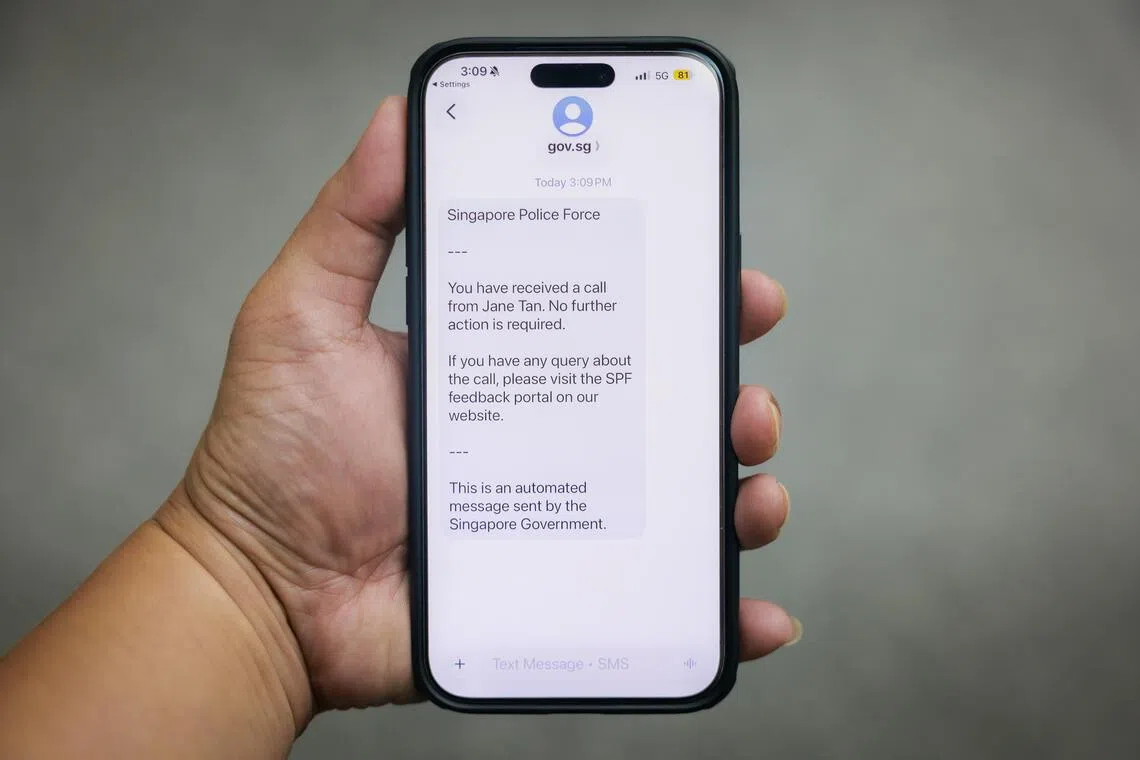
Each call from the police’s new 6000-0999 number will be followed by an SMS sent from the “gov.sg” ID, with details on how people can contact the police if they need further assistance. The SMS will be sent even if the police call goes unanswered.
ST PHOTO: GAVIN FOO
4. What happens to online messaging platforms if they don’t comply with the safeguard requirements?
Failure by the online services to comply will be a criminal offence under the Online Criminal Harms Act and may result in fines of up to $1 million.
Online services that continue to flout the requirements may additionally be fined up to $100,000 for each day of non-compliance after conviction.
5. What should I do if I get a call from 6000-0999 but no SMS from gov.sg, and vice versa?
In some instances, the public might not receive the gov.sg SMS following a call from 6000-0999. This could be due to a delay in message delivery or the recipient’s number being unable to receive SMSes, said the police and OGP.
The public might also receive a gov.sg SMS without a call from 6000-0999 before that. This could happen if the call did not connect, due to recipient’s phone being switched off or out of the coverage area.
Even so, the police and OGP said that the 6000-0999 number remains the primary mode of verification for the public to recognise calls from the police. To verify the legitimacy of the call, the public can also call the ScamShield helpline on 1799.
6. Will other government agencies also get their own single dedicated number to call the public by?
Yes, the authorities are looking into this and details will be shared later. The police are the first government agency to launch a dedicated number.
MDDI said that the Government’s intention is to “make it easier for the public to recognise legitimate calls from government agencies, without having to remember individual agencies’ phone numbers”. This is expected to be done by having different agencies use phone numbers that start with a common set of numbers. More details will be given later.
In future, each of these numbers will be accompanied by a recognisable caller name identifying the government agency the number is tied to. This will provide an additional indicator to help the public identify real government calls.
7. How are the various public agencies involved in the 6000-0999 number?
OGP developed the calling system that allows police officers to make outgoing calls displayed under 6000-0999.
MDDI leads the development of the broader whole-of-Government effort to help the public better recognise legitimate phone calls from the Government.
The ministry also worked with telecoms regulator IMDA to reserve a specific telephone number range for government use, as well as put in place regulatory safeguards to reduce the risk of the numbers being spoofed.
Kenny covers technology, including artificial intelligence, cybersecurity, data privacy, social media and consumer technology issues.
KioskNews shows a cleaned-up reading view extracted from the publisher’s page — the original always lives on their site, not ours.