What Beijing’s two-to-one shipbuilding lead means for the US in war over Taiwan
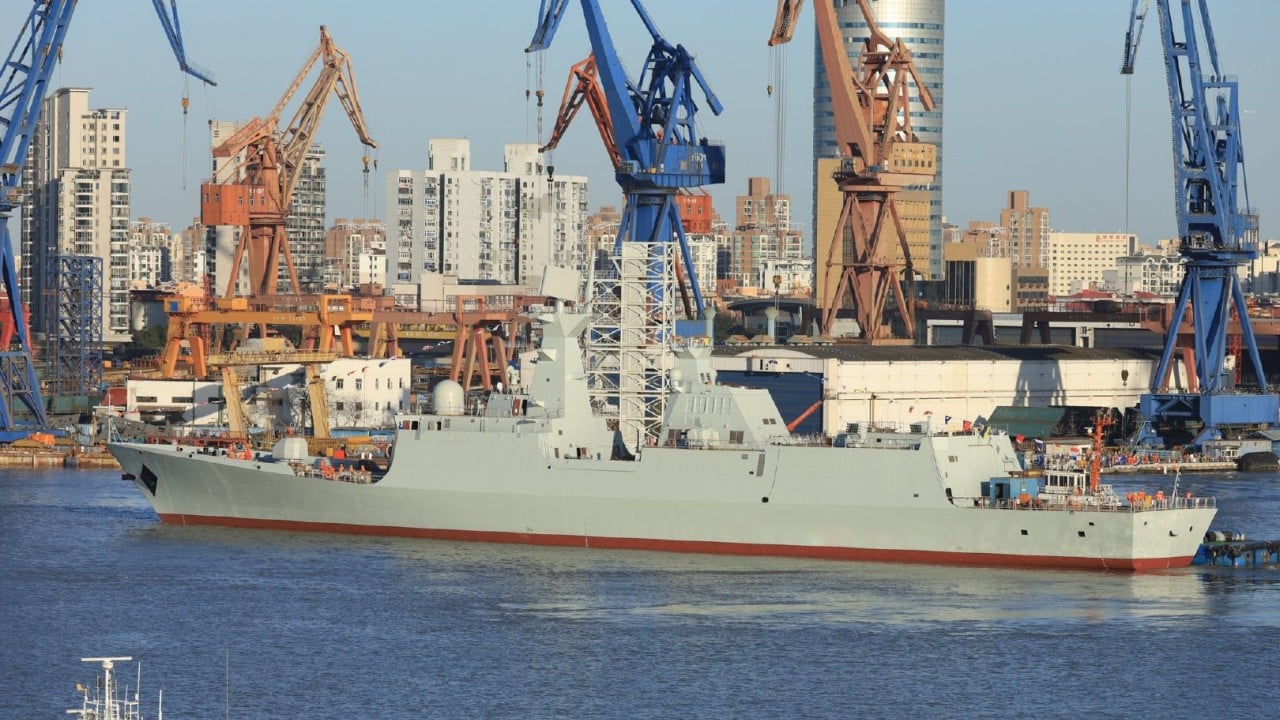
Mainland Chinese shipyards delivered more than twice as much naval tonnage as their US counterparts in 2024 and 2025, according to a new survey, exposing a growing production gap that analysts say could weigh heavily in a prolonged conflict over Taiwan.
Tonnage alone is an imperfect measure of naval power, specialists cautioned, pointing to ongoing US advantages in submarine technology, aircraft carriers and operational experience. They also highlighted China’s ability to draw on commercial shipyards, unmanned systems and dual-use civilian vessels during a conflict. But they differed on how far the balance between the two had already shifted.
Yards on the Chinese mainland turned out 636,208 tonnes of military, paramilitary and auxiliary vessels over the two years, against 270,509 tonnes from American builders, the survey showed.
The survey, compiled by maritime intelligence publication Flottes de Combat and the French Naval Industry Association, found China accounted for more than 43 per cent of global naval production tonnage in the two years, compared with just over 18 per cent for the US.
Chinese yards delivered 84 vessels, up from 31 in 2022 and 2023, while American deliveries rose from 32 to 38, said the report, which was presented in Paris on Tuesday ahead of next month’s Euronaval defence exhibition.
While the US Navy’s combat fleet remains more than double the People’s Liberation Army’s (PLA) by tonnage, China is catching up. But analysts have questioned whether total tonnage alone would prove decisive in a war fought near China’s coast.
09:58
Will Batanes become the next South China Sea flashpoint?
China has had the world’s largest navy by number of ships since at least 2020, according to the Pentagon, with the new survey counting 418 PLA Navy combat vessels on January 1. But at 1.44 million tonnes, they displaced less than half the 3.11 million tonnes of the US Navy’s 283 ships. The US had 11 aircraft carriers to China’s three.
Still, China is rapidly renewing its fleet. More than 40 per cent of the PLA Navy’s combat ships had entered service since 2018. Chinese yards delivered 10 destroyers in 2024 and 2025 to America’s four, while the PLA Navy commissioned 26 combat vessels against the US Navy’s nine.
Retired Royal Australian Navy vice-admiral Peter Jones attributed that pace to consistent shipbuilding practices. Designs appeared to be developed through Chinese naval research bodies and state-owned shipbuilder CSSC, avoiding repeated commercial tenders, he said.
Chinese destroyers and frigates followed a process of “incremental development”, with “modest upgrades between batches” reducing production risks, Jones explained. A “steady drumbeat of work” at five specialised shipyards helped build workforce expertise.
By contrast, the US had “only some elements of this”, he added. Its Arleigh Burke destroyer programme was a success, but other projects suffered from “turbulence in decision-making”. Washington, he said, “just needs to return to the proven approach to shipbuilding across the fleet’s programmes”.
China’s commercial shipyards reinforce that advantage. Brian Hart, deputy director of the China Power Project at the Centre for Strategic and International Studies, said builders had “intentionally blurred the boundaries” between naval and commercial production. Because the same yards built cargo ships and tankers, Beijing could “ramp up production of naval vessels in a protracted war”, he noted.
Chinese civilian ships that are not currently counted in combat-fleet totals could serve as military transports: since 2015, national standards have required certain cargo ships to be able to meet military needs. Hart cited “dual-use barges and ferries” that could boost amphibious transport capabilities, along with unmanned systems outside traditional counts.
Vessel types can distort shorter-term comparisons, said Bradley Martin, a senior policy researcher at the RAND Corporation and retired US Navy captain. American warships were often “large and complicated ships” taking years to build, so the delivery of a single carrier, such as China’s Fujian in 2025, could skew the figures.
China is also catching up in firepower. Hart pointed out it “has been rapidly closing the gap” in vertical launch system cells, which fire missiles from warships and submarines. Still, Hart said, the US had nuclear-power carriers, unlike China. It also has more capable submarines and, crucially, experience gained through decades of global operations and combat.
Yet China is trying to close the undersea gap. The survey estimates that expanded facilities at Huludao – a coastal city in northeast China’s Liaoning province – can produce three nuclear-powered attack submarines annually, exceeding current US output. Martin argued that nuclear submarine warfare was not an area where “quantity can reasonably overcome quality”, though more Chinese boats could increase demands on anti-submarine forces.
02:01
China calls nuclear submarine missile test ‘routine’ as Australia, Japan voice concerns
A war over Taiwan, however, would be fought close to mainland China’s shores, where Martin said US warships would face land-based strike forces, so ship-to-ship engagements “might not be the most relevant consideration”. The longer a conflict lasted, the more Beijing’s industrial depth would matter, particularly its ability to keep producing “landing craft and logistics support forces”.
Lyle Goldstein, Asia programme director at Washington-based think tank Defense Priorities, called China’s shipbuilding lead “not an anomaly, but rather a persistent trend”. The western Pacific naval balance, he argued, “has been tilting decidedly in Beijing’s favour for some time”.
In a mid-Pacific encounter, the US would “almost certainly prevail”, he said, but fighting around Taiwan or in the South China Sea “would radically favour China”. In waters close to the Chinese mainland, such as the Taiwan Strait, “size can actually be a disadvantage”, making smaller diesel submarines preferable to nuclear-powered ones.
To keep pace, Washington would likely need allies. Martin said partners could supply smaller warships and auxiliaries and undertake “battle damage repair”. But Goldstein warned that air and missile strikes could make western Pacific yards unusable, urging stronger rear-area defences across the second and third island chains.
Losses could be severe. Given the lethality of modern anti-ship weapons, Goldstein said, “many ships and even whole fleets would be sunk or badly damaged” in a high-intensity naval war.
In such a conflict, starting fleets could matter less than how quickly they are replaced – and as the survey’s figures show, China is building faster.
KioskNews shows a cleaned-up reading view extracted from the publisher’s page — the original always lives on their site, not ours.