Lawmakers approve hotly contested bill targeting unauthorized use of official logos
After a nearly 10-hour floor debate, the Chamber of Deputies — Mexico’s lower house — approved on Wednesday legislation aimed at digital deception, but roundly criticized as a threat to free speech.
The bill — which had already won passage in the Senate on Sept. 30 — was approved on a 281-83 vote, but only after 177 objections were voiced by 64 different speakers, , several of whom expressed concern that the reform could be used to silence political dissent.
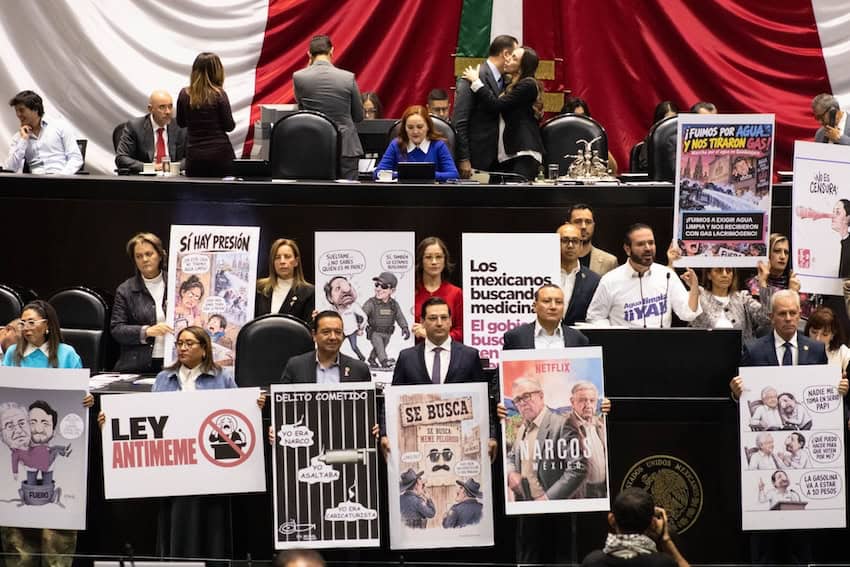
Once signed into law by the president, who sponsored the bill, the reform will allow the penalization of the unauthorized, commercial misuse of elements — such as logos or symbols — that officially identify public institutions. Penalties include hefty fines reaching millions of pesos and prison sentences of one to five years.
Opposition lawmakers have referred to the legislation as an “anti-meme bill,” arguing that its scope and language allow for punishing criticism that takes the form of parody and internet memes featuring official symbols.

There was lengthy debate over Article 403 bis, which sanctions anyone who “uses, reproduces, imitates or incorporates — on a commercial scale — the institutional graphic identity, electronic domains or official documents of any public institution … with the intention of inducing error or deception to commit an illegal act based on official origin.”
Critics fear its vague wording — and the ambiguity surrounding the concepts of deception and intent — could be weaponized to censor parody, editorial cartoons and online criticism.

They also worry that internet providers and digital platforms — which will now be required to remove or suspend content upon receiving infringement or identity-misuse claims — will err on the side of caution by deleting controversial posts rather than risk steep fines ranging from 80,000 (US $4,300) to 4 million pesos (US $214,000).
Supporters of the reform argue that memes, satire and criticism are not being targeted. Rather, they insist, the legislation strictly targets commercial piracy, digital fraud and the malicious impersonation of state institutions using artificial intelligence.

Morena party Deputy Elena Edith Segura pointed to the phrase “on a commercial scale” — i.e., “to obtain profits,” she said — as sufficient clarification that the intended target is piracy.
National Action Party Deputy Luis Agustín Rodríguez disagreed, asking how “commercial scale” would be determined and what “institutional graphic identity” actually means, while also questioning the meaning of “’intention to commit illegal acts based on official origin.”
“When a person’s freedom is at stake, these answers must be expressly stated in the law,” he said.
With reports from La Jornada, Publimetro, Yucatán Magazine and Wired
KioskNews shows a cleaned-up reading view extracted from the publisher’s page — the original always lives on their site, not ours.