These 8 news outlets relied on terror group for casualty figures when reporting on Israel-Hamas war: study
Major media outlets, including The New York Times, The Guardian and Associated Press, relied on casualty figures from the Gaza Ministry of Health, run by terrorist organization Hamas, when reporting on the Israel-Hamas war, according to a new study.
Sign In or Create an Account
The findings showed a dependence on aggregate numbers from Hamas, limited citation of data on terrorist deaths and “disproportionate doubt directed at different sources,” writes author Tatiana Glezer, from independent research group Fifty Global.
“Together, these patterns support a narrative in which total casualty figures are treated as civilian losses.”

Columnist Jesse Kline keeps you up to date with what’s happening in Israel and the effects of antisemitism on life here in Canada. Friday mornings.
By signing up you consent to receive the above newsletter from Postmedia Network Inc.
A welcome email is on its way. If you don't see it, please check your junk folder.
The next issue of Channel Israel will soon be in your inbox.
We encountered an issue signing you up. Please try again
The study, Selective Sources, Scrutiny, and the Absence of Standards in Military Conflict Coverage, was published on Sept. 15, in the peer-reviewed journal Digital Hate Review.

Researchers found that journalists cited numbers from the ministry in 100 per cent of the publications reviewed in the study, whereas only three per cent of all articles reviewed cited Israeli data.
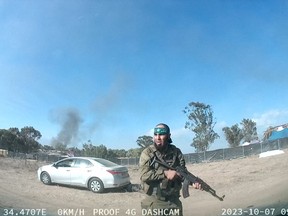
The Israel-Hamas war was triggered by an attack by Hamas terrorists, who killed 1,200 people in Israel and took 251 hostages on Oct. 7, 2023. Although the Israeli military began withdrawing troops from Gaza as part of a peace deal in 2025, there is still violence and unrest in the region.
The study focuses on 1,378 articles published from March to June 2024 by eight English-language outlets: CNN, BBC, The New York Times, The Guardian, The Washington Post, Australian Broadcasting Corporation (ABC), Reuters and Associated Press.
During that time period, there were still living hostages in Gaza.
The study found that like the Gaza Ministry of Health, the outlets did not distinguish between terrorist and civilian deaths in their reporting. Articles rarely included data from Israeli sources.
“Estimates indicating a high proportion of civilian deaths may contribute to reframing a conflict from war to genocide,” according to the study. “In this sense, quantitative representations of harm are not neutral; they carry interpretive consequences that shape both public discourse and institutional judgment.”
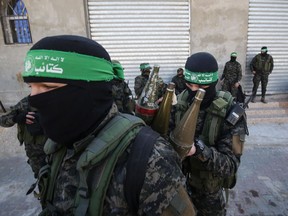
The study suggests that a more comprehensive understanding of deaths during the war could be reached by including both primary sources: the Israel Defense Forces (IDF), which provides estimates of terrorist casualties, and the Gaza Ministry of Health, which does not.
The IDF said in 2024 that they classify terrorists as individuals who were killed while holding weapons, but did not provide further details, the study said.
Through its analysis, the study concluded that the Gaza health ministry “became the primary source of statistical information about the war casualties.” Neither the ministry nor the IDF offer data specific to civilian casualties.
The study also looked at which outlets mentioned that the ministry’s figures do not distinguish between civilians and terrorists.
Associated Press and The Washington Post noted the limitation in around 40 per cent of articles, whereas, on the lower end of the spectrum, the BBC and Reuters rarely did (about 1 to 2 per cent of articles).
“Overall, this essential disclaimer about the composition of the casualties appeared in only about 15 per cent of all analyzed publications,” the study said.
The outlet that most frequently mentioned the ministry’s affiliation with Hamas was the BBC, in about 95 per cent of its articles. Conversely, the connection was made in about 5 per cent of CNN articles, and in 2 per cent of articles by The New York Times and The Washington Post.
Reporting without providing a fuller picture of where the data comes from can lead to one side being viewed as victims and the other side as “criminal or genocidal,” especially in the online discourse.
“These simplified narratives may, in turn, contribute to the spread of hate speech, conspiracy claims, and the amplification of antisemitic or anti-Muslim sentiment,” the study said.
The study calls for “clearer professional standards and greater transparency in reporting conflict-related data.”
Articles for the study were selected by a search using the keyword “Gaza.” Researchers manually extracted statements about casualties and used a coding system to categorize them. No artificial intelligence was used for those tasks.
Join the Conversation
This website uses cookies to personalize your content (including ads), and allows us to analyze our traffic. Read more about cookies here. By continuing to use our site, you agree to our Terms of Use and Privacy Policy.
KioskNews shows a cleaned-up reading view extracted from the publisher’s page — the original always lives on their site, not ours.