Shakeel nears century after 96-run stand with Ghori extends Pakistan's dominance
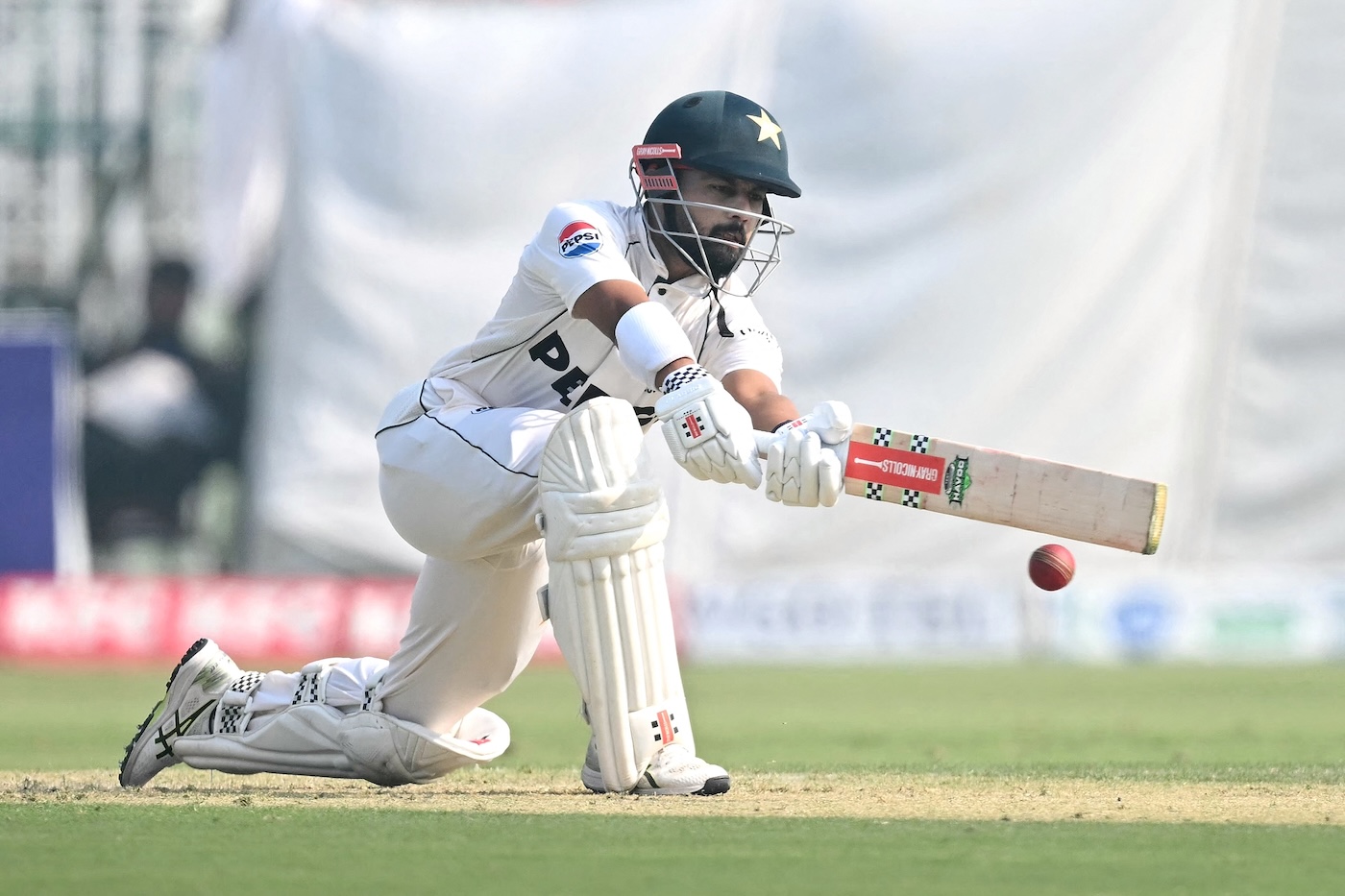
Lunch Pakistan 390 for 6 (Shakeel 91*, Arif 57, Taha 51, Babar 50, Ghori 48, Asitha 2-87, Madushanka 2-97) vs Sri Lanka
Saud Shakeel marched towards a first Test century in over two years as Pakistan continued their dominance on the second morning of the first Test against Sri Lanka on Tuesday in Rawalpindi. The session brought 109 runs and just the solitary wicket, as Pakistan moved from 281 for 5 to 390 for 6 at lunch.
Much of Shakeel's - and Pakistan's - runs in the session came as part of a 96-run partnership with Ghazi Ghori. And once the latter fell, two runs short of a maiden Test fifty, debutant Arafat Minhas stepped in without missing a step, and the pair had put on 41 by the interval.
Sri Lanka's breakthrough came against the run of play, and followed the arrival of the new ball. It was more batter error than anything bowler induced, as Ghazi wafted at a wide one from Dilshan Madushanka. A very good catch from Pasindu Sooriyabandara, who was briefly wrong-footed at gully, completed the play.
It was a brief moment of reprieve on yet another tiring morning for the Sri Lanka seamers. But as has been the case across most of the Pakistan innings, Sri Lanka were unable to string wickets together.
The Shakeel-Ghazi stand was the fourth 50-plus stand of the innings, and before long the Shakeel-Arafat pairing was threatening to become the fifth. Much of this was down to Arafat's proactive approach.
Parachuted in from the white-ball side, he looked every bit the shorter-format player plying his trade in Tests. He faced just seven deliveries before slashing a short one over gully for his first Test boundary, and his second followed soon after with another similar uppercut behind square.
A couple of overs later, he was pulling Lahiru Kumara over midwicket for a first Test six. By lunch, he had motored along to 27 off 49, only slowing down towards the end of the session.
Sri Lanka for their part seemed out of ideas, with their patience with the ball coming belatedly in the face of settled opposition batters, who by that point were more than adept at negotiating any lateral movement on offer.
Ghazi, playing in just his second Test, looked particularly at ease across his 72-ball innings, and was a large part in keeping Pakistan's scoring rate hovering around four an over.
The wicketkeeper-batter's most prominent skill seemed his effective strike rotation, with only eight of his 48 runs coming in boundaries. It meant that the first 50 runs of the stand with Shakeel came off just 51 balls, with the scoring rate only dropping as spin was introduced - and with it some defensive leg stump lines - shortly before the arrival of the second new ball.
Ghazi's supreme comfort at the crease allowed Shakeel to play with relative serenity as he knocked the ball into gaps either side of the wicket almost at will and poached the odd boundary when the opportunity presented itself.
Shakeel's compact defensive technique also continued to test the patience of the seamers - mostly Asitha Fernando and Lahiru Kumara, who bowled a majority of the first hour - as they frequently veered from sticking to persistent lines and lengths. It meant both batters were rarely tested over any consistent period in one given area.
And while the new ball offered movement, the arrival of Arafat has proved timely in exerting even more pressure on Sri Lanka, as Pakistan pushed ahead towards the 400-run mark.
KioskNews shows a cleaned-up reading view extracted from the publisher’s page — the original always lives on their site, not ours.