Jamie Sarkonak: Don’t trust Carney to tell us what EU ‘associate membership’ means
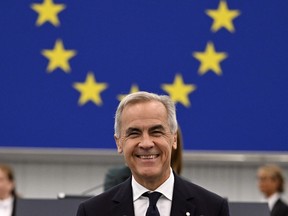
On Thursday, Prime Minister Mark Carney stood before the European Parliament and said that he welcomed the “ambition” to bring Canada in as an “associate member.” He framed it as a sovereignty-reinforcing move, but seeing how many strings and risks come with EU membership — and how little he’s told the public about his plan — it sounds like a slim prospect.
Sign In or Create an Account
Because “associate member” isn’t a real type of EU membership, we’re stuck gleaning what it entails from Carney’s speech. “Seamless digital trade and non-agricultural goods and a wide range of services,” were mentioned, along with closer ties between our financial systems, more communications infrastructure and closer collaboration on AI rules. Even gas exports made the list.
Carney spoke of “deepening people-to-people ties,” giving the example of young people living, working, and studying wherever they want within the hypothetical union. On the studying front, he also suggested membership in Erasmus+, the EU’s multi-billion scholarship program.

Columnist Jesse Kline keeps you up to date with what’s happening in Israel and the effects of antisemitism on life here in Canada. Friday mornings.
By signing up you consent to receive the above newsletter from Postmedia Network Inc.
A welcome email is on its way. If you don't see it, please check your junk folder.
The next issue of Channel Israel will soon be in your inbox.
We encountered an issue signing you up. Please try again
The overall relationship between the two entities should be one of “deep co-operation,” he said. Woven throughout the speech was a nice motif about oak trees grown in Canada from acorns collected at Vimy Ridge, as well as their descendant saplings which were planted several years ago on the former battleground. It was speechwriting done well, and it tapped into exactly what elder voters love.
If you step out of the shoes of a person completely tuned out of politics though, it all starts to look drab.
For starters, it’s hard to trust the content of the speech given the contradictions emitted by the speaker in the days before. Remember that it was from American media that Canadians first heard of Carney’s push for EU “associate membership.” Then, the prime minister denied it.
“We’re not looking to become a member of the European Union,” Carney told a reporter at the Toronto International Film Festival on Sunday. “What we are looking and will begin discussion for is a unique alliance with the European Union, between Canada and the European Union.” CTV also reported that day that a senior government source said that Canada wasn’t seeking EU membership “in any capacity.”
Well, “associate membership” is EU membership in some capacity. We just don’t know what.
More problems: During his speech, Carney praised the existing trade deal with the continent — Canada-European Union Comprehensive Economic and Trade Agreement (CETA) — as “one of the world’s most successful trade agreements.” But this treaty isn’t even in full force because 10 EU member states haven’t ratified it since it was signed in 2016.
The French Senate actually rejected CETA in 2024, and the other holdouts are Belgium, Bulgaria, Cyprus, Greece, Hungary, Ireland, Italy, Poland and Slovenia. For all the nice metaphors about trees and World Wars, we have yet to complete the decade-old trade deal due to disagreements on rules about the climate, GMOs, cattle raising and so on.
As for Carney’s vision of associate membership, it’s important to account for the unsaid drawbacks when evaluating whether it’s actually in our interests. Banding together to push back against the big, bad AI companies might sound appealing to those who are unsettled by new technology, but Europe has alreadyfallen behind on AI in part due to tighter regulation. And if you’re already annoyed at the cookie pop-ups that are thrust into your face whenever you open a website, you should beware of what more could happen to our internet with greater collaboration. Expect an even greater effort to stamp out online anonymity for security reasons.
And while working together on energy sounds nice, remember that you’re talking about the same European Union that once considered livestock culls an appropriate means to mitigate climate change. Yes, we’d love to sell them more of our oil. No, we don’t want any of their environmental regulations.
Finally, the migration issue. Carney paints a picture of opening up a continent to our bright and promising youth, but it simply can’t be taken at face value given how poorly the Liberals have managed immigration and free-movement arrangements. Canada’s international study programs were supposedly merit-based and limited only to the global rich — and then we found out that middle-aged adults from poor countries were using them to move their entire families over, and that actual transnational gangs were using them to flood Canada with their members.
In Europe, the migration wave of the last decade has brought in large populations of foreigners, many of whom have struggled to integrate. Depending on the country of origin, they’ve committed crimes at higher rates and have also been much more prone to welfare dependency. And when they have kids, those kids are EU citizens, regardless of how integrated their families are. Given that many of these individuals are cleared to study, live and work in Europe, we should assume that they would be able to take advantage of any free-movement program with Canada.
To open our borders and accept EU rules on a wide range of subject areas would be a blight on Canadian sovereignty, no different than kneeling to the far-fetched demands of the United States. But Europe seems more polite and the vibe is more to our taste, so “associate membership” it is. Whatever the costs of Carney’s plan, he’s probably not going to tell you about them — it’ll be up to us to discern for ourselves.
National Post
Join the Conversation
This website uses cookies to personalize your content (including ads), and allows us to analyze our traffic. Read more about cookies here. By continuing to use our site, you agree to our Terms of Use and Privacy Policy.
KioskNews shows a cleaned-up reading view extracted from the publisher’s page — the original always lives on their site, not ours.