At least 64 killed as high-speed trains collide in central Spain
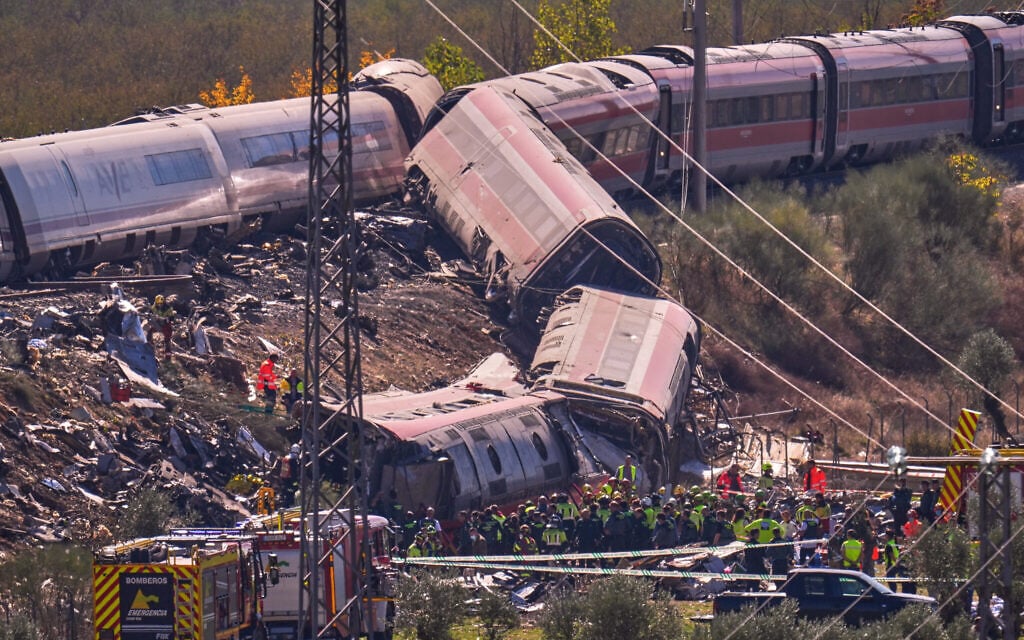
Rescue workers in Spain on Wednesday were scouring the wreckage for more bodies at the crash scene where at least 64 people were killed when two high-speed trains collided, the second deadly accident in less than a year on the line connecting Madrid to the southern Andalusia region, regional authorities said.
“We are speaking of approximately 64 [dead], but this is probably going to grow even more,” the leader of the central region of Castilla-La Mancha, Emiliano García-Page, told reporters at the scene, raising a previous toll of 31.
García-Page warned that the death toll could rise and said at least 80 people were injured.
0:00 / 0:00
Promoted: Jewish Crossroads, Avi Issacharoff

Spain’s rail system operator ADIF said the crash occurred Wednesday morning in the province of Toledo. Rail service was suspended between Madrid, Ciudad Real and Andalusia.
Esther Padilla, spokeswoman for the Castilla-La Mancha region, told state broadcaster TVE that the accident was between two high-speed trains carrying hundreds of passengers and heading in the same direction from the capital Madrid to Seville in southwestern Spain. One ran into the tail of the other that had stopped, knocking two of its cars off the track. She said the cause of the crash was not known.
Get The Times of Israel's Daily Edition by email and never miss our top stories
By signing up, you agree to the terms
A person briefed on the disaster said an express operated by Spanish train operator Iryo stopped near Toledo due to a signal fault, on orders from infrastructure manager ADIF. A train operated by Renfe then struck the stationary train at high speed, causing several carriages of both trains to derail, the person said.
The Renfe and Iryo trains crashed at around 9 a.m., causing the two Iryo wagons to derail.
Renfe said in a statement that after being authorized to continue its journey, its train had crashed into the Iryo train that had remained stationary “for reasons we don’t know.”
“The Renfe train continued on its way as instructed, and a collision occurred. The exact sequence of events, the traffic conditions and the circumstances of the impact will have to be established by the investigation,” Renfe said.
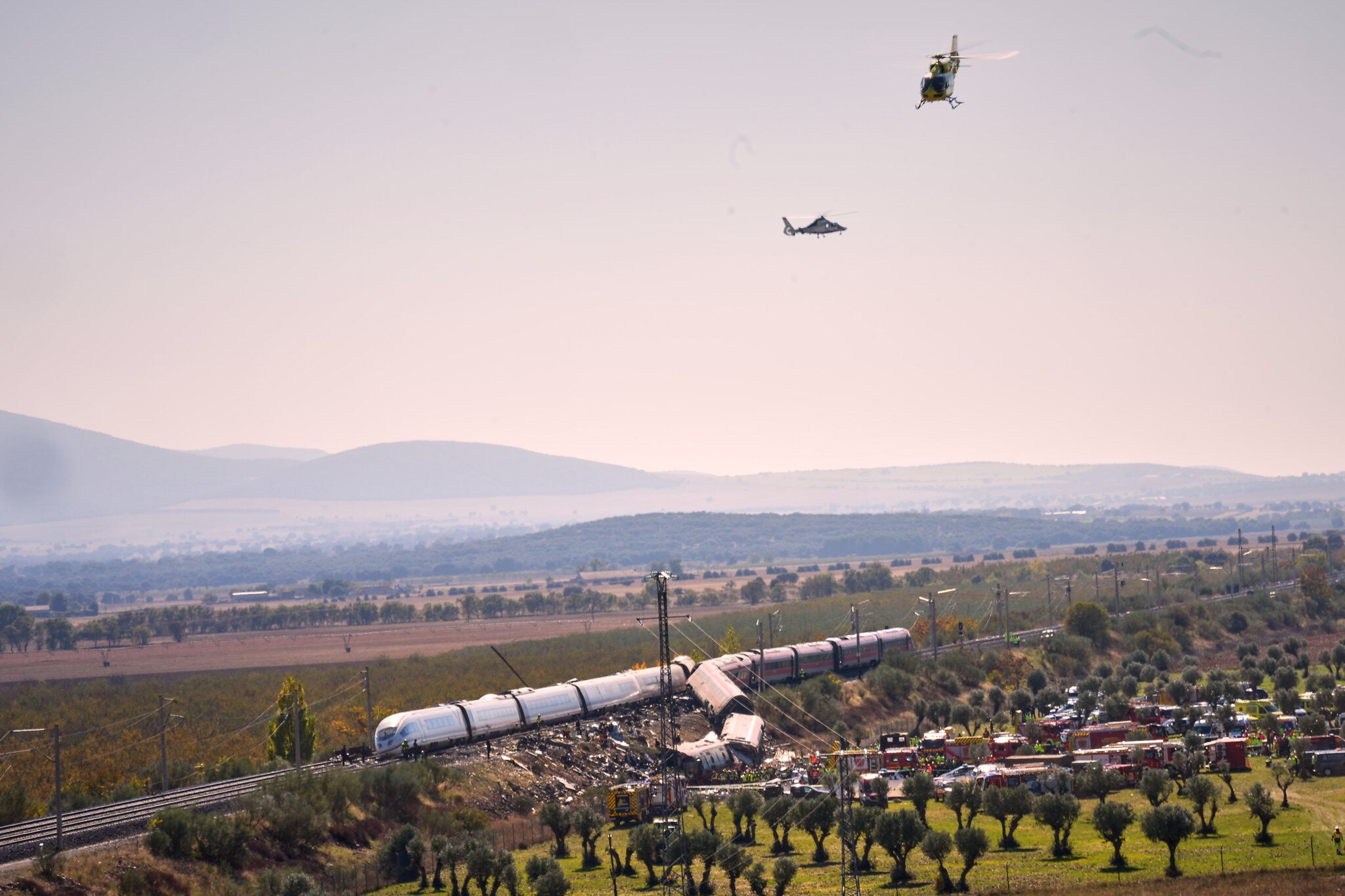
Footage from regional Castilla-La Mancha television showed a derailed train with several carriages remaining on an elevated section of track while twisted metal, broken panels and wreckage could be seen strewn across an embankment beneath the line.
The crash, which occurred in a flat stretch surrounded by fields in between the towns of Urda and Los Yébenes, left one car shredded into bits of metal and other material, scattering debris down a gravel slope.
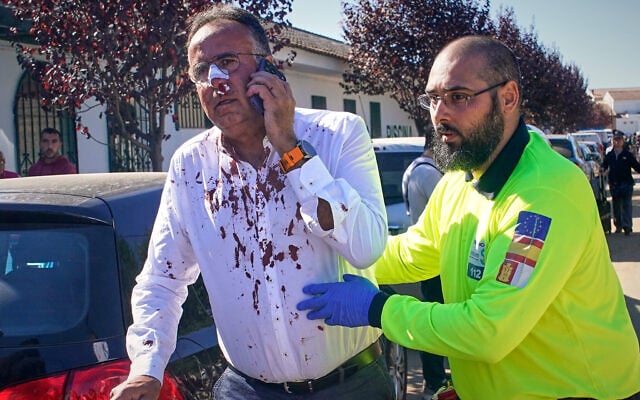
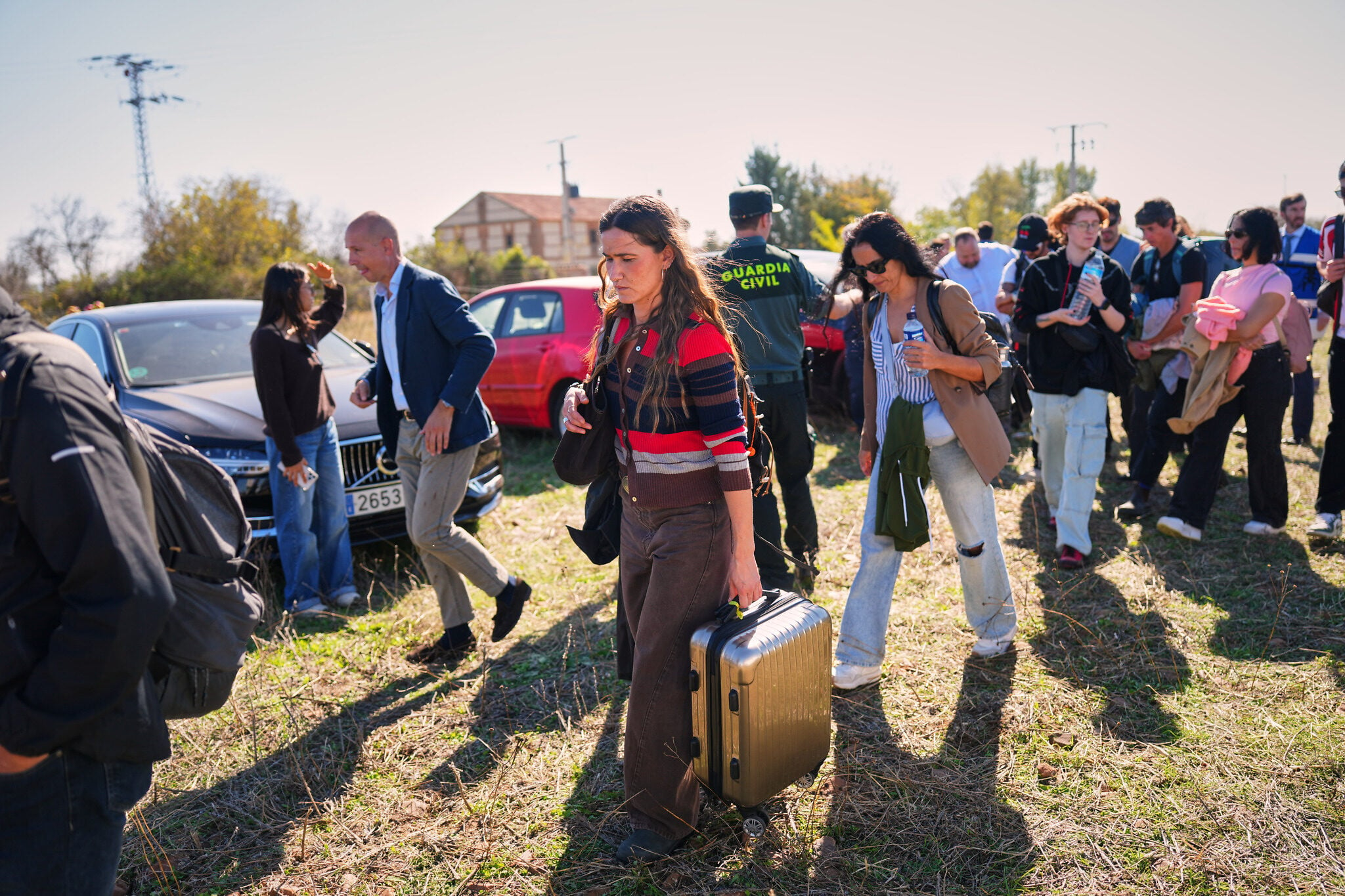
Images shared by local media showed the wreckage of the two trains strewn on the tracks and an embankment as emergency services rushed to the scene, while shocked travelers dragged away their suitcases as they escaped.
Evacuated passengers streamed along a road near the scene, some splattered with blood or with their wounds bandaged, others wheeling suitcases and being given water by volunteers who said it had been donated from neighbouring towns.
Hundreds of ambulances, funeral home vans and helicopters were parked next to a train with several carriages sitting on an elevated section of track while twisted metal, broken panels and wreckage could be seen strewn across an embankment beneath the line where at least three carriages had plunged.
Miguel, a passenger traveling with several colleagues in the rear car of one of the trains, described to COPE radio the moment of the accident.
“We heard a massive roar, a truly enormous thud that went on for 10 seconds, as if the train were about to derail. Through the right-hand window, we could see a wrecked train,” he said.
Eduarda, a passenger on the Iryo train, told Cadena SER radio she felt a strong impact that threw her forward, initially making her think the train had made an emergency stop. She only realized the seriousness of the accident after seeing injured people and being told to evacuate.
After climbing down an embankment to safety, she saw what she described as a catastrophic scene, with part of the train hanging down the slope and a fire in one carriage. Emergency responders, including a helicopter, police and ambulances, arrived within about 20 minutes, she said. “I saw dead people,” she said.
Padilla said that 397 passengers were in the RENFE train and 147 passengers in the IRYO train.
Jesús Pérez Martín, mayor of the nearby town of Los Yébenes, said the situation was “horrific” and pointed to a severe tragedy.
“They are telling me about mutilations and very serious injuries,” he told RTVE.
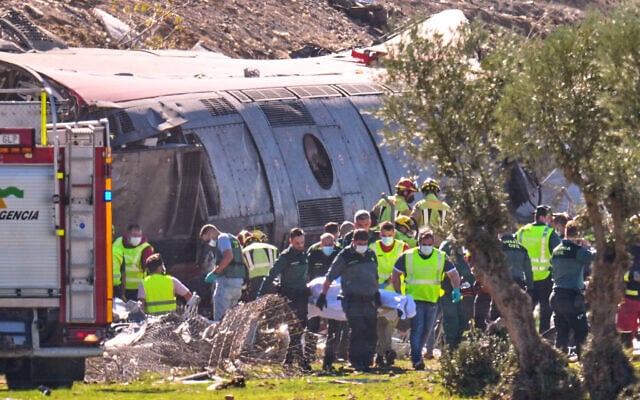
Spanish Health Minister Mónica García told TVE that emergency workers were focusing on rescuing survivors and bodies from the two most damaged train cars. She said that the injured were being sent to different hospitals in the area.
“It was a high-speed impact, so we are expecting this to be a tragedy,” García said.
García also urged people in a post on X to donate blood.
“All resources are currently being deployed,” a spokesperson for the Spanish emergency services told AFP, including “several fire crews, three helicopters, and two mobile intensive care units.”
A military emergency brigade was also deployed to help emergency services, firefighters and police.
The mayor of the nearby town of Urda, Manuel Galán, told Spanish state broadcaster TVE that civil protection authorities had asked his town hall to prepare a sports pavilion to attend to injured passengers.
Renfe said it had activated a special line for families of victims and expressed its condolences. Iryo said it had activated emergency protocols. The Italian-owned company said in a statement that it was “closely working with authorities.”
Spanish Prime Minister Pedro Sánchez canceled his agenda to focus on the crash. “Shocked by the serious train accident in Toledo. My affection, solidarity, and support to all the victims and their families,” Sánchez said on X.
Sánchez, who was seeking to extend his eight-year premiership in the November 29 vote, canceled his participation in a summit on obesity in Madrid after the news broke, while his Socialist party suspended all its campaign activities. The opposition People’s Party also canceled all campaign events, a spokesperson said.
Spain’s King Felipe VI and Queen Letizia said in a short statement on X that they were following news of the accident.
“We are deeply saddened and concerned by the train accident in Urda (Toledo),” the royal couple said. “We share in the grief of the families and loved ones of those who lost their lives, and we send our heartfelt support to the injured and all those affected.”
Spain’s soccer federation postponed all 24 Copa del Rey games scheduled on Wednesday.
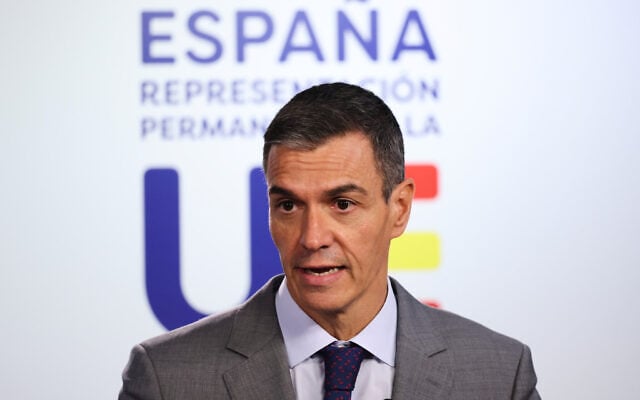
Condolences flooded in from across Spain and Europe. European Commission chief Ursula von der Leyen said “Europe mourns” with the victims after the “devastating news,” while French President Emmanuel Macron expressed his country’s “solidarity.”
Commenting on the incident in a Spanish-language post on X, Foreign Minister Gideon Sa’ar wrote that Israel continues to “follow with deep concern the news about the tragic railway accident,” and that Israel offers its “most sincere condolences to the victims and their families in such difficult moments” and “join[s] the pain of the Spanish people.”
Second fatal accident on line this year
Wednesday’s accident came after another collision between two high-speed trains outside the southern village of Adamuz in January that left 46 dead and raised major questions about safety on the country’s railways.
That crash occurred after a train derailed and smashed into an oncoming train near Adamuz, in Cordoba province, and triggered a debate about the level of investment in railway maintenance in recent years.
It was Spain’s deadliest train accident since 2013, when 80 people died after a train veered off a curved section of track outside the northwestern city of Santiago de Compostela.
Both of this year’s accidents happened on the line linking Madrid to the southern city of Seville. One of the country’s busiest routes, it was Spain’s first high-speed line when it opened in 1992 to coincide with the Seville universal exposition.
Spain is a leader in high-speed rail
Over recent decades, Spain has invested heavily in high-speed rail — which the country’s railway union defines as rails for trains going 250 kph (155 mph) and over — turning it into a world leader.
Spain has laid some 3,900 kilometers (2,400 miles) of such tracks over more than three decades for its 49 million residents. Only China, with 45,000 kilometers (28,000 miles) for its 1.4 billion people, has more high-speed track, according to the International Union of Railways.
Only recently did Spain open its rail network to private companies to compete against Renfe. Iryo started operating in Spain in 2022.
Accidents, including derailments and collisions, increased from 45 in 2016 to 57 in 2024 and 69 last year, according to Spain’s railway safety authority.
Some 25 million passengers used a high-speed train in Spain in the first half of the year, a decline of roughly 14% compared with the same period last year, according to a Reuters analysis of data from Spain’s competition authority.
Spain spent an average of about €1.5 billion a year from 2018 to 2022 on its high-speed network, more than any other country. However, the vast majority went to new infrastructure with only some 16% earmarked for maintenance, renewal and upgrades.
KioskNews shows a cleaned-up reading view extracted from the publisher’s page — the original always lives on their site, not ours.