6 Forgotten Thrillers That Rival 'Gone Girl,' Ranked

The best thrillers make you complicit before they make you afraid. You understand the lie. You can see why somebody tells it. Maybe you even think, for one terrible minute, that you would tell the same one. Then the lie needs protecting, and suddenly a decent person is standing three decisions away from becoming someone they would have hated at the beginning. That’s exactly what Gone Girl was.
That is the territory where these six movies become even more vicious. None survives on a twist alone. The pressure comes from watching ordinary instincts curdle into something dangerous. These are 6 forgotten thrillers that rival Gone Girl.
6 'Calibre' (2018)

Calibre follows lifelong friends Vaughn (Jack Lowden) and Marcus (Martin McCann) on a hunting trip in the Scottish Highlands, where a catastrophic accident leaves them responsible for the deaths of two local people and forces them to decide whether to confess or hide what happened. Matt Palmer directed the film, and he takes that simple setup and keeps tightening it until practically every conversation in the village feels like an interrogation.
The brilliance is how quickly friendship becomes a liability. Vaughn is horrified by what they have done. Marcus keeps finding practical reasons why telling the truth would destroy both their lives. Then locals start noticing inconsistencies, a missing boy becomes impossible to ignore, and every attempt to look normal makes the pair seem guiltier. There is no mastermind here. No elaborate conspiracy. Just two men realizing that one awful choice has created a second choice, then a third, and each new decision costs them another piece of themselves. I would recommend this to anyone who thinks suspense needs scale. Give the right filmmakers two frightened men and one secret, and your stomach will do the rest.
5 'The Gift' (2015)

The Gift follows married couple Simon (Jason Bateman) and Robyn (Rebecca Hall) after they move to Los Angeles and reconnect with Gordo (Joel Edgerton), a socially awkward man from Simon’s school days whose increasingly intrusive gifts and visits begin exposing a version of Simon that Robyn has never known. Joel Edgerton directed the film and also plays Gordo, which makes the whole thing more uncomfortable because he understands exactly how long to leave you unsure about who should frighten you.
At first, Gordo seems like the problem. He appears uninvited, leaves expensive gifts, remembers Simon with an intensity Simon clearly dislikes. Then details about their shared past start leaking out, and Simon’s effortless confidence begins looking a lot less innocent. Robyn becomes the person trying to reconstruct her own husband from evidence he never expected her to see. That is where the movie gets under your skin. Marriage depends partly on believing the biography your partner handed you. Once that biography starts cracking, every old story becomes evidence.
4 'Side Effects' (2013)

Side Effects follows Emily Taylor (Rooney Mara), a woman struggling with depression after her husband returns from prison, whose treatment with a new psychiatric medication appears to cause a horrifying act committed while she is sleepwalking. The case initially looks like a nightmare involving mental illness, pharmaceutical responsibility, and a doctor whose career may be destroyed by a patient he was trying to help.
Steven Soderbergh, the film’s director, has designed the movie in a way that it moves the floor underneath you. Dr. Jonathan Banks (Jude Law) begins investigating what actually happened and slowly realizes that the story around Emily does not behave the way it should. Rooney Mara is phenomenal because Emily can look fragile, blank, frightened, calculating, or sincerely broken without ever announcing which version deserves belief. The movie keeps changing genres while remaining completely fair about the clues it already gave you. By the time the trap becomes visible, the fun is realizing how much of it you willingly helped build.
Collider Exclusive · 8 Questions · 2 Minutes Which Coen Brothers Movie Would You Thrive In? Lebowski · O Brother · Fargo · No Country
Nobody writes people like the Coen brothers. The decent ones. The talkers. The ones who stopped trying years ago. And the ones who can already see how bad this is going to get. Four films, four completely different ways of handling trouble. Eight questions decide which one you would actually walk out of.
🎳Lebowski(1998)
🎸O Brother(2000)
❄️Fargo(1996)
🪙No Country(2007)
01
A bag of money lands in your lap. What happens next? Every Coen film starts roughly here. It never goes smoothly.
02
Somebody is being completely unreasonable with you. How does it go? Coen dialogue is mostly people failing to understand each other.
03
What is your actual relationship with work? Everyone in these films is either working far too hard or not at all.
04
Long drive, bad weather, nobody else on the road. How are you? There is always a drive in these films. It is never a good drive.
05
You are offered a shortcut that is not quite legal. This is the moment where the Coens find out who you really are.
06
The plan has fallen apart completely. What is your move? In a Coen film the plan always falls apart. That is the genre.
07
Which of these sounds most like something you would say? Nobody writes a line quite like the Coens. Which one is yours?
08
How does your film end? Eight questions in, this is the one that decides your movie.
The Verdict Is In Your Coen Film Is…
Four films, four completely different ways of handling money, trouble and other people. This is the one you would survive, why it suits you, and what it would cost you to be there.
The Big Lebowski
You have quietly arranged your life so that very little can get to you, and a surprising number of people find that infuriating. You would be completely at home here.
- The Dude is the only person in the film with no ambition, and the only one who comes out the other side undamaged. That is not an accident.
- You do not chase things. You let situations arrive and you deal with them at your own pace, which is a genuine skill however lazy it looks.
- This is a full crime plot happening around a man who mostly wants his rug back, and that is exactly the energy you would bring to it.
- Everything goes wrong. You abide. The film ends.
O Brother
You talk your way through life and it works far more often than it should. Give you a bad situation and an audience and you will find a way out of both at once.
- Everett never has a plan that survives contact with reality. He has something better, which is the ability to keep talking until a new one turns up.
- You are the optimist in the group, the one who makes a ridiculous idea sound reasonable at two in the morning.
- This is the warmest film the Coens have made. It is a chase, a comedy and a musical at once, and nobody in it is quite beyond saving.
- You would end up famous entirely by accident, and act like you planned it all along.
Fargo
You would survive Fargo because you are the only kind of person who does: patient, decent, and completely unimpressed by anybody trying to be clever.
- Marge Gunderson solves the whole case by being polite, thorough and unhurried while everybody around her panics. That is the entire argument of the film.
- You do the boring parts of the job, which is precisely why you would notice the thing everyone else walked straight past.
- Fargo is about ordinary greed causing enormous damage, and about one person who simply refuses to be corrupted by any of it.
- You would go home at the end of it, have dinner, and sleep perfectly well.
No Country
You do not expect the world to be fair and you stopped being surprised about it a long time ago. That clear-eyed quality is exactly what this film asks for.
- No Country is the Coens at their coldest: a film where being smart, fast and careful might still not be anywhere near enough.
- You plan for the worst, you keep your own counsel, and some part of you is already working out the exit.
- Llewelyn Moss is competent, prepared and resourceful, and the film is honest about whether any of that is ever sufficient.
- You would see it coming. Whether that helps is the one question the film refuses to answer.
3 'Arlington Road' (1999)

Arlington Road follows Michael Faraday (Jeff Bridges), a widowed professor who teaches courses on domestic terrorism and becomes suspicious that his seemingly friendly new neighbors, Oliver (Tim Robbins) and Cheryl Lang (Joan Cusack), may be involved in extremist activity. His obsession sounds paranoid even to the people closest to him, which is exactly the problem when bits of the Langs’ past begin refusing to add up.
The smartest decision in the film is allowing Michael to look increasingly unstable while his suspicions become increasingly reasonable. He has this frantic energy of a man who knows how conspiracy theories sound because he literally teaches the history behind them. Tim Robbins makes Oliver terrifying through friendliness. He smiles, hosts barbecues, talks about family, and keeps making Michael look like the dangerous man on the street. The ending is one of those rare thriller endings that feels cruel enough to make you angry and logical enough that the anger has nowhere useful to go. I have never trusted a cheerful suburban neighbor quite the same way afterward.
2 'A Simple Plan' (1998)

A Simple Plan follows brothers Hank (Bill Paxton) and Jacob Mitchell (Billy Bob Thornton) and their friend Lou (Brent Briscoe) after they discover a crashed airplane containing more than four million dollars in cash and agree to hide the money until they can safely keep it. Sam Raimi directed the film, and he leaves almost all the flashy instincts people associate with him outside because greed is doing plenty of work already.
Hank begins with rules. They will not spend anything. They will wait. They will tell nobody. Then every person involved becomes a variable. Bill Paxton gives Hank the face of a reasonable man who keeps finding reasonable explanations for increasingly unforgivable behavior. Billy Bob Thornton’s Jacob hurts even more because he wants very little from life and understands sooner than Hank does that the money has changed how his own brother looks at him. That bag of cash never feels like freedom for long. It becomes a test they keep failing while insisting the next compromise will finally make everything safe.
1 'Before the Devil Knows You're Dead' (2007)
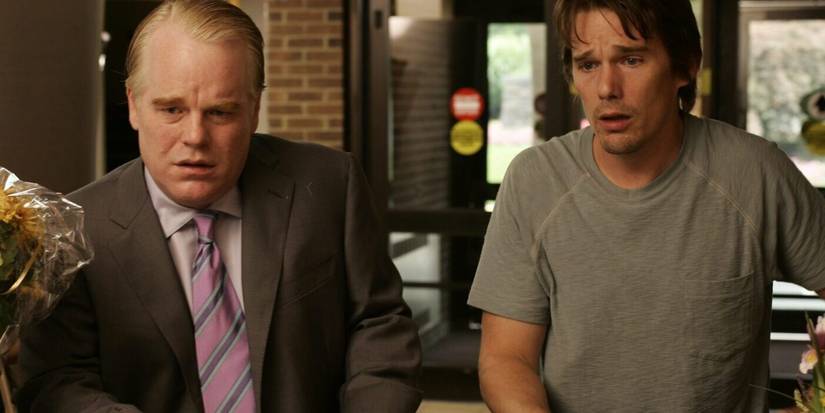
Before the Devil Knows You're Dead follows brothers Andy (Philip Seymour Hoffman) and Hank Hanson (Ethan Hawke) after Andy proposes what he believes is a low-risk robbery of their parents’ jewelry store, a crime that immediately goes wrong and starts tearing through their marriage, finances, family, and relationship with their father. Sidney Lumet directed the film at 82 years old, and there is something almost insulting about how alive and vicious the filmmaking still feels.
The fractured chronology keeps dragging you back through the same disaster from different angles, and each return makes somebody look worse. Philip Seymour Hoffman’s Andy has convinced himself that intelligence separates him from the messier people around him. Ethan Hawke’s Hank is already drowning in debt and panic before the robbery gives him something larger to fear. Their father Charles (Albert Finney) slowly realizes that the violence destroying his family did not arrive from outside it. That is why this one sits at number one for me. The crime is barely the story. The real horror is watching people who already love one another discover exactly how much damage that love can survive before it turns into something else.

Before the Devil Knows You're Dead
- Release Date
- September 26, 2007
- Runtime
- 117 minutes
- Director
- Sidney Lumet
- Writers
- Kelly Masterson
Cast
-

Hank Hanson
-

Andy Hanson
-

Albert Finney
Charles Hanson
-

Gina Hanson
KioskNews shows a cleaned-up reading view extracted from the publisher’s page — the original always lives on their site, not ours.