Milei revives strategic naval base at ‘the end of the world’
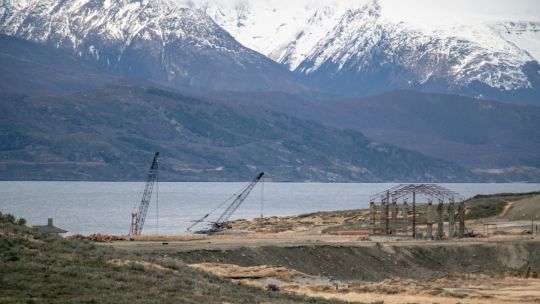
Facing the waters of the Beagle Channel, at the so-called ‘end of the world,’ a concrete slab rises amid small hills covered in low, brownish vegetation.
There are no workers or machinery in sight: Argentina's future Integrated Naval Base remains at a standstill.
Last week, President Javier Milei revived the project after years of delays, announcing that he would “toughen sanctions and penalties” against oil exploration in and around the Islas Malvinas, which are claimed by Argentina but are under British control, where they are known as the Falkland Islands.
Milei also promised to move forward with a base intended to strengthen Argentina's projection towards Antarctica, in an area close to the passages linking the Atlantic and Pacific oceans that has also attracted growing interest from the United States and China.
The President's comments came amid Argentina's rejection of the British ‘Sea Lion’ oil project near the islands, days after his US counterpart Donald Trump declined to rule out reconsidering his country's neutrality in the sovereignty dispute.
For now, however, the future military complex consists of little more than a 2,500-square-metre concrete slab on a 38-hectare site with no public access.
It is located near the airport, around five kilometres from the centre of Ushuaia, capital of the cold and windswept Tierra del Fuego Province at Argentina's southern tip.
The project's foundation stone was laid in 2022 under the government of former president Alberto Fernández. Since then, only the foundations and concrete slab have been completed, representing 9.13 percent of the total project, according to official information.
“The central objective would be to consolidate that Antarctic presence,” said Daniel Guzmán, a veteran of the 1982 war fought between Argentina and Britain over the islands who is today an international affairs analyst.
“It would not only be a base for ships and aircraft to patrol the area, but would also have the capacity to provide services to other navies,” he told the AFP news agency
Ushuaia residents also see an opportunity.
“For some reason, we now have the eyes of the world on this area,” said Rubén Rafael, a 69-year-old doctor.
Support – with reservations
Tierra del Fuego Province Governor Gustavo Melella, an opponent of Milei, also supports the project, though he has drawn a line.
The construction of the base “will make it possible to increase the country's presence in the South Atlantic. We support it as long as it does not involve the participation of other countries,” the governor told AFP.
Melella received Foreign Minister Pablo Quirno and Defence Minister Carlos Presti on Friday.
The possible involvement of the United States in the base had already sparked controversy in 2024, when Milei travelled to Ushuaia to meet Laura Richardson, then head of US Southern Command, and said the base would turn “our countries” into a gateway to Antarctica.
Weeks later, his government clarified that it was not a joint base. More recently, Presidential Spokesperson Adrián Ravier insisted that the project was “100 percent Argentine.”
US visits to Argentina's southernmost region have nevertheless continued.
In April 2025, then-US Southern Command chief Alvin Holsey toured Ushuaia's naval facilities and received briefings on the protection of maritime routes and Antarctic operations.
And in January 2026, a delegation of 23 Americans, including seven members of Congress, also visited the province.
Quiet rivalry
For political scientist Luis Castelli, director of the Tierra del Fuego-based consultancy firm Vox Pópuli, international interest extends beyond the naval base.
“Ushuaia has high geopolitical value because it is located on a channel linking the two oceans,” as well as being close to Antarctica, he told AFP.
The Malvinas and Chile's Punta Arenas also hold similar strategic importance, he added.
Castelli said the region's location is compounded by growing US interest in containing China's advance in an area crucial to maritime routes and access to Antarctica.
“There is an international context that is amplifying the interests of the world's superpowers,” he said.
The two powers have advanced through different channels. While the US presence has become visible through visits by officials, China has gained ground through investment.
In March, China's ambassador to Argentina Wang Wei visited the site of a Chinese-funded thermoelectric power plant under construction on the outskirts of Ushuaia, a project involving investment of close to US$80 million.
“China has already established companies and even bases on the American continent. And under the Americans' Monroe Doctrine” – referring to Washington's traditional view of its relationship with the region – “that does not generate any sympathy,” Castelli said, explaining the rivalry to establish a greater presence in the area.
KioskNews shows a cleaned-up reading view extracted from the publisher’s page — the original always lives on their site, not ours.