Same Himalayan flood, two truths: How China and Nepal control the story
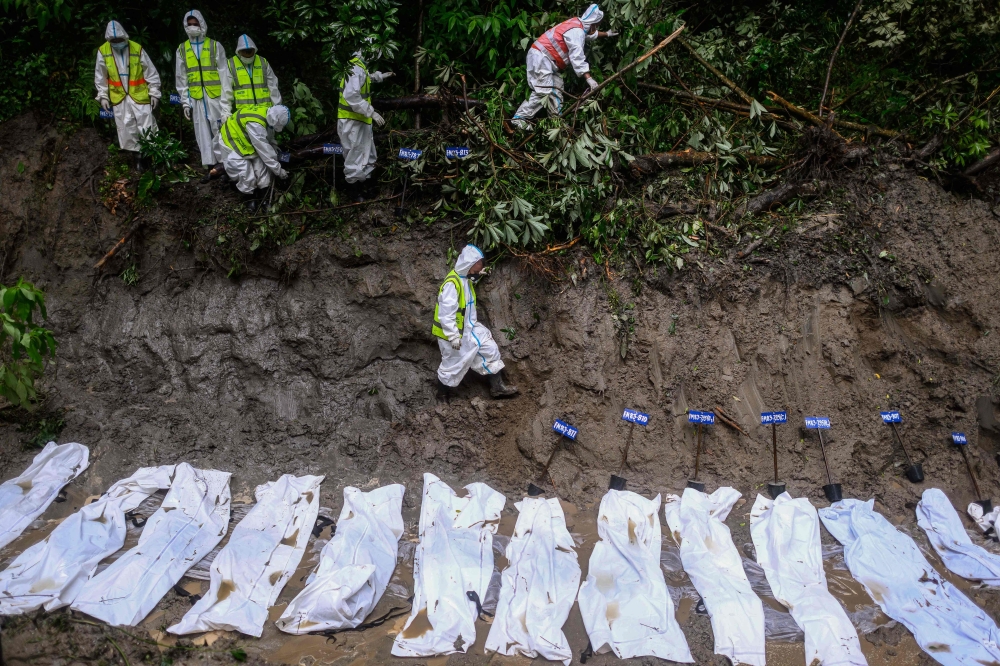

Security personnel walk past unidentified bodies of flood victims kept for mass burial inside a pit at the Gokarna forest reserve in Kathmandu on September 1, 2026. — AFP pic
First Published: Saturday, 12 Sep 2026 9:00 PM MYT
HONG KONG, Sept 12 — China and Nepal have taken different approaches to information after a Himalayan flood, shaping what the public saw of a disaster that killed more than 1,400 people.
The August 26 tsunami-like surge of water, mud and debris from a glacial mountain collapse on the China-Nepal border left more than 5,650 missing, including hundreds of foreigners.
Both China and Nepal have gone after fabricated posts on the flood.
But Beijing has gone further to suppress eyewitness video footage and punish people challenging official figures, in an information crackdown that rights groups say follows a familiar pattern.
Information transmitted by Chinese state media on the flood gave little voice to the missing people’s relatives and focused on emergency workers’ recovery efforts in Tibet, where foreign journalists do not enjoy unfettered access.
Nepal has pressured social media platforms and news outlets to remove fabricated visuals — including some debunked by AFP fact-checkers — but Kathmandu offers regular updates of death tolls via social media. Direct commentary from families of victims is readily available on and offline.
Umesh Shrestha, chair of the independent regulatory body Press Council Nepal, said it had asked more than 100 social media accounts to remove content. Most obeyed.
“Things can spread very quickly,” Shrestha said.
Nepali police arrested one man who allegedly shared a fabricated donation to a relief fund to promote his personal account.
The disaster came just ahead of the one-year anniversary of anti-corruption protests that toppled the previous government, triggered by a social media ban.
China penalised 10 people accused of spreading falsehoods online, according to the Ministry of Public Security.
They include some who allegedly suggested the actual death toll was higher than official figures.
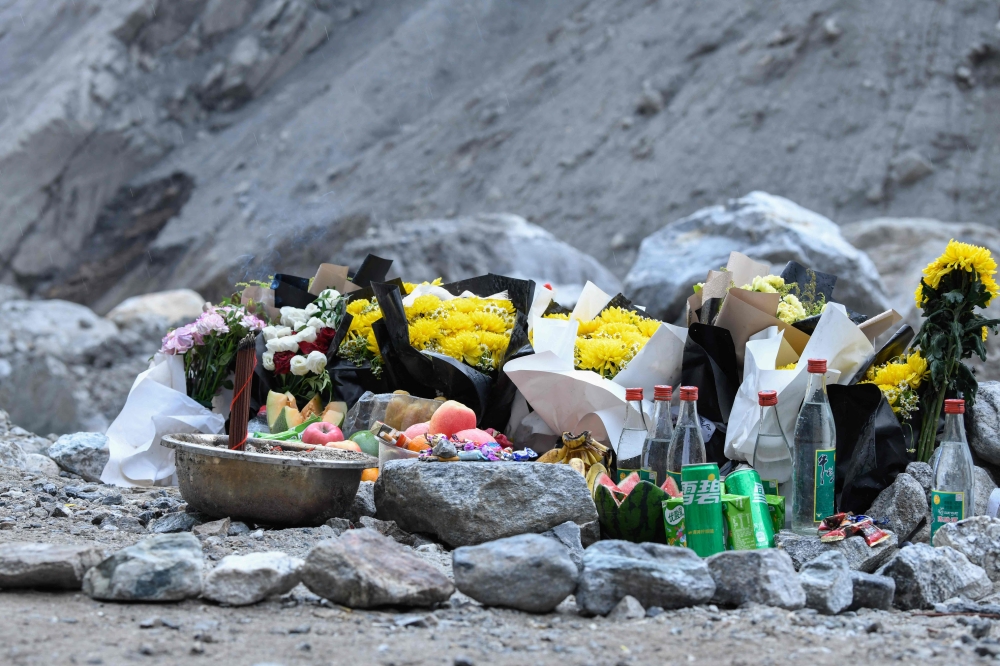
Offerings placed by workers to mourn the victims of the August 26 mudslide are seen at the site of the destroyed Gyirong Port in Gyirong County, in China’s western Tibet region on September 5, 2026. — CNS/China OUT/AFP pic
Beijing’s foreign ministry insists the release of information has been “open, transparent and timely”, and criticised what it has called “malicious smearing and sensationalism”.
It also organised a trip for a small number of foreign media to the Tibetan epicentre of the disaster.
‘Public panic’
AFP fact-checkers have debunked dozens of claims about the floods in multiple languages.
One video that falsely claimed to show the glacial and mountain collapse that caused the flooding – posted on Facebook and X – was filmed in Alaska’s Columbia Glacier days beforehand.
Other footage created using Google’s AI tools showed water breaching a riverbank and flooding streets and amassed tens of thousands of interactions.
“During disasters, public panic is high,” said Nepali investigative journalist Rabi Raj Baral, who is also a member of the Press Council Nepal.
But both Nepal and China have not only gone after fabrications, but have also targeted posts including some sharing genuine footage.
Nepali authorities have held talks with Meta and TikTok to speed up the removal of AI content, graphic images and fraudulent aid schemes.
Both platforms pay AFP to fact-check posts with potentially false information.
Video verified by AFP as showing the deluge engulfing Gyirong Port – the border post with Nepal – and other eyewitness content have largely disappeared from the Chinese internet.
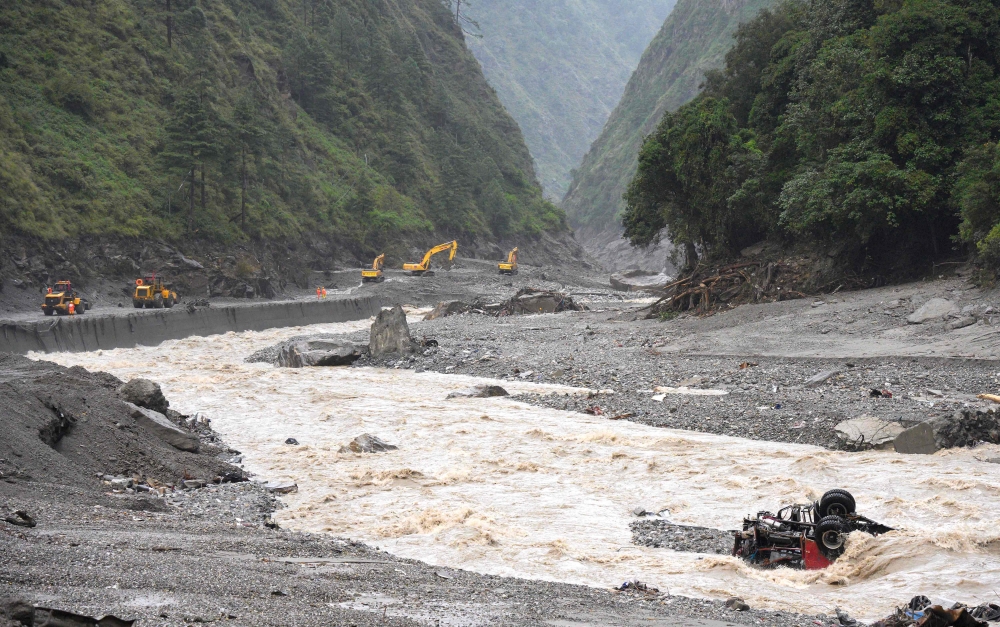
Repair work has been paused along a road leading to Gyirong Port after a mudslide damaged it in Gyirong County, western Tibet, on August 28, 2026, amid the threat of new flooding. — AFP pic
Social media sites such as Douyin and Weibo have instead featured extensive state media coverage of search operations, without naming the missing or showing much footage of families’ reactions.
‘Atmosphere of mistrust’
AFP fact-checkers found flood-related misinformation is mostly absent from Chinese platforms, although conspiracy theories have blossomed abroad.
Posts shared from Canada to South Korea allege China lied about the death toll, and that its dam construction projects caused the disaster — even though scientists say a glacial collapse in Nepal was to blame.
Online critics also point to the fact that the vast bulk of the dead and missing reported by the two governments are in Nepal.
In Nepal, rescuers have retrieved 1,369 bodies, while around 5,132 people are missing, according to the disaster agency Thursday. In China, the toll is 43 dead and 519 missing, according to state media.
The stark difference, however, may be a reflection of the disaster’s geography and scale.
The glacial mountain collapse occurred in downstream Nepal, sending a wave of debris so powerful it smashed China’s high-altitude border post in tightly restricted Tibet, before carving a path of destruction across Nepal.
Bodies on the Chinese side may have washed downstream too, but because of the geography, they could be buried in a thick layer of mud and debris that makes recovery impossible.
Aleksandra Bielakowska, a Taipei-based advocacy manager for Reporters Without Borders (RSF), said that Beijing’s restrictions had created an “atmosphere of mistrust”.
In contrast, Celia Mercier, head of RSF’s South Asia Desk, said Nepal had “largely treated misinformation as a problem within an otherwise relatively open information environment”. — AFP
KioskNews shows a cleaned-up reading view extracted from the publisher’s page — the original always lives on their site, not ours.