More than a bowl of cendol — Ng Kwan Hoong
SEPTEMBER 16 — Some reunions are carefully planned. Others begin with a simple suggestion: “Shall we go for cendol?”
My wife and I were in Ipoh to attend the Malaysian Medical Association Annual Meeting and Dinner. It also became an opportunity to reconnect with an old friend whom I had not seen for more than a decade. Dr Teoh, a retired Director of State Health Department and public health specialist, together with his partner, suggested that we take a short drive to Taiping. One of the destinations was Ansari Famous Cendol, a family-run establishment that has been serving its well-known dessert for three generations.
The journey itself was unhurried. After so many years apart, there was naturally much to catch up on. We spoke about family, work, retirement, mutual friends and the many unexpected turns life had taken since we had last met. By the time we reached Taiping, it was already clear that the afternoon was about much more than finding a famous bowl of cendol.
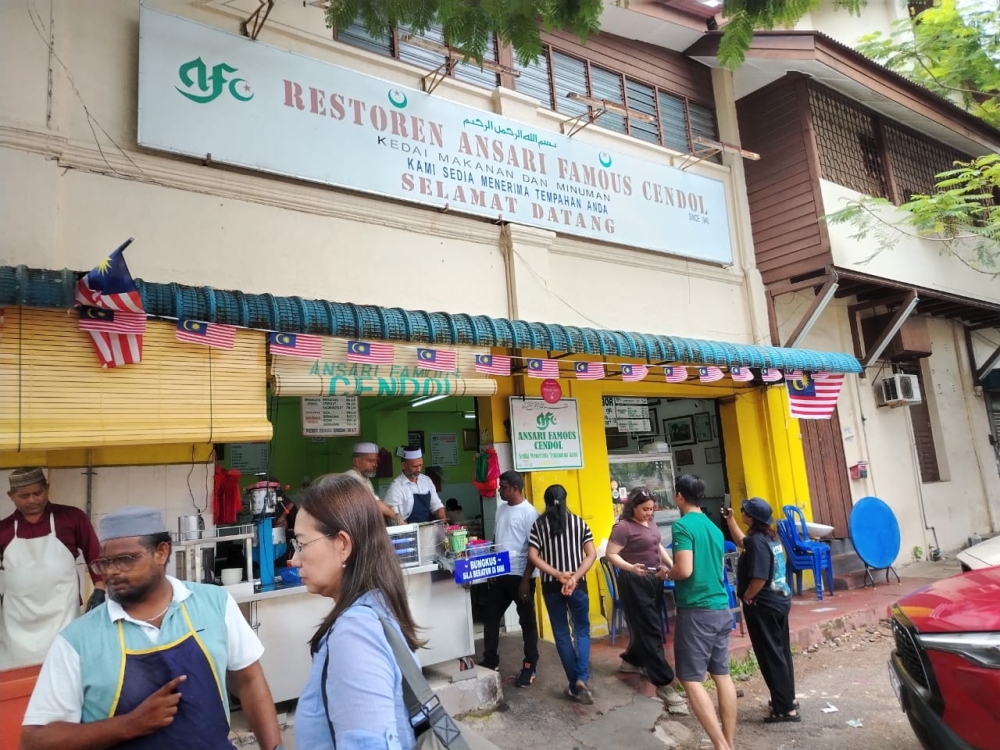
The stall itself was wonderfully modest.
Ansari Famous Cendol in Ipoh. The author argues that Malaysian food is about more than what we eat, creating everyday spaces where friendships endure, conversations resume and social bonds quietly strengthen. — Picture by Ng Kwan Hoong
There were no elaborate decorations or carefully designed interiors. Just a simple shopfront, a few tables and a steady stream of customers arriving throughout the afternoon. During the short time we were there, cars continued pulling up. Some people sat down to enjoy a bowl before continuing their journey. Others ordered takeaway. Young families, elderly couples, students and office workers all came and went with an ease that suggested they had done this many times before.
Watching the scene unfold, I found myself paying as much attention to the people as to the dessert.
A bowl of cendol is, after all, a simple creation. Green rice-flour jelly, shaved ice, coconut milk, gula Melaka and perhaps a generous helping of red beans. The ingredients are neither expensive nor complicated. Yet when combined, they produce something that generations of Malaysians continue to enjoy.
As we ate, conversation flowed as naturally as it had during the drive. We laughed over memories that had somehow remained vivid despite the passing of so many years. We recalled colleagues, shared stories about our children and grandchildren, and discovered that although our lives had taken different paths, the friendship itself had remained remarkably easy to resume.
It occurred to me that the cendol was not really the reason we had come. It had simply given us a place to meet.
Looking around the stall, I began to wonder whether this quiet quality is one of the strengths of Malaysian food culture. Across the country, countless kopitiams, mamak restaurants, hawker centres and family-run eateries perform a similar role every day. People arrive for breakfast before work, gather over lunch with colleagues, meet relatives travelling from out of town or simply stop for a favourite dish after many years away. No one needs an official invitation. No one arrives with a carefully planned agenda. The food provides a reason to sit down, and conversation quietly takes care of the rest.
Perhaps this is one of the few places where Malaysians continue to meet most naturally.
Around the same table sit people of different ethnic groups, ages, professions and backgrounds, not because anyone has asked them to celebrate diversity, but because they happen to enjoy the same bowl of noodles, the same cup of coffee or, in our case, the same cendol. Conversation begins with the food, but it rarely stays there. Before long, it moves effortlessly to family, work, cost of living, football, travel, children or memories from many years ago.
We often speak about national unity in terms of policies, programmes and institutions. These are undoubtedly important. Yet there is another, quieter side to Malaysia that seldom attracts attention. It exists in ordinary places where people gather simply because they enjoy being there. There are no speeches, no slogans and no organised activities. There is only the easy rhythm of people sharing a table, exchanging stories and enjoying one another’s company.
Perhaps that is why family-run establishments such as Ansari Famous Cendol deserve to be cherished. For three generations, they have been serving far more than a traditional dessert. Without intending to, they have also been creating a place where conversations continue, friendships are renewed and new memories quietly take shape.
As we continued with our travel, I realised I would remember much more than the taste of the cendol. What stayed with me was the conversation, the laughter and the pleasure of reconnecting with an old friend after so many years apart.
Looking back, I think the journey to Taiping was never really about finding a famous bowl of cendol. It was about rediscovering something that has long been part of Malaysian life. Our food does more than satisfy our appetite. It gives us somewhere to gather, somewhere to pause and, perhaps most importantly, somewhere to continue conversations that might otherwise have been left waiting.
In the end, that was what made the afternoon memorable. The cendol was excellent, but what lingered long after the last spoonful was finished was the simple reminder that some of Malaysia’s strongest bonds are built not through grand occasions, but around ordinary tables where people still find time to sit together. Perhaps that is why it was always more than a bowl of cendol.
* The author is an Emeritus Professor of Biomedical Imaging at the Faculty of Medicine, Universiti Malaya. A 2020 Merdeka Award recipient, he is a medical physicist by training but also enjoys writing, drawing, listening to classical music, and bridging the gap between older and younger generations. He may be reached at [email protected]
** This is the personal opinion of the writer or publication and does not necessarily represent the views of Malay Mail.
KioskNews shows a cleaned-up reading view extracted from the publisher’s page — the original always lives on their site, not ours.