Youth revolt sweeping Europe holds dire warning for SA
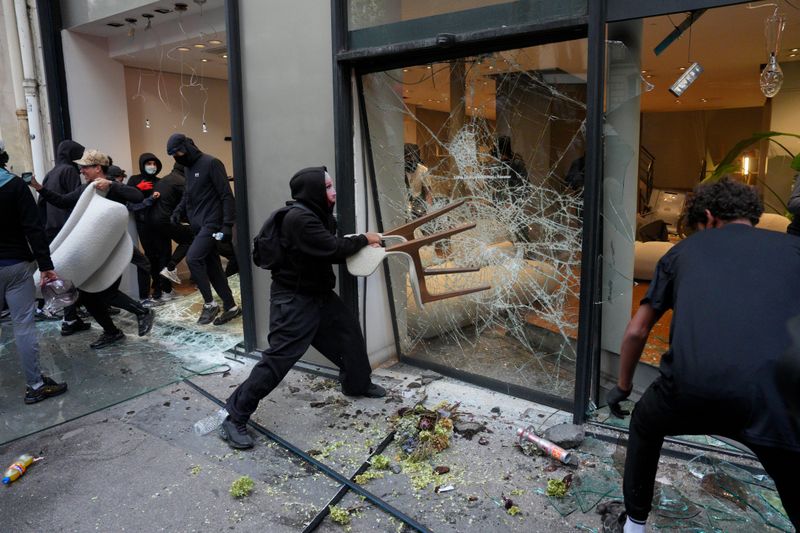
Across Europe, the young are in revolt. The student protests throughout France over the past few weeks have attracted most of the attention, largely due to the violence into which they have (in part) descended.
Scenes of rioting, looting, burning buildings and violent clashes with the Gendarmerie have been more reminiscent of a revolution than a dispute over the state of high schools.
But France is not alone.
From Italy and Spain to Belgium, Germany and Portugal, young Europeans are angry. And they are taking to the streets to voice their frustrations at a political and economic system that appears to have abandoned them.
In Serbia, the consequences have already been extraordinary. After two years of protests, a student-led movement has just swept to victory in a general election, ending the long, kleptocratic and nepotistic reign of Aleksandar Vučić and his cronies.
The immediate cause of these protests differs. In France, the deterioration of schools and access to higher education have been the main frustration. In Spain and Portugal, it has largely been housing.
Elsewhere it is the cost of living, corruption, or the increasingly precarious nature of employment.
Yet beneath these different grudges lies a common theme. An entire generation has come to believe that its future has been taken from it. And it is increasingly hard to argue otherwise.
Protests of fear, not hope
The comparison with May 1968 is particularly revealing. Daniel Cohn-Bendit, one of the leaders of that uprising, recently said that 1968 was fundamentally a movement of hope. Young people believed the future would be better and wanted a greater role in shaping it.
Today’s protesters are motivated by something different: fear.
Fear of an economy that no longer offers security or opportunity. Fear of artificial intelligence destroying the jobs they have spent years preparing and hoping for. Fear of climate change, war and the mounting public debt they will ultimately inherit.
Their grandparents protested because they wanted to change the future. Today’s generation is protesting because it fears there will be no future worth living in.
A broken social contract
The post-war social contract that underpinned European prosperity has effectively collapsed. The promise was that if you worked hard and got a decent education then you could reasonably expect to own a home, raise a family and enjoy a better standard of living than your parents.
That was the deal.
It may not have been perfect, and it certainly was not available to everyone (especially minorities arriving from former colonies in the 1960s and 1970s). But it was sufficiently widespread to sustain the idea that each generation would be better off than the last.
For millions of young Europeans, that promise now looks more like a cruel joke.
Without inherited wealth, adulthood increasingly means moving between temporary jobs, spending an exorbitant share of income on rent and postponing the decision to have children indefinitely. University degrees offer scant protection.
Meanwhile, the public institutions that were supposed to provide opportunity and security – schools, universities, healthcare and social services – have increasingly been hollowed out.
Inequality has tended to be framed as the divide between rich and poor. Less attention has been paid to the divide that runs between generations.
In France, for example, the over-60’s – who account for roughly a quarter of the population – control an estimated 60% of the country’s wealth, according to figures cited by the French Senate. They also receive the lions share of social spending – overwhelmingly through pensions and healthcare – funded mostly by the taxes and contributions of the working young.
None of this means that older people are uniformly wealthy, of course. Many pensioners struggle financially. Nor should we begrudge those who spent their lives working for the relatively miserly pensions they were promised. The problem isn’t that the older Europeans are doing so well. It is that younger Europeans are doing so badly.
Blame boomer policies, not the boomers themselves
And blaming the boomers, however fashionable, misses the point. They were fortunate to come of age when housing was affordable, employment relatively secure and economic growth did largely translate into rising living standards for the majority.
What followed, however, was a series of policies that, whether by accident or design, shifted economic advantage from labour to capital, and from those trying to accumulate wealth to those who already possessed it.
A decade of loose monetary policy inflated property prices and financial assets, benefiting those who already owned them. Young people watched in frustration as the bottom rung of the housing ladder rose far faster than their stagnant incomes.
The labour market reforms of the 2000s and 2010s, sold under the language of flexibility and competitiveness, protected established workers while consigning new entrants to temporary contracts and lower protections.
The austerity that followed the Eurozone crisis disproportionately hit education, public investment and services on which younger generations depend.
Then came the pandemic, which deprived young people of years of education, employment and normal social development. This was followed by successive energy crises that have further eroded their spending power.
And now, having been told for years that Europe cannot spend more on schools, housing or better public services, the young are watching vast sums being spent on rearmament. The EU has committed €90-billion in loans to Ukraine for 2026 and 2027, alongside the ambitious military spending undertaken by nation states. Fiscal straitjackets have appeared far more flexible when defence, not public services, is at stake.
There are legitimate reasons why Europe needs to strengthen its security. But the hypocrisy and inconsistency is hard to ignore. For a generation that cannot afford to buy a home, now being asked to pay for a military build-up – for a war they will potentially be asked to fight in – is hardly appealing.
The youth of SA may be next
On this week of yet another election that almost certainly will change little, the mystery, perhaps, is why South Africa’s young are so compliant. Their predicament is incomparably worse than those protesting in Europe. Youth unemployment is among the highest in the world. Inequality is staggering.
Housing, education and employment opportunities remain grotesquely uneven, while the promise that democracy would deliver “a better life for all” has turned out to be a blatant lie.
For the vast majority of South Africans, the future does not merely look bleak. It looks decisively worse than the lives of their parents, notwithstanding the enormous achievement of one person, one vote.
Perhaps the struggle for daily survival leaves little time for political mobilisation. Perhaps the enduring power of liberation politics has obscured the extent to which economic opportunities remain concentrated in the hands of a privileged few.
But this will not continue indefinitely.
For those wealthy Europeans who have fled south, settling comfortably into their holiday homes along Cape Town’s bucolic Atlantic Seaboard, convinced that the extraordinary inequality surrounding them can somehow be kept permanently at bay, I would suggest taking a drive beyond the familiar confines of their summer idyll.
The young in SA may be too preoccupied with surviving today to fully appreciate the extent to which the economic and political system has failed them.
KioskNews shows a cleaned-up reading view extracted from the publisher’s page — the original always lives on their site, not ours.