Nvidia launches investigation into CEO's alleged relationship with Chinese spy
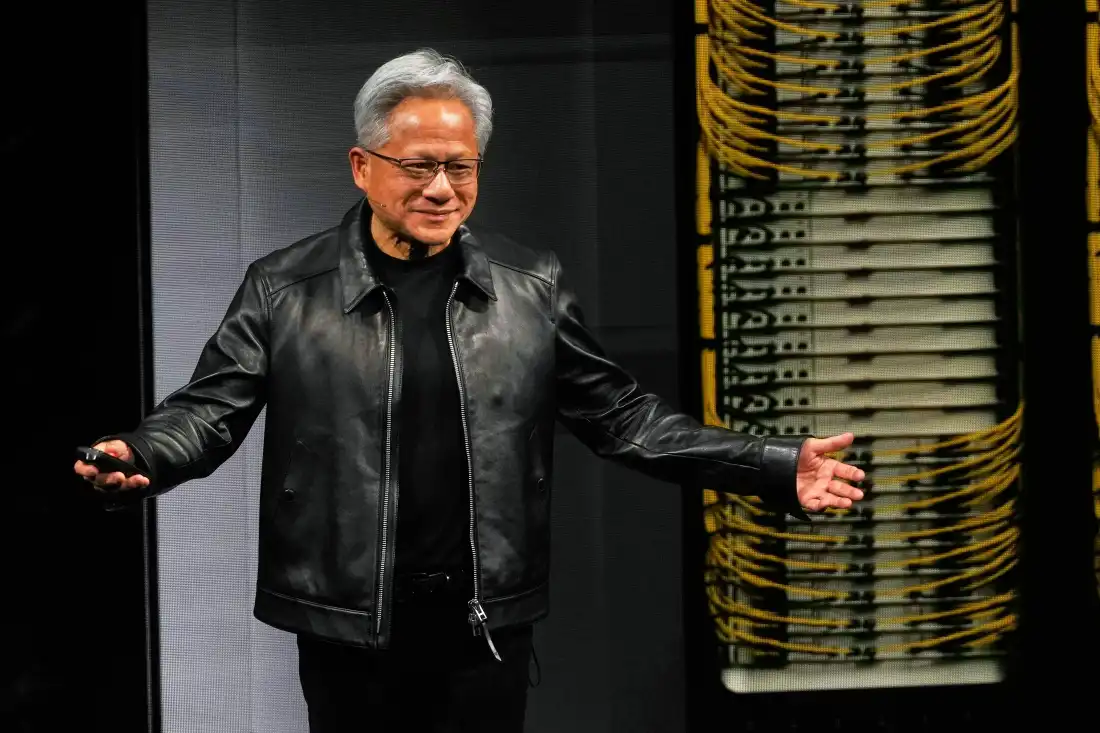
Nvidia CEO Jensen Huang delivers his keynote on the company's GTC event in Berlin, Germany, Wednesday, Oct. 21, 2026. Markus Schreiber/AP hide caption
Markus Schreiber/AP
The massive artificial intelligence chip maker Nvidia says it is launching an internal investigation, after reports that the company's CEO was in a close relationship with a Chinese spy.
In the statement announcing the investigation, Nvidia cited recent reporting by The New York Times, which alleges Nvidia CEO Jensen Huang was the target of a Chinese intelligence operation that sought to send advanced Nvidia AI chips to China.
"While the Board has no reason to believe that either national security or NVIDIA secrets were compromised, the Board's inquiry will examine all available information," the statement from the company's board of directors reads in part.
The Times released a series of reports over the last two weeks detailing Huang's alleged relationship with a woman named Alice Huang, who is accused of being a spy for China. The two are not related. NPR has reached out to the Chinese Embassy in Washington, D.C. but has not received a response.
"Alice Huang is a Chinese national. She's a Chinese businesswoman who had something of a mysterious and meteoric rise," Times reporter Ana Swanson explained on NPR's technology podcast Machine Gods.
Alice Huang ran a Singapore-based company that purchased nearly $5 billion in Nvidia chip technology, Swanson says. "At the same time, she was also seen personally with Jensen Huang on a couple of occasions after some industry events in Taiwan. They were photographed together both at a bar with other suppliers and then also out to dinner with some other executives."
The reporting by the Times suggests Alice Huang may have helped China get around U.S. limits on exports of powerful AI chips.
According to Nvidia, Huang sent an email to his employees on Sunday, acknowledging the relationship, and apologizing for being unfaithful to his wife.
"I support the investigation and will cooperate fully," Huang wrote. "I love our country and our company. I am committed to protecting NVIDIA and supporting America's national security. I am proud and grateful to be an American."
Last week, three Republican members of Congress sent a letter to the Nvidia CEO requesting that he brief lawmakers about the relationship, and about the company's "security protocols against foreign adversary espionage."
Nvidia dominates the global market for AI chips, and has seen explosive growth in recent years, as NPR has reported. The company started as a manufacturer of chips for computer graphics, which later turned out to be crucial for training artificial intelligence.
Nvidia's CEO and President Trump have repeatedly appeared in public together in recent years. According to Huang, Nvidia is helping to fund the construction of a new ballroom at the White House.
KioskNews shows a cleaned-up reading view extracted from the publisher’s page — the original always lives on their site, not ours.