China proves a cut above with world-first precision laser experiment in space
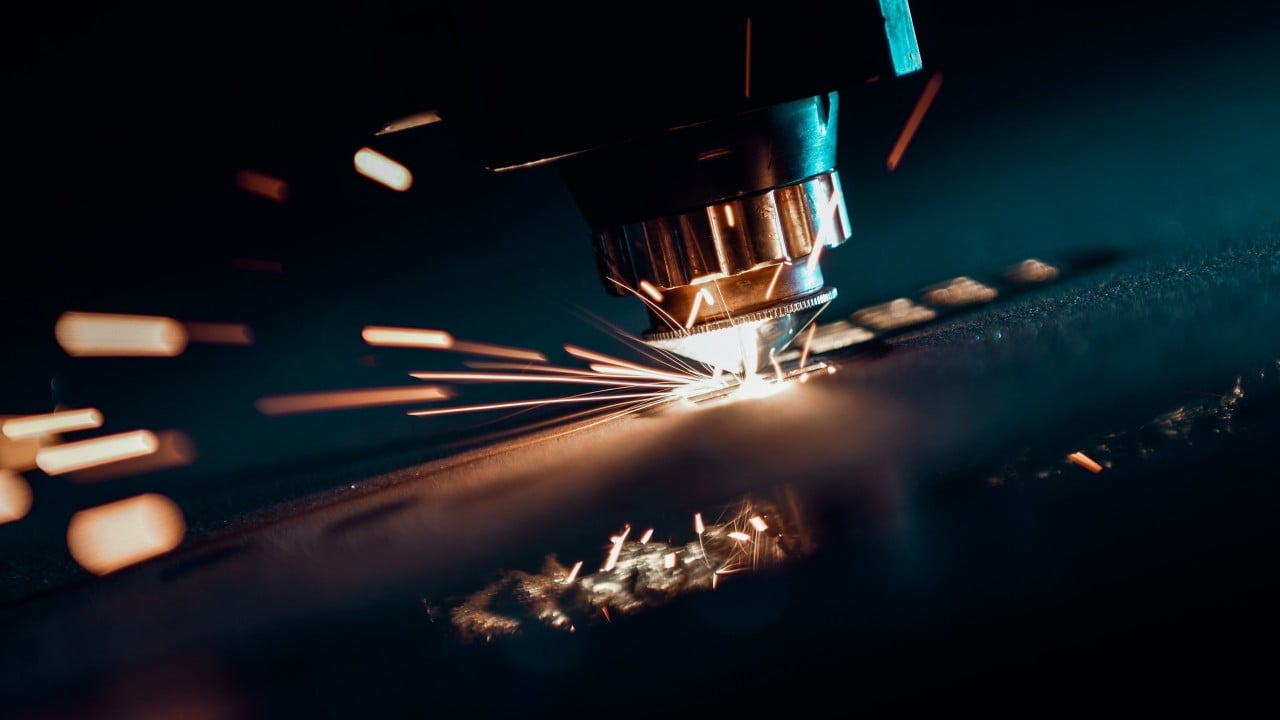
China’s space scientists have become the first to carry out precision laser cutting in orbit, slicing a piece of “large-scale equipment” with a robotic arm fixed to the outside the Tiangong space station.
The official Science and Technology Daily reported on Wednesday that millimetre-scale cuts were made by a laser maintenance device operated remotely from “hundreds of kilometres away”.
Precision laser cutting involves focusing a beam of light to slice or melt material with extreme accuracy, a difficult and risky process in orbit.
The Tiangong device was developed jointly by Huazhong University of Science and Technology (HUST) and the Shanghai Institute of Space Power-Sources, with the researchers taking just a year to go from initial design to a flight-ready model.
Professor Huang Yu, who led the HUST research team, told Science and Technology Daily that regular maintenance and high-precision repair were vital to the long-term operation of space stations.
To translate ground-based laser processing equipment into space, the team overcame several challenges, including operating in the extremes of space, achieving millimetre-level positioning and executing micrometre-level precision cutting, Huang said.
According to the report, the Tiangong device operates using multi-axis positioning mechanisms and is guided by an advanced vision system.
“A multilevel vision system guides, identifies and positions the device, automatically completing high-precision laser cutting and waste material recovery,” HUST’s mechanical science and engineering school said in a social media post in September.
The school said automated repairs could now be completed on the Tiangong, which would help to extend its lifespan and lay the foundations for an in-orbit maintenance system.
HUST has been identified as a Chinese institution of concern by the United States, with companies and facilities affiliated with the university appearing on the US Bureau of Industry and Security Entity List.

Space-based laser technologies have drawn scrutiny over dual-use concerns, particularly their potential to damage, disable or destroy other spacecraft.
Both Beijing and Washington have pursued directed-energy and laser-weapon research, fuelling fears of an orbital arms race as each seeks to gain a strategic edge in space.
Researchers are grappling with how long-term orbital and lunar operations can be made more efficient and cost-effective.
Nasa is working on in-space servicing and manufacturing for Earth orbit and the moon, including laser-beam welding.
“Laser systems can perform joining, cleaning, cutting and repair activities, which will enable the construction of large in-space structures that could not fit on a single launch vehicle,” according to an abstract by the Marshall Space Flight Centre posted on Nasa’s STI research repository in July.
The abstract said Nasa was working on a number of space laser welding projects, including a compact vacuum welding chamber – which is planned to launch to the International Space Station – and an autonomous robotic arm to perform welds in a simulated lunar surface environment.
In a report on space welding published in 2020, Nasa said that welding and additive manufacturing in space could help repair spacecraft more economically without requiring new parts to be shipped from Earth.
As countries aim to build long-term presences in space and launch more spacecraft into Earth orbit and beyond, concerns have also been raised about the potential weaponisation of spacecraft.
Last month, a report by the US Defence Intelligence Agency alleged that China could deploy space-based directed-energy weapons by the late 2020s, though it did not present evidence for the forecast or say whether this would be a laser- or high-power microwave-based device.
KioskNews shows a cleaned-up reading view extracted from the publisher’s page — the original always lives on their site, not ours.