'Absurd and novel': Shanmugam dismisses WP MP’s call to raise issues at Singapore’s meetings with foreign counterparts
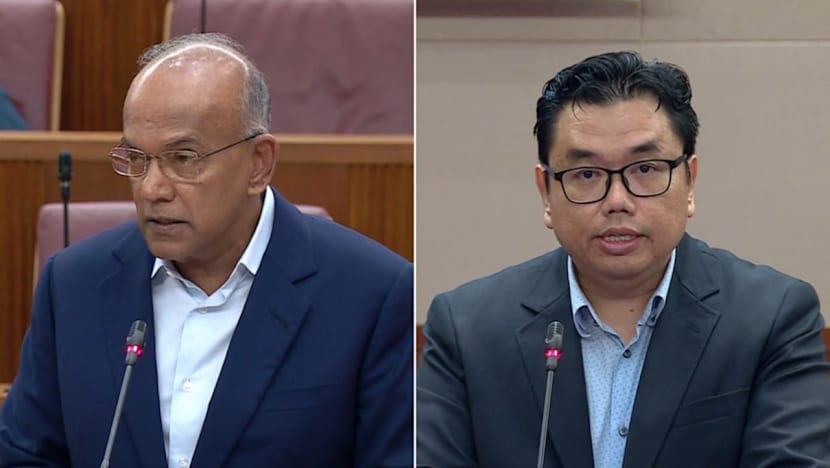
SINGAPORE: Singapore cannot conduct foreign relations on the basis that every ministry should raise international law issues whenever it meets foreign counterparts, Senior Minister K Shanmugam said in parliament on Wednesday (Nov 4), calling such an approach "absurd and novel".
Mr Shanmugam, who is also Coordinating Minister for National Security and Home Affairs, was responding to Workers’ Party (WP) MP Fadli Fawzi, who argued that the Ministry of Home Affairs should have raised Singapore’s position on Israeli settlements and settler violence during a meeting with Israeli officials.
Mr Shanmugam also accused Mr Fadli of sending "two messages to two different audiences": one to the general public that the WP was focused on Singapore’s national interests, while another was directed specifically at the Malay-Muslim community that the government was "unprincipled and soft on Israel".
"That's what this question and the subsequent explanation is all about - getting people to view our international relationships through the prism of race and religions, race and religion," said Mr Shanmugam.
"That is just wrong."
In response, Mr Fadli said he rejected the characterisation that he was motivated by race and religion. He added that he did not suggest that Singapore should raise every bilateral or foreign policy issue at every meeting, and it was not the Workers' Party's position.
The 18-minute exchange between the two men arose from a parliamentary question Mr Fadli had submitted on Oct 7 on a meeting between Singapore and Israeli officials.
The MP asked whether Singapore had discussed how to address illegal settlements and settler violence in the West Bank during the meeting, whether Singapore requested that the meeting be secret, and if not, why a correction order under the Protection from Online Falsehoods and Manipulation Act (POFMA) was not issued against a news report in Israel news outlet Haaretz.
The Haaretz newspaper had reported on Sep 7 that a delegation comprising representatives from the Israel Prison Service and National Security Ministry made a "secret visit" to Singapore that month.
The report also claimed that the death penalty was discussed during the meeting, with the Ministry of Home Affairs (MHA) later disputing this.
Mr Shanmugam’s written reply on Oct 7 set out how Singapore regularly holds discussions with international counterparts on security and law enforcement matters, as well as why MHA responded to Haaretz but did not issue a POFMA notice.
He had also asked Mr Fadli to say whether MHA should raise broader concerns about a country’s policies during bilateral engagements, and whether this should apply consistently beyond Israel.
If so, Mr Fadli should explain how such an approach would serve Singapore’s overall interests.
On Wednesday, Mr Fadli said that it would have been relevant to clearly reiterate at the meeting Singapore's principled position that Israeli settlements in the West Bank are illegal under international law, and the deep concerns about settler violence against Palestinian civilians in the West Bank.
Referring to Mr Shanmugam's question on whether this principle should apply only to Israel or consistently to all countries, Mr Fadli said: "I believe that the principle that Singapore should address issues that are relevant to our concerns and our commitments and in our interests, should be applied consistently to all countries with which the Ministry of Home Affairs engages with".
“It is also my belief that when engaging with foreign counterparts, Singapore should maintain a whole of government approach in upholding our commitment to international law and a rules-based international order.”
In response, Mr Shanmugam asked if Mr Fadli meant that every ministry must raise international law issues when meeting a counterpart ministry, even if the issues are not directly relevant to the ministry.
"Can I ask, sir, on that logic, it would be even more important as a rule, to raise bilateral issues as well between two countries, regardless of which ministries' meeting?"
Mr Fadli reiterated that Singapore should raise an issue during a bilateral engagement “if it is relevant and in our interest to do so”.
Mr Shanmugam said Mr Fadli had maintained that the principle should apply to all countries, but had not answered whether it should also extend to the full range of bilateral issues between Singapore and those countries.
The suggestion of how Singapore's bilateral business between countries should be conducted, that every ministry when meeting Israel or any other country must raise all possible issues of international law and all possible bilateral issues would "certainly be novel", said Mr Shanmugam.
He explained that the Ministry of Foreign Affairs and the Cabinet as a whole decide on Singapore's overall stance towards any particular country, as well as the extent of meetings, including whether these take place at all.
Each ministry also deals with issues directly relevant to them, he added.
As a small country, it is important for Singapore that international law be upheld. But this does not mean repeating its principles at every meeting.
"These things are dealt with, with common sense and skill. And if (the) Member believes that meetings with Israel on the West Bank settler issue, every meeting should raise those issues, put down an adjournment motion and we can debate it," he said.
ICJ ELECTION "TESTAMENT" TO SINGAPORE'S DIPLOMACY
Mr Shanmugam cited an example of Ambassador for International Law Rena Lee who has been elected as a judge of the International Court of Justice (ICJ), becoming the first Singaporean and first woman from Southeast Asia to do so.
Ms Lee, 57, secured the highest number of votes in the United Nations (UN) General Assembly with 151 out of 191 votes, and also received the joint-highest number in the UN Security Council with 13 out of 15 votes.
The Ministry of Law and Ministry of Foreign Affairs worked very hard to lobby countries, said Mr Shanmugam, adding that he too was involved in early meetings.
Ms Lee's votes were a "testament" to Singapore's skill in diplomacy and the way the country conducts itself, he added.
He put forth a scenario of meeting the five permanent countries of the UN Security Council and bringing up the weapons they have supplied to conflict zones where there are breaches of international law.
"You start out by listing this category of international law issues, and then you say, 'by the way, can you please support us?' I think Members and Singaporeans can see how absurd and novel such a position is," said Mr Shanmugam.
"TWO MESSAGES"
Mr Shanmugam said that there was a “more fundamental point” about Mr Fadli’s statements.
"To jump on this Haaretz article, make absurd suggestions on how we conduct and how we should engage in the belief that people won't understand how inter-ministry conversations really take place, in the complete belief that people will ignore the details of how Singapore conducts its relationships, and try and present the picture that the government is unprincipled and soft on Israel."
Mr Shanmugam added that it is wrong to try to view Singapore's international relationships through the prism of race and religion.
Mr Fadli rejected the characterisation that his position was motivated by race and religion.
"This is primarily an issue about how Singapore can uphold its commitments to international law, consistently impartially and objectively," he said.
He added that Singapore should be raising concerns only when they are “relevant”.
He maintained that in the case of the Israeli meeting, the existence of illegal settlements was relevant as the Haaretz article had named two officials in the Israeli delegation linked to the construction of illegal outposts in the West Bank.
In response, Mr Shanmugam said he could not understand how the issue of settler violence is relevant to MHA’s discussions when Mr Fadli does not know what was discussed between both sides.
“I have said in my speeches that the primary point of international law and approach has got to be enlightened self-interest,” he said.
He added that Mr Fadli should have realised from Mr Shanmugam’s question that his position was “absurd”.
“Instead of that, he walks in further and doubles down,” said Mr Shanmugam.
On whether Singapore requested that the meeting with Israeli officials be kept a secret, Mr Shanmugam said meetings between MHA and its counterparts are almost always kept confidential, except when parties request for them to be made public.
He reiterated that he had given his answer that one party requested that the meeting be made public.
KioskNews shows a cleaned-up reading view extracted from the publisher’s page — the original always lives on their site, not ours.