From ‘Stranger Things’ to ‘Rings of Power,’ We’re All Living in Jamie Campbell Bower’s Fantasy World

Carly Lane is an Atlanta-based writer and critic who has been with Collider in some form or fashion since 2021. She considers herself a television nerd, diehard romance/sci-fi/fantasy reader, and nascent horror lover. Her fondness of books is only eclipsed by the towering TBR that her shelves can't possibly contain.
She is the author of A REGENCY GUIDE TO MODERN LIFE: 1800s ADVICE ON 21ST CENTURY LOVE, FRIENDS, FUN AND MORE, published through DK Books (an imprint of Penguin Random House) and currently available wherever books are sold.
Jamie Campbell Bower seems surprised by the notion that he’s become the king of genre. It seems like a topic worth bringing up at the start of our conversation, though, and not just because he’s carved out some time from an increasingly packed schedule to talk about the latest high-profile project on his acting resume. The bigger reason is that Bower himself has always seemed like the type of actor who innately belongs in a realm that’s much more extraordinary than our own.
Even the briefest glance at his filmography immediately lends credence to that belief. After scoring his first on-screen role in Tim Burton’s silver-screen adaptation of Sweeney Todd, he hopped on the vampire train, appearing in three of five Twilight Saga films, then played a bad-boy Shadowhunter in the big-screen swing at The Mortal Instruments and later picked up a wizard’s wand for two Harry Potter movies. He nearly became part of Game of Thrones with a prequel series that would have preceded House of the Dragon — before HBO decided not to move forward with it. And countless words have been written about Netflix's Stranger Things, with Bower’s performance as the nightmare-inducing Vecna arguably transforming him into a worldwide phenomenon right alongside the Duffer Brothers' show itself. But the truth is that his journey to the fantastical started much earlier than that.
“If I'm to go right back to even before Sweeney Todd and being on-screen, my formative years were being on stage at my local theater and participating in productions like Alice in Wonderland,” Bower reflects. While his preteen enthusiasm for music and performance has certainly endured since then — there’s even an electric guitar casually displayed in the background of the office he’s calling from — he admits now that what called to him early on transcended any one medium.
“I suppose, in a way, I've always been drawn to those worlds. I've always been drawn to immersion into universes and finding a sense of beauty in them, regardless of what it is that I'm doing. It's the stepping outside and stepping into that has always interested me. Period. And that goes not just across acting, but other creative pursuits.”
It’s a more thoughtful response compared to the version that Bower admits he’s previously given — now, he has the years, experience, and perspective to be able to look back on a career largely made up of several big-name genre franchises and find the deeper meaning of it all.
“I remember getting asked questions like that when I was younger, and being flippant and off-the-cuff. ‘Oh, well, it's because I have long hair and I look like a sort of sickly Victorian child,’” he quips, before his expression turns more reflective. “But I think it's probably more just the fact that that's what my soul craves.”
How Jamie Campbell Bower Found His Way to Middle-earth
As any fantasy or sci-fi lover can attest, the biggest stories start with the smallest kernel of an idea. Whether the world in question is made up of dragons or aliens, it all originated from a single mind. The adaptation process, on the other hand, which Bower has increasingly become familiar with over the most notable stretch of his career, represents the exact opposite. By the time the last Twilight movie or the Stranger Things series finale had premiered, the end result was the product of countless individuals working together across different departments to create something that the London-born actor describes as the purest form of fun. Within that collaboration, Bower shares, is where he’s most comfortable existing, especially in the wake of an adolescence where he’s previously admitted he often felt like an outsider.
“Performing was always this space where I felt freest,” he divulges, before offering up something that’s even more revealing, given his performance history. “It's also been the space where I felt the most terrified.”
Some of that fear, Bower expands, sits in the pressure that can come from joining an already established world — take Season 4 of Stranger Things, or the newest installment of a major Amazon fantasy adaptation that we’re dancing around discussing before getting into the nitty-gritty story details.
“Being on a film set’s very scary at times — particularly when you're young or when you’re stepping into a world that is loved or known.” Alongside that weight, however, Bower readily reflects on how his past experiences on fantastical film sets have actually been a form of creative escape. “Maybe this is art in general sometimes, but more in these worlds, I feel a greater sense of, dare I say it, emotional safety. There's that warmth. There's that strong sense of blending in oneself. That, I think, is the thing for me. Because I go into a room like that and, ‘Oh, I'm home! I know where I am.’”
That hasn’t always been the case for him on every set, he alludes, but it’s hard not to notice the instances where Bower has been afforded the most freedom to show what he’s capable of — even behind extensively intricate makeup and prosthetics — are also the moments when it’s impossible to look away from his performance. Beyond acting, that aforementioned desire for complete creative immersion seems to have evolved into a philosophy for everyday life.
“I'm a big believer that we can all create our own worlds, whether it be in our own writing or how we decorate, what we choose to consume.”
Since we’re already on the subject of his filmography, though, it makes sense that Bower then moves to shout out those whose contributions to these larger-than-life worlds he’s been able to play in often go unsung.
“There are also other people involved in that sense of belonging, within the creation of those worlds,” he admits. “I, as an actor, have my own experiences of that, but there's also the other beautiful, probably more important work that goes on within that is so hands-on.” He immediately acknowledges the hair and makeup departments that have aided in his past screen transformations — and specifically name-drops five-time Emmy-winning prosthetics designer Barrie Gower, who spearheaded the creation of Vecna through largely practical effects, as well as Alex Sherrod, the lead sculptor for Stranger Things’ final season.
“This is a space where the freedom to be creative across the board is so apparent for all of us, and that's such a pleasurable thing to be around because you're seeing people do the thing that they love. It’s existed in their brains, and it’s been percolating, and all of a sudden it's manifesting into a reality in order to build a world, and that is so freeing and pure.”
In case you haven’t picked up on it already, the ability to find community and even sometimes family on a project is something Bower inherently holds dear — so perhaps it’s not surprising at all that his time on Stranger Things, which he describes as full of “beautiful memories” filming in Atlanta, is ultimately what led him down the path to entering Middle-earth.
Bower's Journey To Becoming Celeborn Was a Major Change of Pace From 'Stranger Things'
When Bower first learned that he’d been cast in Season 3 of The Lord of the Rings: The Rings of Power, he burst into tears.
That’s not hyperbole. It’s a variation of a story Bower himself has been telling in the months following the official confirmation of his casting. Not only did he, by his own admission, start weeping, but he also had to pull over — he was driving at the time — and call his younger brother, Samuel, to share the good news. While he’s alluded to the existence of FaceTime screenshots that confirm the intensity of his reaction, he’s also insisted that the video in question will never see the light of day.
Still, it seems worth resurrecting the anecdote during our own conversation, if only to ask: What kind of significance does J.R.R. Tolkien’s world hold for Bower, and why did it conjure such a profound swirl of emotion for him when he found out he was going to be a part of it? As it happens, we’re the same age, so of course we both have equally vivid memories of watching — and rewatching — Peter Jackson’s legendary adaptation of the classic fantasy trilogy.
“Those first three films were, have, and always will be the movies that I put on as I'm lying sideways on the couch with a blanket over me on a rainy October, November, December, January, February, March… it depends on where you are. If you're in England, it could be fucking any time,” Bower quips. “But they hold so much peace and joy and light within that heart space for me.”
That initial introduction to Tolkien came by the time he was entering his teenage years, he adds — and on the heels of mostly “playing Power Rangers,” so there was no pretending to wield swords as Aragorn or a bow and arrow as Legolas. Yet watching Tolkien’s story unfold onscreen through Jackson’s lens kept bringing him back to reflect on the deeper themes underneath, and that ultimately made Middle-earth a very intriguing playground for an actor continually looking to immerse himself in the otherworldly.
“I'm curious about the possibility — fuck it, I’ll be more confident,” Bower laughs. “I’m curious about the probability that when Tolkien created that world, it was so imbued with this sense of love and beauty, and yes, of course, the battle between darkness and light. But even Tolkien, and I'll probably fudge this, said something along the lines of, ‘Good can often do evil and doesn't realize that it's doing it.’ There is a certain nuance to that.”
Years later, during the production of Stranger Things, Bower couldn’t help but notice that one of his fellow artists had a foothold in the latest adaptation of Tolkien’s writings. During the hours-long process of prosthetic application required to turn him from disarmingly handsome to utterly terrifying, he attempted to pick Gower’s brain about working on Rings of Power as often as possible. Gower’s answer — describing his experience on set as being akin to “family” — seemingly told Bower everything he needed to know, and by the time the offer to audition for the Prime Video series finally came his way, he embraced his first hunch.
“I always tend to go with a gut feeling when I receive something, and it's been through trial and error,” Bower admits, with a laugh. “But I remember when I received the sides for the show, and having watched the first season and being in the middle of watching Season 2 at the same time, and working with Barrie Gower, there was this pervasive sense of deep emotional connection, and it did feel like something else. It felt like something that I hadn't been experiencing for some time.”
After an initial audition, which Bower taped with his brother’s help, as well as a chemistry read with star Morfydd Clark (more on that later), the good news came through. As it happens, those initial tears of joy were only the beginning of what defined the first three weeks of production on Season 3 — where, as he divulged via roundtable at San Diego Comic-Con, his inner child was “kicking and screaming with glee” at the realization of the adventure he was about to embark on.
“It's that feeling of what seems to have been baked into the Lord of the Rings cake,” Bower expands with me now, “and from the discussions that you and I are having, I'm going to make an assumption that you feel the same, but that's the thing that grabs us. It's like looking at a painting. There are some paintings that I look at, and I’m like, ‘That’s beautiful, but it’s not for me. I don’t get it.’ And there are other pieces of art that aren't necessarily beautiful, but I'm like, ‘Oh my God, this is moving me in such a way that I have no choice but to just stare at it,’ and that's what this world did to me and did for me.”
When Bower was finally announced as a member of The Rings of Power’s Season 3 cast, the role itself was still a secret, but anyone with eyes could have guessed, based on bone structure alone, that he would be playing an Elf. More than that, he’d be playing the one Elf whose absence from the narrative has been the subject of hot debate. Within the massive scope of Prime Video’s adaptation, Celeborn holds significance as the husband of Galadriel, played by Clark, with the question of his whereabouts hanging over the story from the very first episode. Although he is originally presumed dead after the events of the war that resulted in the defeat of the Dark Lord Morgoth, Season 3 reveals that Celeborn has actually been alive the entire time — though not necessarily well, after spending an age imprisoned and apart from his wife.
"Of course there was a fear, but the walls were down, and that's where I wanted Celeborn to be."
For Bower, the role of Celeborn represented a stark change of pace after Stranger Things’ official series wrap, particularly in the makeup chair. Although he’d certainly ditched Vecna’s prosthetics in order to play the character’s original human incarnation, Henry Creel, he wanted to bring something new to his performance in The Rings of Power, stripping away any sense of artifice or manipulation in favor of something that actually proved even more intimidating to inhabit.
“There was always something else that [Henry] wanted, regardless of what it was that he was doing,” Bower explains. “So a lot of the performance was about performing to the other actor that I was in front of. ‘Don't see my intention. I know what I want from you, but I'm not going to show you what I want from you.’ Whereas, for Celeborn, and this idea of sensitivity and vulnerability, I was like, “I'm going to approach this character with a total open-heart space. What he is saying, what he wants, what he is, will be what you see.’”
Admittedly, it still takes a minute before Celeborn and Galadriel’s emotionally fraught reunion happens in the show’s present-day timeline. Season 3 picks up after a five-year time jump, where the War of the Elves and Sauron is well underway. The new Dark Lord, who’s taken over from his predecessor, has already made some decisive moves in conquering Middle-earth, with only a handful of regions — including Númenor and Rivendell — still left to stand against the encroaching evil. If it feels like everyone has been touched by Sauron’s corruption in some form in Season 3, that’s intentional, and Bower didn’t want to shy away from emphasizing that his own character has been put through the wringer while in captivity.
“Celeborn has been through the works. He has suffered, and I wanted to show that suffering, because if he buries it and he presents the false version of himself, there’s no connection. And in the face of this suffering, Celeborn can hold space for the pain. He can choose not to make everyone else suffer, whereas with Henry, he’s like, ‘Well, I suffer, therefore everyone else suffers.’” Even in this snapshot examination of the two characters, both of whom happen to share his face, it’s evident that Stranger Things’ most iconic villain still holds a special place in Bower’s heart.
“I love Henry, and I love the little boy inside of him, but there's a great sense of protection around him that he has created. With Celeborn, I wanted walls gone. I wanted it all to be there and accessible and witnessed.”
The decision to embrace more vulnerability, though, was accompanied by the spike of fear that Bower’s had before — but it led to its own epiphany once he was finally on set at Shepperton Studios, where The Rings of Power’s third season was primarily filmed.
“I remember the first day of shooting and being so terrified. So, so terrified. And then there was this moment where it just dropped in. I have quite visceral reactions to things — if I know something feels good within me, I'm like, ‘Ah, yes!’ I remember being on set, being like, ‘Ah, yes!’ and then seeing members of the crew look at me and being like, ‘Sorry.’” Bower chuckles at the recollection, but the assertion that follows is as unapologetic as any other instance where our conversation has referenced his bigger shows of emotion. “Of course there was a fear, but the walls were down, and that's where I wanted Celeborn to be.”
Bower Had To Become a Very Different Celeborn in 'Rings of Power' Season 3
The below contains spoilers for The Rings of Power Season 3 premiere.
As refreshingly in touch with his feelings as Bower’s Celeborn is, that trait might not have been nearly as successful without the right chemistry onscreen. When the reveal of his role was first announced, the actor was quick to describe his version of the character as a “lover-boy” — arguably a far cry from the reserved elder and statesman he becomes by the events of Tolkien’s novel trilogy. Yet The Rings of Power Season 3 practically gifts Bower with the perfect opportunity to show off a more sensitive side, with an opening flashback that jumps back to the very first moment Celeborn and Galadriel laid eyes on each other. Bower says his own connection with Clark was simultaneously instantaneous, but certainly began — at least on his end — from a place of professional reverence.
“It's no secret that I have been a fan of Morfydd’s work for a very long time.” How big a fan, you ask? “I mean, I have merchandise with her on it.” He goes on to cite Clark’s acclaimed performance in Rose Glass’s psychological horror film Saint Maud as an influence on his own work. Apparently, it only took one look during their chemistry read, the final stage in Bower’s audition process, for the two actors to forge their own bond.
“I was in the knowledge of what I wanted to bring, which was this rawness,” he reflects. “The moment we started chemistry reading together, there was this instant connection, this instant sense of safety. I've discovered that in my own artistic journey, that feeling of safety is so important with all the creative people that I'm working with. So we locked eyes, and it was like, ‘We're here.’”
In hindsight, Bower adds that even if his test with Clark hadn’t led to him booking the role of Celeborn, getting to act opposite someone he’s admired for so long was a worthwhile experience on its own. Fortunately, that’s not what happened next. “I genuinely remember leaving the chemistry read and jumping on the phone and calling one of my delightful, long-suffering agents, and saying, ‘I had the best time. If this is all it is, I'm so grateful. I'm so happy.’ Then, of course, a week later I get the phone call, and I'm driving along and crying.”
When Celeborn and Galadriel first cross paths, the ensuing meet-cute plays out through an unexpected amount of physicality and stuntwork for both actors. What Bower refers to as a “tête-à-tête fight” feels perfectly fitting for the warrior Galadriel is at this point in the story, particularly after two seasons of heavy action. The fact that she’d rather practice the sword alone, in the woods, attracts the attention of Celeborn, who finds himself torn between a weariness about war and an inability to fully reintegrate himself into a peaceful Elven society. When the two begin sparring with each other, the moment evolves from a playfully flirty encounter into the beginnings of an epic romance.
"It's no secret that I have been a fan of Morfydd’s work for a very long time."
“There's such a beauty to all of that movement,” Bower praises. “It's an intentional way of fighting, and it’s so Elven, and it's just fluid and dreamy and powerful and strong.” His desire to preserve the elegance of the entire sequence resulted in close collaboration with Rings of Power stunt coordinator Roy Taylor as well as series director Charlotte Brändström, who helms some of Season 3’s most pivotal episodes. Because Bower was so intent on nailing such a defining scene for his character, it led to a brief surge of disappointment when he convinced himself he hadn’t initially done so.
“I remember going home and being upset about the fact that I didn't feel like I'd gotten something right on set,” the actor explains, before expanding on the moment in question — when Galadriel challenges Celeborn to graze her with his sword and initially believes she’s escaped unscathed, only to find he’s successfully cut off a lock of her hair, which she allows him to keep. “I watched the playback, and I was like, ‘No, it's not beautiful enough,’” Bower recounts, “and Charlotte was like, ‘It's fine, Jamie. Don't worry.’ I saw the edit, and I was like, ‘She’s absolutely right. It is fine.’ But I very much wanted to keep that beauty throughout the whole fight.”
What proved even more disarming than crossing swords was Celeborn and Galadriel’s choreographed party dance, which Bower says handed him and Clark another means of connection — primarily because they approached it with a shared degree of reluctance.
“I did dance at school, but I don't love to dance, and haven't danced on camera for years. I think the last time I danced on camera was a film I made with Roland Emmerich, called Anonymous. I don’t think I even danced in that; I just had a lesson. And of course, that’s a very exposing place to be. You’re both like, ‘Well, I’m shit at this, so let’s see how this goes.’” Bower laughs. “But I think that helped us to build that relationship — because within that, it was just kind of like play again.”
His on-screen romance with Clark almost feels like a whirlwind on its own — in one moment the characters are learning each other’s first names, and in the next they’re planning out their future and the life they want to have together after the fighting is over. Yet none of it would have been possible without what Bower likens to an immediate esteem between co-stars that only strengthened during Season 3’s production.
“It was there instantly, and then every step that we took towards the world of it and towards building it was another step forward,” he says. “I think there's also a truth to having watched the films when I was younger and seeing Galadriel, and being like, ‘Oh my God! She’s amazing!’ You carry that reverence with you, too. I don't know what that is — by luck, by design, by potential manifestation, but it was just there. It was just in us.”

While Celeborn’s introduction in The Rings of Power is a pretty suave one, all things considered, he’s a very different Elf when Season 3 returns to him centuries later. Gone is the character who once fought with beauty and elegance, and in its place is someone who’s been forced to abandon all of that in favor of simply living to fight another day. Behind the scenes, it led to frequent discussions between actor and stunt team about how best to represent that deterioration of form whenever Celeborn had reason to pick up a weapon.
“This character has been imprisoned for so long,” Bower explains, discussing his conversations with Taylor about the biggest difference between Celeborn’s past and present approach to combat. “I wonder if there's a world in which the beauty of form within his fighting is, at this point, no longer necessary because it's become about survival.”
Finding the best way to portray that devolution was an experimental process on set, the actor adds, recalling one sequence in particular featuring an imprisoned Celeborn “when we went to 11 on it and had to kind of dial it back to seven.” The specifics are less important than what it led to: the revelation that Bower had to cross that invisible line for the first time to know exactly where it was. “We had to go there to bring it back,” he admits, before launching into a longer explanation about the Elf lord’s overall feelings about violence.
“It's not something that he celebrates. It's not something that he's going to be overjoyed about. I remember his voice kind of popping up in my head before we would do these scenes: ‘If I have to, then I must. It’s not that I don’t want to, but if I have to.’ That has been a cool fundamental belief that I discovered within creating him. He’s adept and good at what he can do, but would prefer not to.”
Despite the decision to embrace less physical restraint for Celeborn over time, Bower’s own voice, which has a distinct resonance, feels perfectly suited to a character with centuries of wisdom to draw from. Yet even within the world of The Rings of Power, the Elves have a mellifluous way of speaking that’s born from their own language. Finding the best pitch for Celeborn may not have been as demanding as preparing to deliver Vecna’s chilling dialogue in Stranger Things, for example, but it was still a matter of striking the right balance.
“There were takes that we did in that first meet-cute between Galadriel and Celeborn where my pitch was so high. I was like, ‘I wonder how youthful we can make him at this point.’ And it didn’t work.” Bower chuckles. “So, we had to find that middle ground.”
While Celeborn couldn’t exactly start from a place of innocence, it was still essential for his voice to be equally reflective of his Season 3 arc while also hinting at the co-ruler of Lothlórien he will ultimately become. It’s a significant part of what Bower describes as the overall journey he went on with the character.
“The experiences that he goes through — particularly, and I would say most importantly, this season — really transform the way he ends up sounding. It was always going to be about having this ethereal nature and this lyricism and this poetic kind of being to him, and a sense of beauty, but it was also about exploring the journey of innocence into suffering, into finding hope, into finding light, into suffering again, and getting into this space of wisdom. And within that wisdom — and I've even sent emails more recently to the creators about where I found him now — it’s about finding that stillness, finding that balance and knowledge.”
When I ask whether Bower’s own musical background proved helpful in figuring out how Celeborn would sound, he admits that his experience there — first at London’s National Youth Music Theatre, later with the now-disbanded group Counterfeit, and now in both collaborative and solo performance efforts — has helped him develop a stronger understanding of his body’s most unmistakable instrument and what it’s capable of.
In the same breath, however, Bower confirms that no amount of planning is a proper substitute for what can emerge spontaneously, sometimes when it’s least expected. It happened with Vecna, whose hair-raising cadence Bower initially envisioned in the vein of Freddy Krueger before drawing inspiration from Hellraiser’s Pinhead, and it happened again with The Rings of Power’s most highly anticipated new character.
“There is also something that happens when you’re creating, and I'm sure you experience this as a writer, too. You can do all the notes, and you can do all the pre-thinking and all the kitchen table work, as we like to call it, but there's also a point in time where you have to be like, ‘You're going to do what you're going to do, and you're going to fly and exist in your way.’ And then he lands.”
After ‘The Rings of Power,’ Bower Is Finally Ready To Return to the Stage

There’s no possibility of us delving any further into The Rings of Power’s third season — partly because only four episodes will have premiered as of this writing, and partly because Bower very gallantly wants to avoid divulging any twists I haven’t screened yet. Since our time together is almost at an end, now seems like the right time to inquire about what’s next for him, beyond Middle-earth.
After years in worlds containing supernatural creatures of all sorts, you’d think Bower might easily be drawn to something more contemporary, but there’s actually one specific genre that he’s willing to admit he doesn’t think he has the chops for.
“I just had a conversation with my team the other day about the things that are interesting me and the things that I want to avoid, and comedy is always the thing that I'm so desperate to avoid. It's such a unique, specific talent that some people have, and I'm not that guy. I just don't have that. Some people can paint beautifully; I'm not a painter. That's just not in the skills that I've been fortunate enough to have,” he concedes, flashing a grin that ends up somewhere between self-effacing and thoroughly charming. “So comedy's always the thing that we’re kind of like, ‘Eh, we're okay.’”
That doesn’t mean he doesn’t feel some kind of pull toward a more grounded tale, and there’s no hesitation in him when he confirms as such. “There's always been a part of me that's wanted to do more of what we in England call the ‘kitchen sink drama,’ one that is complex and deeply human. That would be really interesting to me.”
"Comedy is always the thing that I'm so desperate to avoid."
Amidst whatever stories are still lying in wait for Bower to put his unique stamp on, his biggest future pursuit is his first-ever solo concert in London next year. He privately breaks the news here, not knowing that by the time the announcement goes out to fans, tickets will sell out impressively fast. Although performing solely as himself has the potential to resurrect some of that fear we’ve been talking about, it also represents yet another avenue for Bower to embrace the freedom that simply creating can provide. It’s a lesson he still finds himself navigating from time to time — with the occasional guidance from those who have been in the business a bit longer.
“Two weeks ago, I sat next to a musician in a very famous band, and I asked them, ‘After all these years, it's a business for you, and it's how you pay your mortgage and put your kids through school. How do you still find the joy in it?’ And they said to me, ‘The first thing I do when I get into the room with the guys, I say, ‘Do you want to play?’ I said, ‘Fuck. It's just that fucking simple.’ That's all it is. In other creative pursuits in my life, I've been so used to being the person that has to oversee everything to the point of it being quite consuming — unaware that it's consuming, but it being consuming.”
As Bower prepares to return to the Alexandra Palace Theatre, it’s tempting to ask whether any of his most recent stage performances — like last year’s one-night reprisal of the role of Henry Creel in Stranger Things: The First Shadow — had anything to do with it. Instead, he brings up a January email from Biffy Clyro frontman Simon Neil, which included an offer to perform alongside the band at Finsbury Park. But even that opportunity very nearly didn’t come to pass when Bower’s fear briefly took over.
“I was so struck by a certain terror that it took me three months to reply to his email — and bless him, when I did reply positively, he was still positive about the opportunity! But I got to that show, and I saw everybody working at the top level, doing their thing, and that nothing needed touching.
“I didn't have to do anything,” Bower muses, “but I can't lie and tell you that my brain wasn’t like, ‘Well, I've got my monitor mix, but what if I need this?’ And I was just like, ‘Chill. Just let it happen and let it breathe and let it be.’ And I did, and I just had the most incredible experience.”

There’s no doubt that night became an important reminder of what Bower wants to strive for with his own show, the details of which are still largely under wraps — but even the tease he’s willing to drop now feels perfectly aligned with his biggest artistic goals. “It’s really about a reconnection to that childlike sense of wonder and love and hope and safety — and yeah, weirdness. Of course, weirdness.”
Regardless of which realm he ends up playing in, Bower’s determined to have fun there, but he’s also learning to be content with not having control over every single detail. On a personal level, it turns out that just means knowing when to let other artists help him build the most immersive version of his own world.
“That's what I'm going back to now — that sense of letting go and letting things exist, and… fuck it, stepping back into my fantasy,” Bower declares, with a mischievous smile. “There you go. You're welcome.”
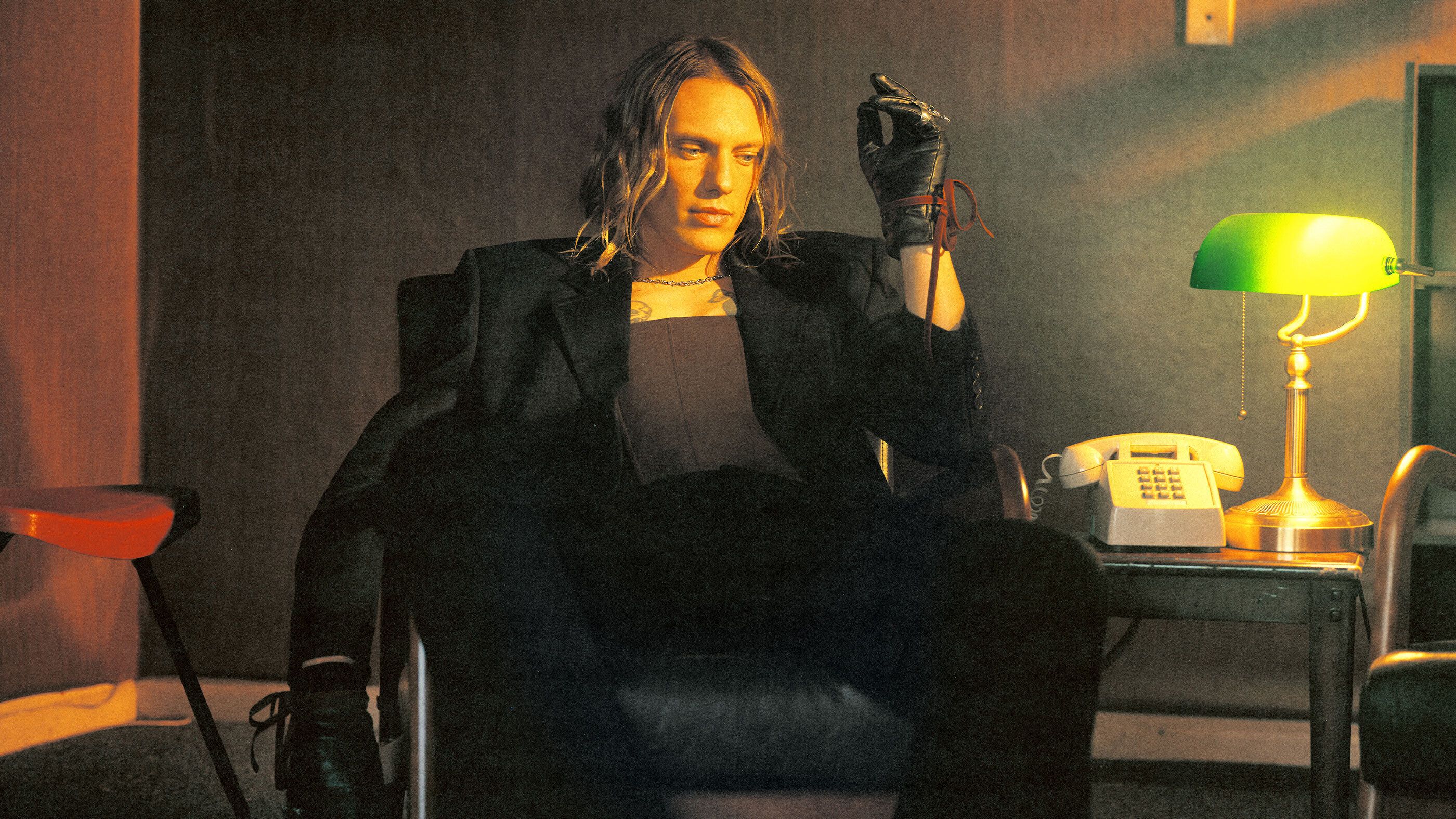
Photography: Gina Gizella Manning | Location: Our Home Studios, Los Angeles
- Groomer: Johnnie Sapong | Grooming Assistant: Michelle McDevitt
- Styled by: Nathan Henry | Styling Assistants: Makayla Godden and Stoyan Chuchuranov
- Outfit 1: Top, Waistcoat, Jacket, Trousers, Shoes by AMIRI, Gloves from Stylist Archive, Jewellery by The Great Frog
- Outfit 2: Jacket, Trousers, Corset by Mithridate, Gloves from Stylist Archive, Jewellery by The Great Frog, Shoes by McQueen
- Digital Imaging Tech: Jesse Tam, Camera Assistant: Fernando Ponce, Gaffer: Andrew Kowalski, Production Assistants: Amirza Indradjaya + Judson Emery
KioskNews shows a cleaned-up reading view extracted from the publisher’s page — the original always lives on their site, not ours.