3 parking lots, but only room for 2 – the squeeze at Singapore's older car parks
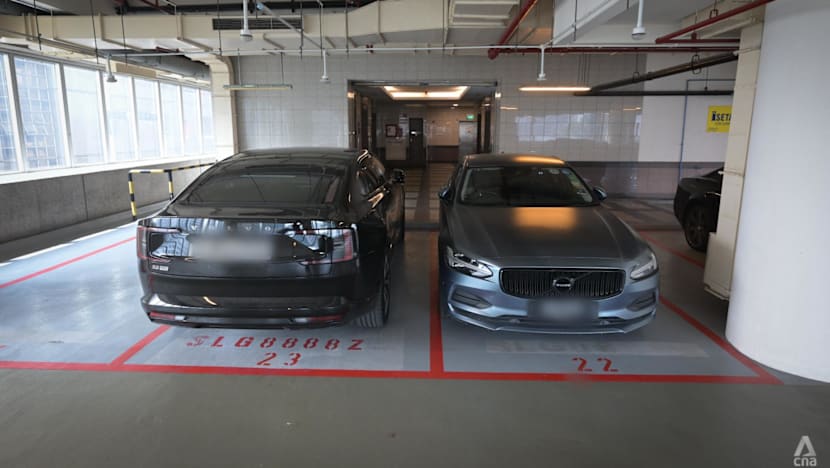
To an uninitiated driver looking for a car park lot in Orchard Road during peak hours, Shaw House along Scotts Road might seem like a good bet.
There is usually no shortage of parking with several left lots empty even though they are close to the lifts.
But drive up to those lots, and one can see why they are still empty – they are too narrow for larger modern cars to fit into.
Shaw House, like a number of older buildings, is notorious for having tight car park spaces.
The car park is made up primarily of blocks of three lots, hemmed in by two walls on either side. But once two cars are parked in one of these blocks, it is virtually impossible for the third remaining lot to be used.
Even if a third vehicle does manage to squeeze into the space, it is unlikely that the driver or passengers would be able to open the car doors.
Mr Nevin Ho, who visits Shaw House to watch movies or go to a nearby 24-hour gym, is all too familiar with this situation.
The content creator said friends or family members driving him there typically give empty parking spaces on the lower floors a miss and head straight to the upper floors, where they know there are fewer cars already parked.
Even then, Mr Ho and other passengers may have to alight before the car is parked.
"If you own a big car, and you park in the middle lot, no one else can park in the lots on either side. Or even if you can park, the driver may not be able to come out.
"Maybe they must crawl out from the top," he said with a laugh.
An online search of discussion forums found drivers complaining about a number of car parks aside from the one at Shaw House, including People's Park Complex, Burlington Square and OCBC Centre, with drivers unhappy not only over narrow lots but also tight corners and ramps.
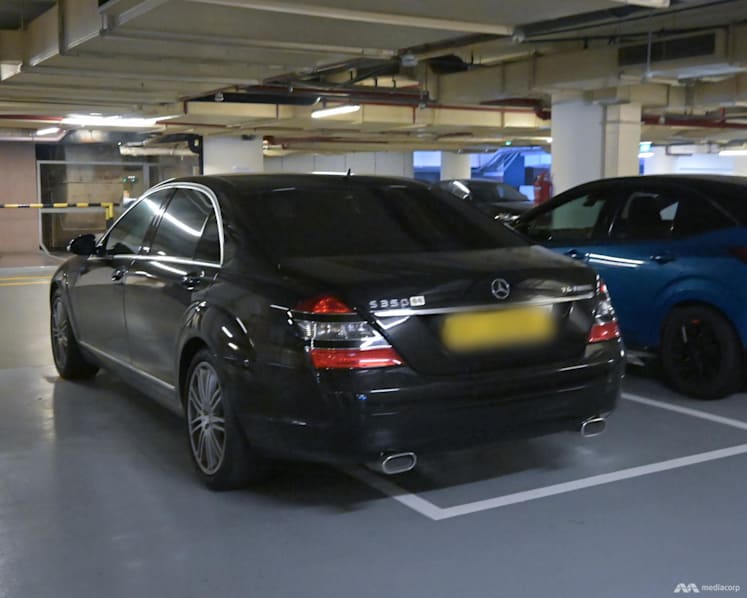
CARS GOT BETTER BUT ALSO BIGGER
The car parks drawing the most complaints were built decades ago. And while most of Singapore's car park infrastructure has remained largely unchanged, the cars navigating them have been slowly growing in size, creating an increasingly awkward fit.
And it's not just luxury car owners who are facing this issue.
In Singapore, the width of the top-selling car model in 2015, the Toyota Corolla Altis, was 1,780mm. Last year, the top-selling model was the BYD Sealion 7, which is 1,925mm wide.
Brussels-based Transport & Environment (T&E), an independent non-profit organisation that campaigns for cleaner transport in Europe found last year that the average dimensions of new cars sold in Europe, some of which are sold here, have continued to increase.
It reported that the average length of new cars has been increasing by about 1.2cm a year, while their height has risen by around 0.5cm annually. In 2024, it reported that the average width of new cars was increasing by about 0.5cm a year.
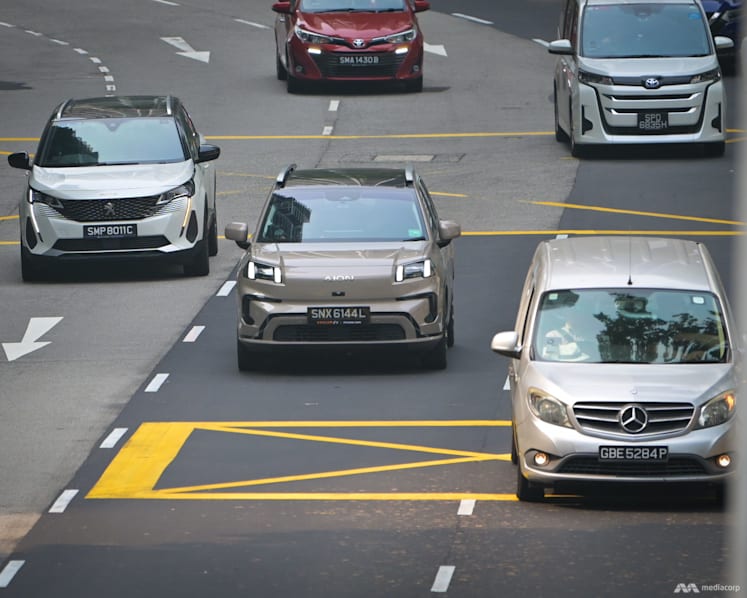
Under current standards, a regular car parking lot in Singapore must be at least 2.4m wide and 4.8m long.
When a lot is next to a wall or column, an additional 300mm of clearance is required to provide enough room for car doors to open comfortably, the Land Transport Authority (LTA) told CNA.
However, the latest requirements, revised in January 2024, apply only to new private developments and redevelopment proposals, and are not retrospectively applied to existing developments built to earlier standards.
The LTA could not provide information on previous dimension requirements for regular car park lots.
NAVIGATING TIGHT LOTS AND RAMPS
CNA visited three car parks which are infamous among drivers for having tight lots and narrow ramps.
At Shaw House, which was built in 1958, CNA found some parking spaces that were less than 2.3m wide while others just eked out 2.4m, if measured to the outer end of the boundary markings.
Many also did not have the 300mm clearance next to a wall or column that would be required in a new or redeveloped car park.
Another driver, who wanted to be known only as Mr Chong, described the car park as "very challenging", saying the spaces were narrow even for his sedan.
"It is also difficult to enter or exit the car (after parking)," he said.
Over at Beauty World Centre at Upper Bukit Timah, the narrow lots are primarily caused by pillars eating into lot space. The parking situation has resulted in some shoppers avoiding the basement car park altogether.
Ms Wai Mun Yong, 38, a finance professional who visits the shopping centre a few times a week because her son attends enrichment classes there, has taken to walking to the mall from her nearby home instead of driving.
"This is one of the worst car parks I have to go to. It's just very cramped.
"If I parked in a lot with the pillars surrounding the car, I can't even open the driver's side door," she said, describing her Tesla Model Y as being slightly "bulky".
On occasions when she does drive, the difficulty does not always end once she has managed to park. To get enough room to buckle her children into the car, she sometimes drives down to an open space on the first floor before picking up her children.
"I just want the space big enough to open the door," she said.
Another regular visitor, Ms Karen Hsu, makes a similar calculation when she drives her Bentley to Beauty World Centre once or twice a week to buy groceries.
If she cannot find a suitable space, the housewife said that she has to either go to a higher level, or park at other car parks near the shopping centre.
"I mean, this is an old car park, so the lots are smaller, so I can't blame them," said the 50-year-old. "But cars are getting bigger, so it's a struggle for more and more car owners to park here."
I mean, this is an old car park, so the lots are smaller, so I can't blame them. But cars are getting bigger, so it's a struggle for more and more car owners to park here.
CNA found that the widths of parking spaces at Beauty World varied. Two lots nestled between pillars measured about 2.4m wide each, but there were also lots that were 2.5m wide and some 2.8m.
Over at Pandan Valley, a condominium built in 1977, motorists face not only narrow lots but also tight ramps and turns between the levels of its four multi-storey car parks.
Mr Alvin Lam, 34, encountered this on his first visit to the development, when he was there with a colleague for work.
As he turned up a ramp to the second storey, he heard what he described as "the most ear-piercing screech any driver could hear".
His car had struck a knee-high structure protruding from a pillar, which he said he had not noticed or expected.
The impact damaged his side fender and headlight cover and bent an iron bracket of his side fender. He had the car repaired over three days in Johor Bahru, Malaysia for RM3,000 (S$941).
For residents who use the car park regularly, navigating these tight spaces has become something of a science.
Ms Jeannie Loo, 39, typically takes two manoeuvres to negotiate one of the ramps safely. After successfully making the turn in one go several times, she had become complacent on one occasion and ended up scratching and denting her car.
The financial consultant paid about S$400 (US$312) to repair the dent and paint her car.
Ms Loo still uses the multi-storey car park, but said she now drives slowly and takes more time to manoeuvre her way through the ramps. The open-air car park is an alternative, but one she would rather avoid.
"It comes with bird poop, leaves and twigs ... The hot sun is really what I want to avoid."
Other residents are less willing to take their chances on the ramps, she said. Some who fail to find a space on a lower level would reverse out and park in the open-air area instead of continuing upwards.
Making the lots larger may not provide a straightforward solution either.
Ms Loo said repainting them to create wider spaces would mean having fewer lots on each level, potentially forcing more motorists to travel higher up the multi-storey car park – and negotiate more of the ramps they already find difficult.
At Pandan Valley, which has four multi-storey car parks, CNA found narrow ramps and tight turns between levels. One ramp measured about 2.8m across, with visible scrape marks on the pillars beside it. There were also similar marks found on the pillars at other ramps.
Under LTA requirements, the minimum clear width for a single-lane ramp or accessway for cars is 3.6m on a straight section and 4.2m on a curve.
When contacted by CNA, Pandan Valley's estate management team said it had not received any feedback about the car park since it took over five months ago.
REDRAWING THE LINES
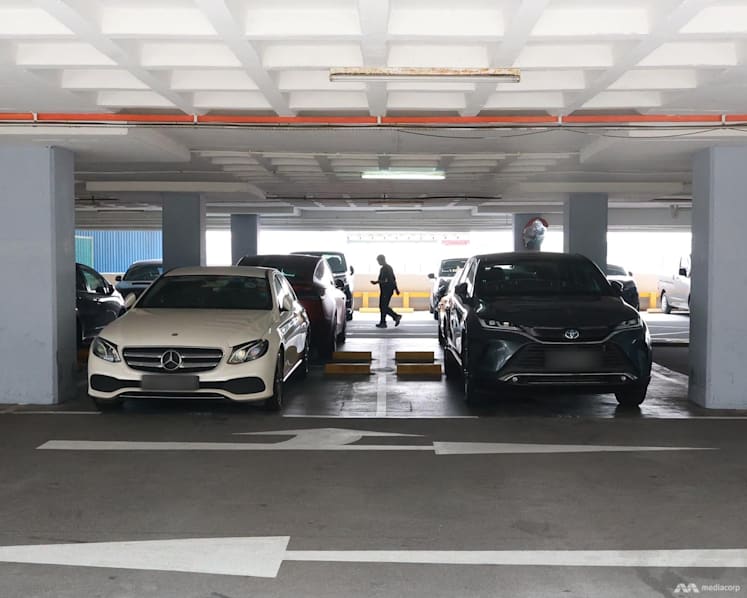
Some older developments have sought to create more room for motorists by reconfiguring their parking spaces.
Katong Shopping Centre, which was built in 1971, has redrawn some of its parking lots and turned spaces with three lots side-by-side into spaces that accommodate only two cars now.
When CNA visited the building, it found the original markings remained faintly visible alongside the newer ones.
CNA contacted Katong Shopping Centre seeking to ask when and why the lots were redrawn, how their dimensions had changed and whether the move reduced the overall number of parking spaces, but calls to the management went unanswered.
Similar changes have also been made to the parking layout at Orchard Rendezvous Hotel.
The hotel, however, said it did not have the historical information needed to establish exactly what changes had been made, including the dimensions of the lots before and after. It declined to comment further, saying it did not want to provide information that could be incomplete or inaccurate.
Beyond changes made by individual developments, LTA said it regularly reviews its standards for parking layouts.
These reviews include design simulations that take into account vehicle dimensions and manoeuvring requirements, as well as the space needed for drivers and passengers to get in and out of their vehicles.
For Ms Loo, who has learnt to take her time navigating the Pandan Valley car park after damaging her car there, motorists also have a responsibility to be careful.
"Can it be avoided? Absolutely," she said. "But I think a functional car park should not cause so much stress and anxiety for anyone."
KioskNews shows a cleaned-up reading view extracted from the publisher’s page — the original always lives on their site, not ours.