How to vote in Israel: A guide for the first-time voter ahead of the Knesset elections - explainer

Voting in Israel can mean navigating unfamiliar party names, ballot slips marked in Hebrew, and rules about where to vote.
From finding your assigned polling station to stepping behind the voting screen, here’s what you need to know before you cast your ballot on October 27.
Who can vote in Israel’s election?
Israeli citizens who are 18 or older on election day and appear in the electoral register can vote in Knesset elections. A criminal conviction or imprisonment does not itself remove an eligible citizen’s right to vote; Israeli election law provides voting arrangements for prisoners and detainees.
In Israel, you do not register to vote, as the electoral register is compiled from the Population Registry. This also applies to new immigrants, whose eligibility depends on their citizenship and registration details being recorded by the applicable cutoff.
If you recently made aliyah, check that you appear in the electoral register rather than assuming your new identity card alone guarantees you can vote in the upcoming election.
Where do I vote?
Polling stations will be erected on October 27 across the country, and, for soldiers serving in Gaza or Lebanon, early booths will be established at pre-approved sites guarded by military personnel beginning on October 20.
Soldiers deployed in Gaza and Lebanon should refer to their unit commanders to be informed of the locations of their polling stations and their designated voting times.
For soldiers serving within Israel, military polling stations will operate on election day from 8 a.m. to 10 p.m. Military bases will have fixed polling stations, though mobile stations will travel to soldiers stationed at outposts, protecting communities, conducting training exercises, or participating in various operational activities.
Soldiers should contact their unit’s election officer for information about voting hours at their location.
Soldiers may vote at either a civilian or military polling station, but they may vote only once, as voting multiple times is a criminal offense.
Civilians should refer to the government’s electoral register to determine the location of their polling station.
Voters with limited mobility whose assigned polling station is inaccessible can vote at any station designated a ‘special accessible polling station,’ which can be located on the Central Elections Committee’s list. Polling stations will also operate in designated hospitals, allowing eligible hospitalized patients to vote after presenting identification and a voting authorization issued by the hospital. Patients admitted to a day hospitalization department on election day are excluded.
What should I bring?
Bring your Israeli identity card, a valid Israeli passport, or a valid Israeli driver’s license bearing your photograph. Soldiers in regular or career service may also use a valid military identity card.
An expired Israeli identity card is accepted for voting, the Population and Immigration Authority has clarified. Passports and driver’s licenses, however, must be valid. Make sure the photo lets polling station staff identify you.

When can I vote?
Most polling stations open at 7 a.m. and close at 10 p.m. on election day. In small communities with no more than 350 eligible voters, polling hours are shorter: 8 a.m. to 8 p.m. Hospital, prison, and nursing home polling stations also generally operate from 8 a.m. to 8 p.m. gov.il
Check the Central Elections Committee’s guidance before heading out. Anyone voting at a hospital or another institution should also check the notices posted there for the station’s specific opening hours. gov.il
If you arrive before your station’s closing time, you are entitled to vote even if the queue delays your turn until afterward.
What happens inside the voting booth?
When you enter the polling station, present your ID to the polling committee, who will confirm your identity, find your name on the station’s voter list, and hand you an official light blue voting envelope.
The voting process is completely analog. The voter takes their envelope behind a screen for complete privacy, chooses the paper slip of the list they want to support, places it inside the envelope, and seals it before leaving the booth.
The voter then steps out from behind the screen and places the sealed envelope in the ballot box in front of the polling committee.
Your vote is entirely secret: No one is permitted to follow you behind the screen, and you do not need to show anyone which slip you chose.
How do I pick the right slip?
In Israel, voters elect a party list, rather than directly choosing the prime minister.
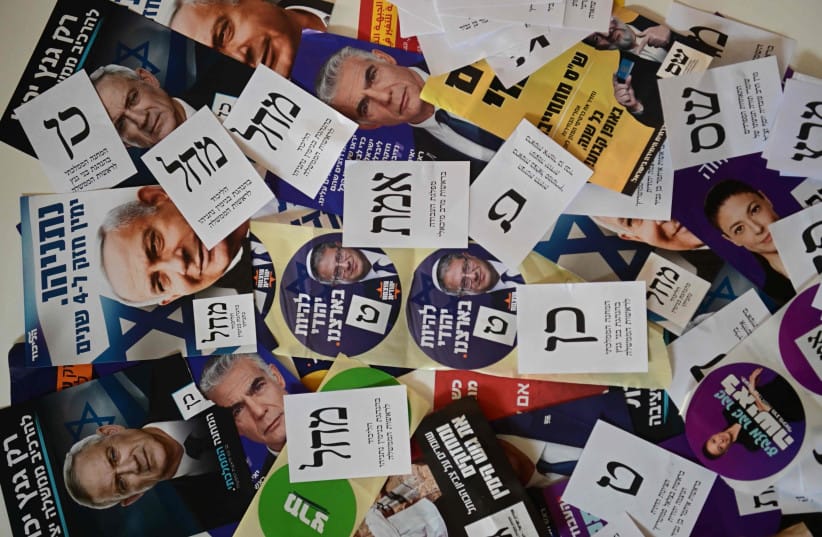
Inside the voting booth, voters are faced with a variety of paper slips, with each party represented by one to three Hebrew letters. To avoid confusion, voters should be aware of what each slip represents before selecting it.

What could invalidate my vote?
Place only one ballot slip for your chosen party list in the official envelope supplied by the polling committee. Slips for different lists in the same envelope invalidate the vote, as do four or more identical slips. Two or three identical slips are accepted, but count as only one vote.
Any mark that could identify a voter will also invalidate a vote, as will using an outside envelope rather than the official one provided at the station.
Blank slips serve a specific purpose: a voter can write the identifying letter(s) of their chosen list on one, add its official name, and nothing else, in Hebrew or Arabic.
What happens to my vote afterward?
After the nation has voted and the polling stations close, the counting begins to distribute the 120 Knesset seats.
To enter the Knesset, a party's list must receive at least 3.25% of all valid votes. Lists below that threshold receive no seats, and their votes are excluded from the seat-allocation calculation.
The Knesset’s 120 seats are divided proportionally among the qualifying lists, with a formula allocating the remaining seats after the initial calculation.
After the election, the president consults representatives of the elected parties and assigns a Knesset member the form a government. The largest party’s leader does not automatically become prime minister: The outcome depends on assembling a government that can win the Knesset’s confidence.
KioskNews shows a cleaned-up reading view extracted from the publisher’s page — the original always lives on their site, not ours.