Nvidia faces defining test as Jensen Huang probe adds to chip stock turbulence
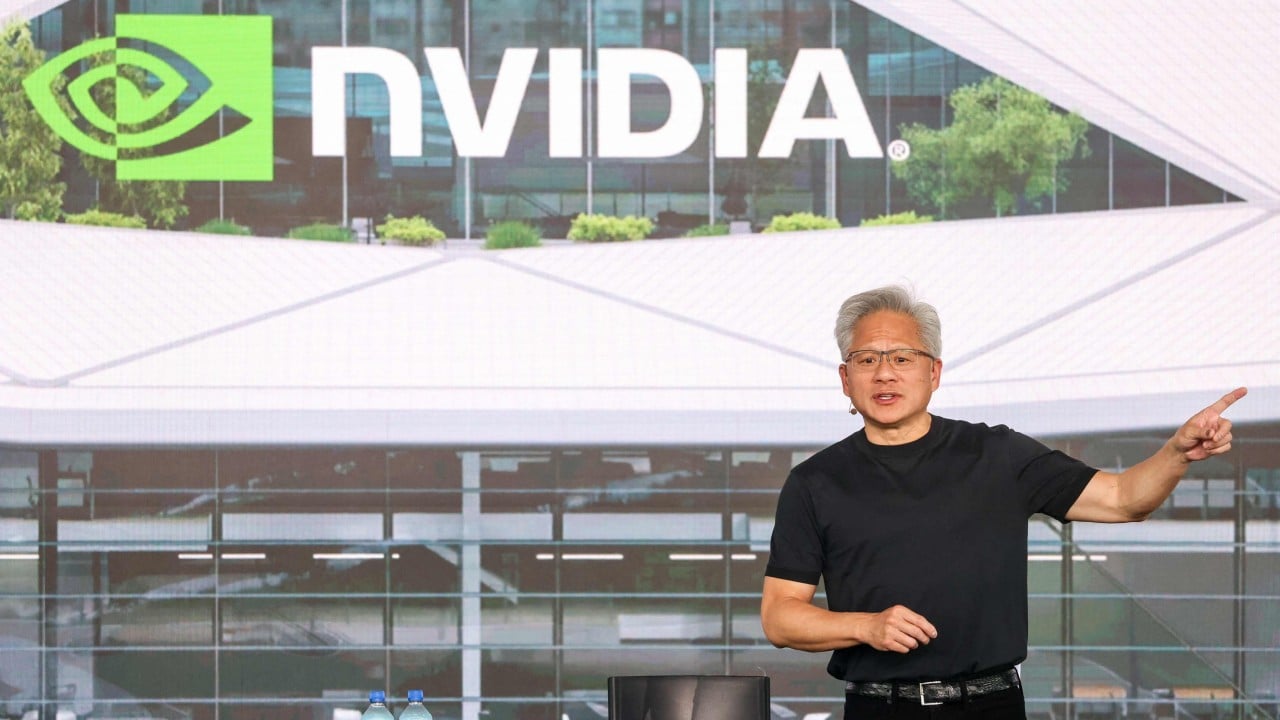
Nvidia is facing an unprecedented valuation test as a board inquiry into CEO Jensen Huang exposes the US chipmaker to a rare key-person risk, while investors also weigh the midterm elections’ potential impact on Washington’s chip controls and AI regulation.
The company’s shares fluctuated in pre-market trading in the United States, sliding more than 5 per cent, following Huang’s bombshell confirmation over the weekend that he had been unfaithful to his wife and would cooperate with an investigation into his conduct.
The probe has added to the turbulence facing the world’s largest chipmaker, whose shares endured a roller-coaster end to last week, tumbling 9.3 per cent on Thursday before rebounding 2.8 per cent on Friday.
The sudden convergence of shocks has also fuelled a counter-rally in Chinese alternatives, with shares of domestic chip designers surging in Shanghai on Monday on expectations that tightening US chip curbs could accelerate Beijing’s semiconductor self-reliance drive.
Cambricon Technologies and MetaX Integrated Circuits closed up 6.02 per cent and 5.66 per cent, respectively, while Enflame Technology soared 17.26 per cent.
The leadership scrutiny strikes at a vulnerable point for investors accustomed to Huang’s central role in Nvidia’s meteoric ascent. “Investors tend to struggle to price in key-person and governance issues,” former Pimco CEO Mohamed El-Erian wrote in a social media post, pointing to Nvidia’s weight in global financial markets and the tech sector.
In a statement published on Sunday US time, Huang said he had been unfaithful to his wife and would cooperate fully with the independent inquiry, which was opened after reports surfaced that he had been targeted by a foreign intelligence operation.
Nvidia’s board expressed confidence in the CEO, saying it had no reason to believe that US national security or trade secrets had been compromised.
Compounding the turmoil are rising concerns over data-centre bottlenecks following last week’s US midterm elections. Democrats captured both chambers of Congress and flipped the governorship in Texas, a key hub for domestic AI infrastructure.
Texas Governor-elect Gina Hinojosa campaigned on pausing approvals for new data centre facilities until state lawmakers enact community-protection measures.
Wall Street has already begun pricing in infrastructure delays. In a client note on Sunday, Morgan Stanley analysts projected that 5 gigawatts of US data centre capacity originally forecast to come online in 2028 – about one-fifth of the total for that year – could be pushed to 2029 instead, citing likely postponements in Texas and Ohio.
At the same time, pressure is mounting in Washington to close loopholes in advanced semiconductor export-control regimes. Democratic Senator Elizabeth Warren said on CBS News on Sunday that there was bipartisan support on the Senate Banking Committee to enforce stricter curbs on chip shipments to China.
Chris McGuire, a former National Security Council official and senior fellow at the Council on Foreign Relations, also urged the US Department of Commerce to tighten export controls, arguing that existing regulations must be applied more rigorously to shipments routed through intermediaries in third-party jurisdictions.
Concerns over chip diversion have followed Nvidia for months. Culper Research, which disclosed a short position in the chipmaker in May, alleged that over 20 per cent of Nvidia’s compute revenue in its last financial year came from hidden Chinese demand routed through Southeast Asian intermediaries, including Singapore-based Megaspeed.
The New York Times reported in October that US officials had concluded Alice Huang, a former Megaspeed executive close to Jensen Huang, was passing information to Beijing.
Nvidia previously said that internal reviews found no evidence of Megaspeed diverting chips to China. Megaspeed and the Singapore authorities did not immediately respond to requests for comment from the South China Morning Post.
Beijing dismissed the allegations on Monday. “The ‘Chinese spy’ allegation is purely unsubstantiated and directed at smearing China,” Chinese foreign ministry spokesman Guo Jiakun told a regular press briefing.
Nvidia, whose guidance for its October quarter assumed no data centre compute revenue from China, is scheduled to report its third-quarter earnings on November 17. The chairs of three US House committees have asked Huang to brief them behind closed doors on November 18.
KioskNews shows a cleaned-up reading view extracted from the publisher’s page — the original always lives on their site, not ours.