Coastal erosion in England has claimed at least 183 homes in past 16 years
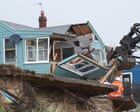
Seaside communities along the east coast of England have lost at least 183 homes to coastal erosion and landslides over the past 16 years, figures obtained by the Guardian reveal.
After councils judged properties across the Yorkshire and East Anglian coasts too vulnerable to remain safely occupied, the homes were proactively demolished.
The demolitions cost £1.1m, with the Environment Agency contributing about £482,000 towards clearing 61 homes at risk of collapsing and the rest paid for by councils and at times by homeowners themselves.
Coastal erosion is the gradual wearing away and retreat of the sea shoreline, which can destabilise cliffs and eventually force homes and infrastructure to be demolished before they collapse. While it is a natural process, scientists said the climate crisis was accelerating the retreat of the UK’s shores.
The Guardian requested data from nine councils noted in a House of Commons environment, food and rural affairs committee (EFRA) report as being some of the most vulnerable to coastal erosion.
East Riding of Yorkshire council, which includes vulnerable communities in Skipsea, Aldbrough and Mappleton, has demolished 66 homes since 2010 – the most of these nine local authorities.
Great Yarmouth borough council (GYBC) has demolished 64 homes since 2010, with all the houses located in the village of Hemsby. Since December 2025, the council has removed 41 properties in the seaside resort.
A GYBC spokesperson said: “Last winter, the dunes in Hemsby saw about 50% of the erosion predicted for the entirety of the next 30 years. More than 10 metres of land was lost in just over 12 months.
“Council staff continue to liaise with people to make sure residents and the public are safe and work closely with people to offer support and advice and explain the options available.”
North Norfolk council has proactively demolished 21 homes over the same period.
East Suffolk council, which only held data for the past six years, recorded a sharp rise in demolitions last year. Eight homes were demolished between 2020 and 2024, and 16 between May last year and April this year.
Most of East Suffolk’s homes demolished this year are understood to be in Thorpeness. Hilary Lightfoot’s home, in which she lived and raised a family for 20 years, was demolished this year. “I’ve lost £650,000 – that was what my flat was worth,” she said. “I’ve had to dig into my pension savings to buy a house, of which I still owe money on. I’ve borrowed money. It’s just disastrous.”
The Environment Agency estimates that 3,500 properties in England are at risk from coastal erosion by 2055, increasing to more than 10,000 properties by 2105.
More than 6 miles (10km) of major roads, 107 miles of minor roads and 3.5 miles of railway – many serving small, coastal communities – are also at risk from erosion over the next 80 years, according to the EA.
Unlike flood damage, which can be covered by the Flood Re scheme, there is no UK insurance product for coastal erosion because insurers treat coastal retreat as a “virtual certainty” for some seaside homes rather than an accidental risk, according to the EFRA committee’s report.
East Suffolk council said that although some government funding was available towards demolition, “there are currently limited mechanisms to support the wider costs of adaptation and relocation” for residents.
The authority said it had invested about £1.5m in short-term measures designed to slow erosion and give residents more time to prepare, while also testing new approaches through the government’s flood and coastal innovation programme.
after newsletter promotion
Sophie Day, senior research associate at the University of East Anglia, said because the east coast was made up of “very sandy, gravelly, silty material”, it was more vulnerable to erosion.
She said wetter winters, made more likely by the climate crisis, would saturate and destabilise soft cliffs such as those on the east coast, while increased storminess and rising sea levels would worsen the impact of high tides and leave beaches with less time to recover between storms.
While councils have increased spending on sea defences over the decades, Day said these protections have created an “illusion of permanence” for what is an accelerating issue. The scale of the threat from coastal erosion meant “we are going to have to shift to more of an acceptance of not intervening any more and enabling retreat”, she added.
Day said adapting to a retreating coastline meant planning for the loss of homes and infrastructure before the next emergency, while working more closely with communities.
“Having skilled people who are able to engage, who have the time, the training, the skills, to go and sit at somebody’s kitchen table and talk to them about the fact that, in a year, even five months’ time, their home may not be livable. What are the options? How can we find ways of giving people choices and support?”
North Norfolk district council (NNDC) said: “Households in all 21 homes were supported by NNDC. Nineteen of these properties were proactively demolished before they reached the cliff edge and became an emergency.
“NNDC continues to work with the Environment Agency and Defra … to better prepare communities. A number of pilot opportunities are under development. It is hoped that through this work, more targeted support for those impacted can become part of the business as usual and supported by government for the whole coast into the future.”
A spokesperson for East Riding council said: “East Riding of Yorkshire has some of the fastest eroding coastlines in Europe, resulting in the loss of homes, businesses and roads. Through the Changing Coasts East Riding project, the council is working directly with residents, businesses and communities to find out the full economic, environmental and social impacts of these losses.”
An Environment Agency spokesperson said it was “very aware” of how erosion was affecting coastal homeowners and communities.
They said: “While local authorities are best placed to support affected residents, we’re backing them with £36m for coastal erosion adaptation pilots, slashing planning regulation red tape in vulnerable areas and offering £10,000 grants to fund the safe demolition of affected properties – with scope to go further for more complex jobs.”
KioskNews shows a cleaned-up reading view extracted from the publisher’s page — the original always lives on their site, not ours.