Here’s your guide to fare hikes for jeepneys, buses and other public utility vehicles
Already have Rappler+?
to listen to groundbreaking journalism.

ROAD. Traditional jeepneys ply their routes in Manila to Quezon City, on March 16, 2026. The Land Transportation Franchising and Regulatory Board has approved fare hikes for jeepneys and will announce the amount of the increase on March 17.
Rappler
The fare increases were originally set in March but were suspended by President Ferdinand Marcos Jr. amid the conflict in the Middle East, which drove up global oil prices
AT A GLANCE
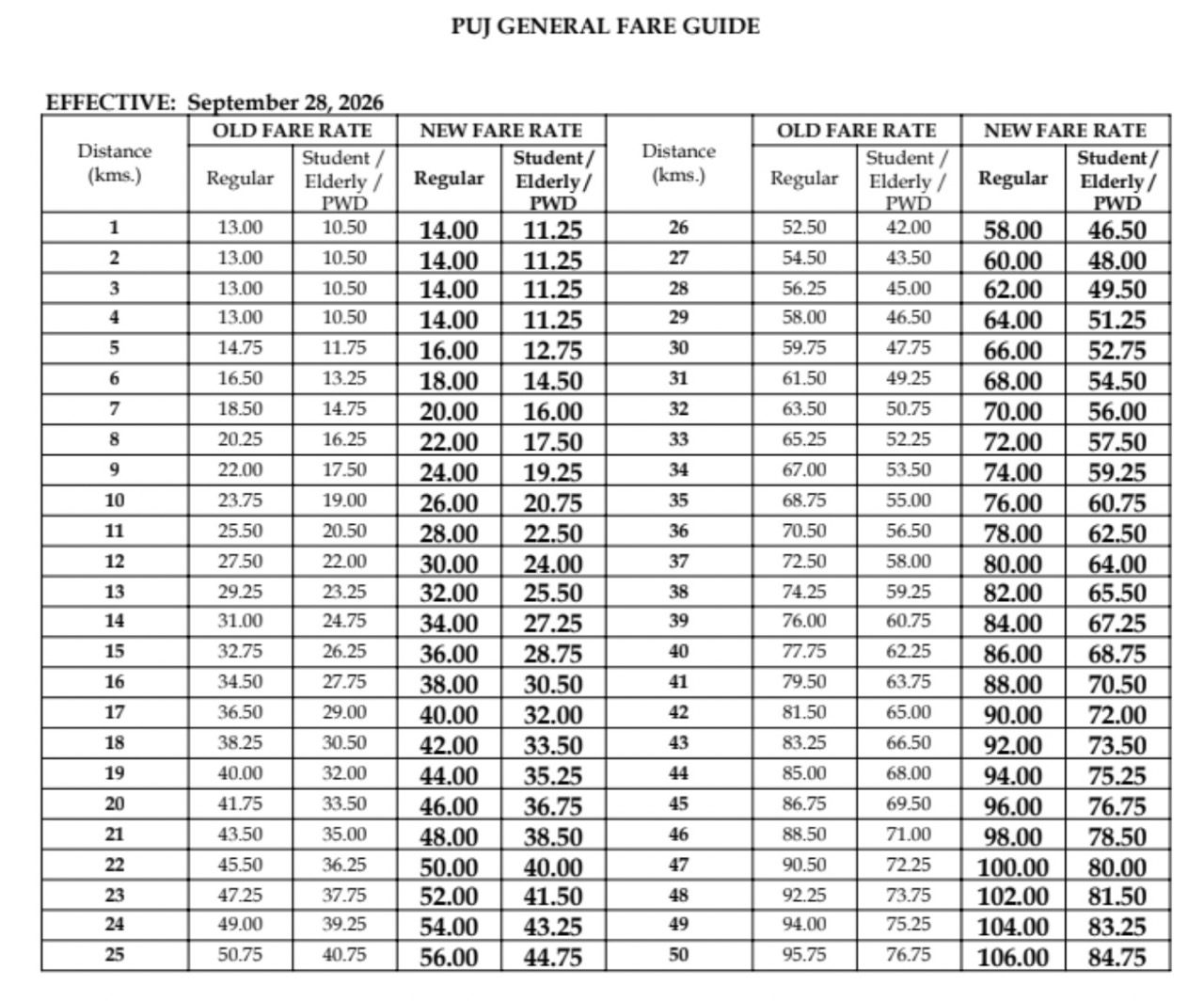
- Starting September 28, commuters in the Philippines will face higher fares for public utility vehicles (PUVs) as the Department of Transportation lifted the suspension on previously approved fare increases.
- The minimum fare for jeepneys has increased from P13 to P14, while modern jeepneys now charge a minimum of P17, and bus fares have also been adjusted with ordinary buses starting at P15 for the first 5 kilometers.
- Ride-hailing services have seen a base fare increase of P20 across all vehicle types, with significant percentage increases for various car types, and taxi flag-down rates have also risen.
This is AI-generated. Read the article for full context. Report any errors.
MANILA, Philippines – Commuters will pay higher fares for public utility vehicles (PUVs) starting Monday, September 28, after the Department of Transportation (DOTr) lifted the suspension on fare increases approved by the Land Transportation Franchising and Regulatory Board (LTFRB).
The fare increases were originally set to take effect in March but were suspended by President Ferdinand Marcos Jr. amid the conflict in the Middle East, which drove up global oil prices.
Public utility jeepneys
The minimum fare for jeepneys increased from P13 to P14. The rate for each succeeding kilometer rose to P2 from P1.80.
For modern jeepneys, the minimum fare is now P17 from P15. The rate per succeeding kilometer also went up to P2.40 from P2.20.
Bus fare
The new bus fare structure for Metro Manila is listed as follows:
- Ordinary buses: P15 for the first 5 kilometers, plus P2.49 for every succeeding kilometer
- Airconditioned buses: P18 for the first 5 kilometers, plus P2.98 for every succeeding kilometer.
For provincial buses, the first 5 kilometers on ordinary buses will cost P12. The succeeding-kilometer rates are:
- Ordinary: P2.20
- Airconditioned: P2.45
- Deluxe: P2.60
- Super deluxe: P2.70
- Luxury: P3.35
Ride-hailing cars
The base fare for ride-hailing cars or transportation network vehicle services (TNVS) increased by P20 across all vehicle types. Here’s a comparison of the old and new base fare:
| Type of car | Base fare (before) | Base fare (effective September 28, 2026) |
| Sedan | P45 | P65 (44% increase) |
| AUV/SUV | P55 | P75 (36% increase) |
| Hatchback | P35 | P55 (57% increase) |
| Premium | P145 | P165 (13% increase) |
The rate per kilometer remains at P15, with no additional charge for fractional distances.
Point-to-point (P2P) buses
P2P bus fares increased by 15% from the existing rates, depending on the route.
Taxis and UV Express vehicles
For UV Express, the provisional increase is listed as follows:
- Traditional UV Express: P2.60 per kilometer for traditional UV Express
- Modern UV Express: P3 per kilometer
The flag-down rates for taxis will also increase depending on the type of taxi, as listed below:
- Regular taxis: P65
- Premium Silver Taxi Service: P80
- Premium Gold Taxi Service: P95
The flag-down rate for airport taxis, meanwhile, increased by P40, or 53%, from P75 to P115 for the first 500 meters.
There will be no changes to the rates for every succeeding 300 meters or each two-minute waiting period.
The fare increases come after different bus operators in the country appealed to the Marcos administration. – Rappler.com
KioskNews shows a cleaned-up reading view extracted from the publisher’s page — the original always lives on their site, not ours.