Ontario hospitals owed private banks $70 million last year — and one wasn’t sure it could even keep operating
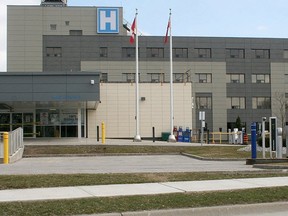
Ontario hospitals, forced to borrow privately in order to keep the lights on, owed banks more than $70 million in operating loans by the end of fiscal year 2025-26, according to hospital financial statements.
Sign In or Create an Account
With 80 of the 129 Ontario hospital networks posting operating deficits last year, at least $1.45 million in public health-care dollars went to bank interest payments from just eight hospital networks, the Investigative Journalism Bureau found.
Niagara Health, for instance, paid about $549,000 in interest on operating loans, said the organization’s spokesperson, Erica Bajer. The Huron Perth Healthcare Alliance in southwestern Ontario paid $346,000 in interest on its operating borrowings, according to spokesperson Gerry Rucchin. CEO Andrew Williams said the institution continues “to focus on minimizing debt servicing costs wherever possible” while focusing on patient care.

Get a dash of perspective along with the trending news of the day in a very readable format.
By signing up you consent to receive the above newsletter from Postmedia Network Inc.
A welcome email is on its way. If you don't see it, please check your junk folder.
The next issue of NP Posted will soon be in your inbox.
We encountered an issue signing you up. Please try again
Strathroy Middlesex Hospital, west of London, Ont., expressed concern in its financial statement about its ability to even continue operating.
And 12 Ontario hospital networks, including Scarborough Health Network, North York General Hospital and The Ottawa Hospital collectively increased their borrowing capacity from the previous year by close to $460 million, according to financial statements.
“The only way for them (hospitals) to survive is to borrow money … That’s totally unsustainable,” said Michel Grignon, a health economist at McMaster University in Hamilton. “It doesn’t make any sense that taxpayers would simply line the pockets of banks, that’s absolutely not the way it was supposed to work.”
The need to increase borrowing capacity last year is a “sign hospitals have been cut to the bone,” he said.
Neither the Ontario Ministry of Health, Ontario Health nor Health Minister Sylvia Jones responded to questions about hospital bank borrowing or provincial funding.
It doesn't make any sense that taxpayers would simply line the pockets of banks, that's absolutely not the way it was supposed to work
The true value of interest paid on operating loans remains shrouded in secrecy, with some hospitals not disclosing this information in their financial statements. Some declined to provide it to the IJB when asked.
A hospital network spokesperson from Waterloo Regional Health Network said she’d been advised not to disclose the hospital’s borrowing details, adding “there is nothing that’s going to serve our purposes.”
Jennifer Lawrance, CEO of Red Lake Margaret Cornehour Memorial Hospital in northwestern Ontario, said she believes it is “ethically wrong that taxpayers should be paying interest” for hospital borrowing.
“I’m not suggesting that the hospitals who are borrowing are wrong in doing so,” she added. “They’re doing that to keep their doors open, because funding isn’t keeping up with the operational costs.”
One of the biggest percentage deficits recorded this year was from Anson General Hospital in northeastern Ontario, in Iroquois Falls, near Timmins, which finished the year in the red for the fourth consecutive time.
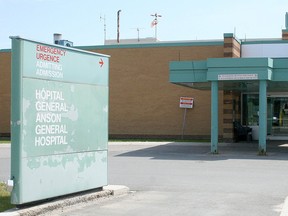
Asked if the hospital expects to find efficiencies that would return it to a balanced position, Paul Chatelain, CEO of the MIC Group, which includes Anson General Hospital, told the IJB, “We don’t have any fat to trim.”
“Our reserves are not keeping up, they’re almost depleted.”
Ontario law requires hospitals to plan for a balanced budget each year but the province can give special dispensation to end the year in the red. Financial records show the province can also provide one-time shortfall funding, including at least $325 million given to 30 hospital networks last fiscal year, according to the IJBs analysis of hospital financial statements.
The latest IJB findings come six months after the Ontario government pledged an additional $1.1 billion in funding for hospitals as part of its 2026 budget, up four per cent from the previous year. The Ontario Hospital Association says costs are increasing by six per cent a year, due to an aging population and inflation.
David McNeil, CEO of Health Sciences North, in the greater Sudbury region, told the IJB that his hospital had identified $18 million in savings over the past three years, mostly by reducing the use of private agencies to staff nurses.
Still, Health Sciences North, which had total revenues of close to $800 million last year, explicitly states in its financial statements the need to rely on “temporary financing through its existing credit facilities” in the short-term.
“We would prefer not to have to rely on lines of credit to sustain the operations of the hospital. That’s the fundamental piece and that’s what we’ve been struggling with as an industry,” McNeil told the IJB. “Efficiency itself is not going to be sufficient enough to close the gap between what hospitals need and what they’re spending today.”
McNeil said his hospital keeps the provincial health ministry “well informed” of its bank borrowing.

Variations in financial reporting across the province’s hospital sector make annual comparisons of indebtedness difficult to monitor.
A January IJB investigation found Ontario hospitals paid at least $4 million in interest on borrowing in the fiscal year 2024-2025. Nearly $2 million of that was paid by Hamilton Health Sciences.
This year, the hospital would not disclose any interest paid on its borrowing for 2025-2026.
Hamilton Health Sciences financial statements show it owed $40 million on its two operating lines of credits by fiscal year-end and intended to “rely on temporary financing through its existing credit facilities” in the short term.
Waterloo Regional Health Network (WRHN) owed close to $9 million on its operating line of credit in March 2026 and paid close to $1 million in interest on this line and its two operating loans. The hospital reported defaulting on its bank loans in its most recent financial statement.
The network’s spokesperson, Cassandra Easton, told the IJB the loans did not relate to operating borrowing, but declined to disclose how much interest the network paid on its borrowings to sustain daily operations, saying she’d “been advised not to provide anything further.” Easton declined to say who provided that directive.
In March, the hospital’s annual financial statement showed it was “in violation of the covenants” relating to several loans. The hospital network reached an agreement with the bank, which is not named in the financial statement, not to demand a repayment until April 2027.
“Access to credit is a common treasury management tool used by large healthcare organizations to support liquidity and maintain financial stability,” Easton said in an email, adding the hospital “maintains ongoing discussions” with the province about financial pressures.
Among the hospitals that increased their borrowing capacity from last year was the Ottawa Hospital (TOH), which increased its operating lines of credit to $120 million in 2026, up from $24 million in 2025.
“Having sufficient line of credit as a liquidity buffer is a standard industry best practice of managing financial risks actively and does not warrant any funding issues,” TOH spokesperson Michaela Schreiter said in an email.
“TOH recognizes the importance of minimizing the interest burden on taxpayers. Hence, the hospital manages its working capital prudently and draws on the line of credit only when needed,” she added. As of March 2026, it had not drawn on this line of credit.

Scarborough Health Network arranged for a new $120-million operating line of credit, and North York General Hospital took out a new $60-million loan to finance day-to-day operations, the financial records show.
In a response to questions, Scarborough Health Network spokesperson Leigh Duncan said it is “one of Ontario’s most efficient hospital systems,” and “continues to experience significant growth and demand pressures.”
“Any borrowing capacity available to the organization is a financial management tool that helps ensure continuity of operations and patient care while we work within existing funding structures,” Duncan said.
North York General Hospital did not respond to requests for comment.
Strathroy Middlesex General, which worried about its ability to operate, cited an accumulated deficit of over $24 million and an increased use of credit lines.
“As a result, there is material uncertainty that may cast significant doubt on the hospital’s ability to continue as a going concern,” read the hospital’s financial statements.
Julie McBrien, CEO of Middlesex Hospital Alliance, which Strathroy Middlesex General belongs to, declined to comment on the specifics of the hospital’s financials, but said the hospital system “continues to navigate significant system pressures while remaining focused on delivering safe, high-quality care.”
Len Brooks, professor emeritus of business ethics and accounting at the University of Toronto, told the IJB that hospitals borrowing from banks “is not unreasonable” given that the province itself operates in a deficit.
“There’s lots of good work that can be done if hospitals have funds in the short run, even if sourced from banks,” said Brooks. “It might be a very good thing for them from the perspective of patients.”
The problem, says Brooks, is when hospitals routinely cite chronic, structural deficits as reasons for borrowing, which means they are routinely spending more than they are taking in.
“That signals to the government that there’s something to watch for and to look into.”
Health-care workers say ongoing deficits are being felt across hospital floors.
Dr. Raghu Venugopal, an emergency physician who works across three Toronto hospitals, told reporters that despite the uptick in provincial funding, things are “worse than ever before.”
“Hospital budgets are literally the issue of life and death,” he says. “One of the markers that can’t lie is the number of hallway stretchers, and that’s just metastasized like cancer.”
Citing a lack of acute care beds, he said patients have died, “because we didn’t get to them and we didn’t do the medical work because there was nowhere to offload them.”
The Ontario Nurses’ Association has claimed that hospitals have cut more than 1,500 nursing positions since December 2025, attributing the cuts to underfunding. The province has not provided an official number.
“Letting go of those nurses means, of course, the quality of care is going to decrease,” said health economist Grignon. “This is going to translate into more adverse events. It is going to translate into patients not being taken care of in a timely manner.”
The Investigative Journalism Bureau (IJB) at the University of Toronto’s Dalla Lana School of Public Health is a collaborative investigative newsroom supported by Postmedia that partners with academics, researchers and journalists while training the next generation of investigative reporters.
Our website is the place for the latest breaking news, exclusive scoops, longreads and provocative commentary. Please bookmark nationalpost.com and sign up for our daily newsletter, Posted, here.
Join the Conversation
This website uses cookies to personalize your content (including ads), and allows us to analyze our traffic. Read more about cookies here. By continuing to use our site, you agree to our Terms of Use and Privacy Policy.
KioskNews shows a cleaned-up reading view extracted from the publisher’s page — the original always lives on their site, not ours.