Israel killing Hamas officials will not lead to group's elimination, BoP source tells 'Post'
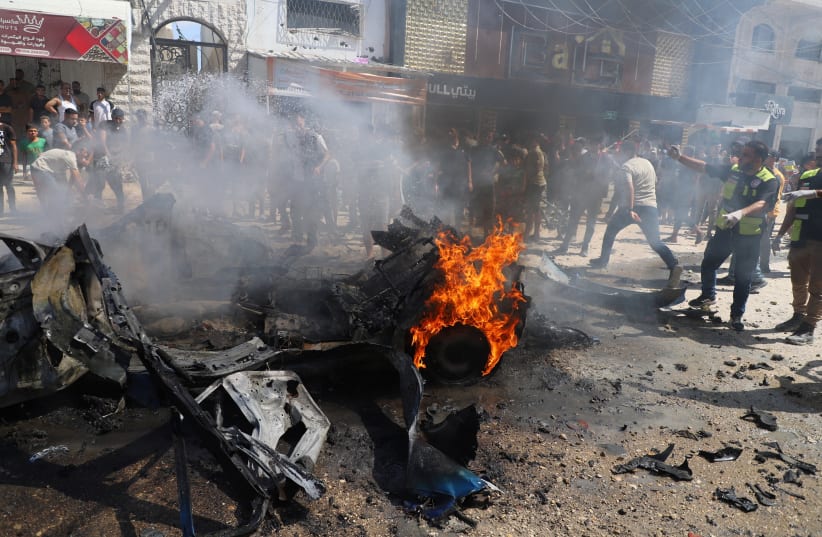
A source close to the Board of Peace has criticized Israel’s current policy in the Gaza Strip, arguing that while Israel’s targeted killings of Hamas operatives may be justified, the strategy will not ultimately lead to the dismantling of the terrorist organization.
“The government’s policy is targeted eliminations while leaving Hamas with its army and its rule,” the source told The Jerusalem Post. “The Board of Peace wants the complete dismantling and elimination of Hamas. Israel is eliminating individual Hamas members, but not Hamas itself.”
The comments come amid a dispute over how the next stage of the Gaza process should proceed following the July 30 agreement between Hamas and the Board of Peace on a framework for the group’s phased disarmament.
The agreement, announced by US President Donald Trump on July 30, calls for Hamas and other armed factions in Gaza to surrender their weapons as part of a broader process that would eventually see IDF troops withdraw and civilian and security responsibilities transferred to new Palestinian and international structures. An implementation mechanism was to be prepared during an initial 14-day period.
Agreement reached after months of negotiations
The agreement was reached following months of negotiations involving Hamas and the Board of Peace, with Qatar, Egypt, and Turkey playing roles in the mediation process.

Under the framework, the disarmament process would include an inventory and storage of weapons and the dismantling of the military capabilities of Hamas and other armed factions in Gaza. The process would be overseen through an international mechanism and linked to the broader transfer of governance and security responsibilities in the Strip.
Israel, however, has made clear that it does not accept the framework as currently formulated.
“Israel rejects the 15-point plan for Gaza. The IDF will not withdraw until Hamas is genuinely disarmed,” Prime Minister Benjamin Netanyahu said at a cabinet meeting in early August.
Against that backdrop, senior Board of Peace officials sought to persuade Israel to observe a 14-day period of calm to allow the disarmament process to begin. The proposal included an exception for what the Board described as “immediate threats.”
Israel initially appeared to observe that principle, although the government did not publicly endorse the arrangement.
Israel targets Hamas' terrorists, clashes with BoP officials
In recent weeks, however, Israel has resumed targeting Hamas operatives, including members accused by Israel of participating in the October 7 massacre, holding hostages, and serving in senior positions within the organization.
Israeli officials have argued that Hamas used the 'quiet period' in which Israel was limiting its strikes primarily to immediate threats to rebuild and strengthen its military capabilities, rather than prepare for the disarmament process envisioned by the Board of Peace.
The source close to the Board of Peace sharply disagreed with the Israeli approach, describing it as “a policy similar to the period before October 7.”
The Board of Peace, meanwhile, is presenting its proposal as an alternative to continued Israeli military operations: the complete dismantling of Hamas’s military infrastructure and an end to its rule in Gaza.
“The way to do this is 14 days of calm, apart from operations against immediate threats, and full cooperation by the government in all the preparatory and logistical steps for voluntary disarmament,” the source told the Post.
“If Hamas begins dismantling itself at a rapid pace and provides all the coordinates of the tunnels, that would be excellent,” the source said. “If it does not disarm, then the IDF receives international backing to do so by force.”
In recent weeks, the Israeli security establishment has reported a series of targeted killings and arrests of senior Hamas field commanders and members of the organization’s military and security apparatus.
Among the most prominent recent operations cited by Israeli officials was the killing of Naael Abu Obeid, identified as the commander of Hamas’s Rafah Brigade, alongside other field commanders at the battalion and Nukhba cell levels.
Israeli special forces also carried out a raid in Gaza City in which they captured Muin al-Arbid alive. He was identified as the head of Hamas’s General Security apparatus.
The Board of Peace source, however, argued that such operations, even when successful against individual commanders, do not by themselves resolve the broader issue of Hamas’s continued military and political presence in Gaza.
“The government’s policy is targeted eliminations while leaving Hamas with its army and its rule,” the source said.
The disagreement reflects a broader question facing the Gaza framework: whether disarmament can be achieved through a negotiated and internationally supervised process, or whether Israel will continue using military force to degrade Hamas’s capabilities until it is satisfied that the organization can no longer threaten Israel.
For the Board of Peace, the distinction is significant. Its framework is based on the assumption that Hamas’s military and governmental structures ultimately need to be dismantled as part of a transition to a new governing and security system in Gaza. The organization has described its broader role as promoting stability, lawful governance, and reconstruction in Gaza.
For Israel, however, the concern is that any prolonged pause in military operations could give Hamas an opportunity to recover and reorganize.
KioskNews shows a cleaned-up reading view extracted from the publisher’s page — the original always lives on their site, not ours.