Researchers on mission to improve heat illness data at A&Es in Singapore
SINGAPORE - The island-state’s blazing heat is inescapable, but symptoms of heat-related illnesses can be similar to other diseases, and may often be misdiagnosed at the emergency room.
For example, a patient with fever, low blood pressure or confusion may initially be suspected of having an infection or sepsis, or blood poisoning, rather than a heat-related illness.
This could result in an underreporting of heat illnesses and give an inaccurate picture of the prevalence of heat-related illnesses in a population, and how it drives other diseases.
As Singapore prepares for hotter weather, a senior consultant from Singapore General Hospital’s Department of Emergency Medicine is working with 10 public hospitals’ emergency departments to better understand whether rising temperatures have resulted in more cases of serious heat illnesses here.
“The purpose is to establish a more systematic and consistent way of recognising, characterising and reporting heat-related illness across Singapore,” said SGH senior consultant Marcus Ong, who is also director of the Pre-hospital and Emergency Research Centre at the Duke-NUS Medical School.
Under the HEAT-MAP study, which ends in 2028, medical staff at the emergency rooms first identify patients with suspected heat-related illness. Symptoms include fainting, cramps, seizures and headaches.
They then collect relevant clinical data such as the patient’s core temperature, and record information about whether they were working strenuously in hot environments.
Clinical data can also include underlying medical conditions that make the patient more vulnerable to heat such as heart disease.
Medical staff may also order lab tests to understand the severity of organ injury associated with heat stress.
“By routinely asking about heat exposure and collecting information on symptoms and circumstances, we can better identify cases that might otherwise be overlooked,” said Ong.
Data from the study will serve as a starting point for future projections of Singapore’s risk of heat threats amid global warming.
The Ministry of Health (MOH) told The Straits Times that the number of heat-related illness cases at the emergency departments of all public hospitals here increased from 280 in 2024 to 398 in 2025. The years 2024 and 2025 were among the top 10 warmest years in Singapore.
The number of admissions rose from 69 cases in 2024 to 81 cases in 2025. Between 2021 and 2024, one heat-related death was recorded.
MOH did not reveal the types of heat illnesses, which can include heatstroke, heat exhaustion and severe muscle cramps.
HEAT-MAP also wants to look into how heat could have aggravated other conditions like heart disease and lung ailments.
A heat illness could also occur alongside an infection. And the sickest patients may be confused or unconscious and unable to tell medical staff that they spent time in a hot environment.
This issue is not isolated to Singapore. A multi-country study on heatstroke reporting practices – published in scientific journal Temperature in July – stated that heatstroke is often underdiagnosed because a patient may die with competing diagnoses such as a heart attack, stroke, infection or kidney failure.
Records are less likely to capture the larger number of deaths in which heat acts as a contributing factor rather than the direct cause, said the paper.
As part of Ong’s study, researchers from the NUS Yong Loo Lin School of Medicine will use the two-year dataset to identify high-risk groups that have been overlooked. They will also be using the information to forecast how the population could be affected by heat illnesses in the future.
Stepped-up cooling at hospitals, nursing homes
Meanwhile, several hospitals and residential homes have been taking more measures in recent years to protect patients during hotter, humid periods.
For example, hospitals under the National University Health System (NUHS), the National Healthcare Group and the KK Women’s and Children’s Hospital have installed additional portable fans and portable air-conditioning in subsidised wards.
Since 2014, NUHS has been progressively implementing pre-cool mechanical ventilation systems in subsidised wards. This involves cooling outdoor air before it enters non-air-conditioned wards, complementing ceiling fans.
NUHS did not reveal which hospitals this has been rolled out in, but said: “During periods of hot weather, cooling measures may be stepped up, including extending the operating hours of spot-cooling systems to help maintain a comfortable environment for patients, visitors and staff.”
Spot cooling refers to fan coil units used to provide additional cooling in specific areas where needed.
At Ang Mo Kio – Thye Hua Kwan Hospital, the air coolers in the wards include a misting function if temperatures rise.
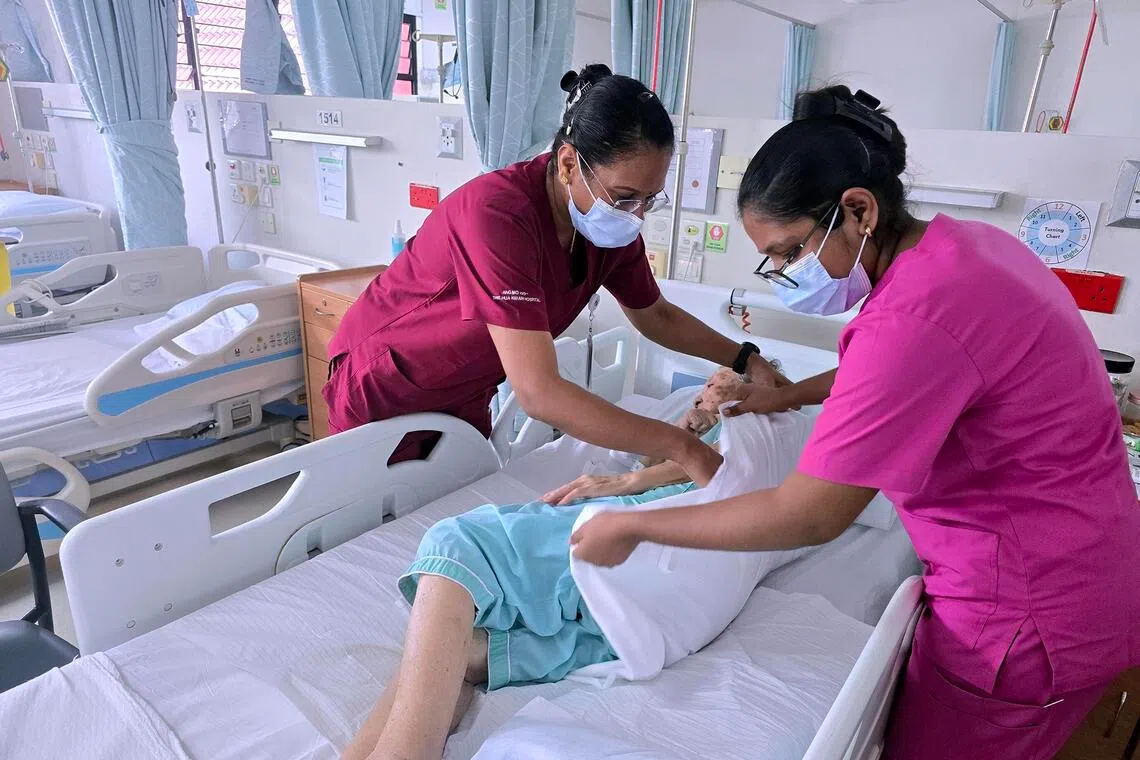
For bed-bound patients at Ang Mo Kio – Thye Hua Kwan Hospital, heat and moisture can increase the risk of skin irritation and problems around existing wounds. Regular repositioning, skin checks and changing of bedding and clothing are important.
PHOTO: ANG MO KIO - THYE HUA KWAN HOSPITAL
Like in some HDB blocks, the hospitals’ external walls are being coated with cool paint that reflects more sunlight and reduces heat absorbed by the building.
At hospitals and nursing homes, heat affects various patients differently, so medical staff have to take different precautions.
For example, bed-bound patients need to be checked more closely for heat rashes and bed sores, which can worsen with sweat. Patients with dementia may showcase their discomfort by being more agitated or withdrawn.
At the Thye Hua Kwan nursing homes, residents with chronic conditions such as lung or heart disease may have lower oxygen saturation levels, and shortness of breath when it gets hotter.
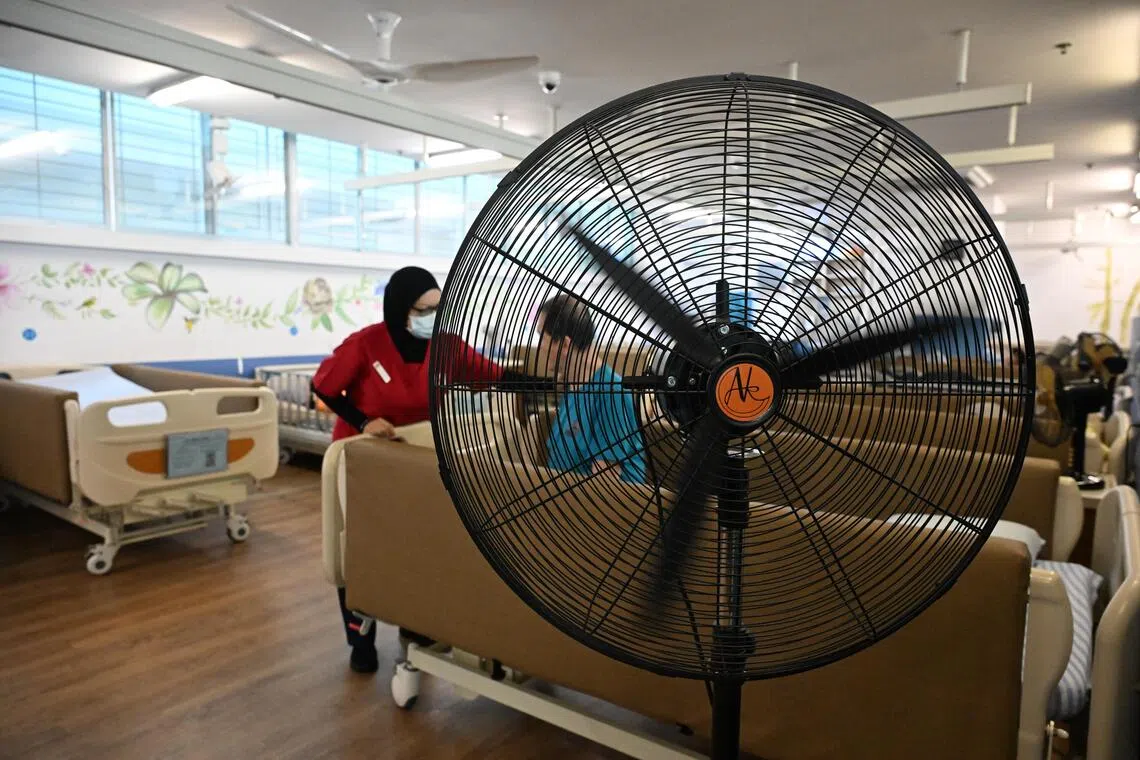
Wards at the Red Cross Home for the Disabled are equipped with industrial standing fans, alongside ceiling fans and air-conditioning.
ST PHOTO: AZMI ATHNI
At the Red Cross Home for the Disabled, “many have complex care needs, limited mobility and varying abilities to communicate discomfort or recognise that they are becoming overheated”, said the Singapore Red Cross’ assistant secretary-general of operations Charis Chan.
“Our approach is proactive rather than waiting for residents to show significant symptoms. Staff monitor residents’ hydration, skin condition, behaviour, general condition and comfort, and escalate any concerns for further assessment,” she added.
KioskNews shows a cleaned-up reading view extracted from the publisher’s page — the original always lives on their site, not ours.