LOCAL ELECTIONS 2026: MK support down as Zuma disappears from stump — new big poll
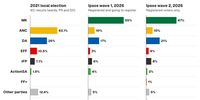
With its leader Jacob Zuma out of sight since early October, the uMkhonto Wesizwe party’s support in eThekwini has dropped by eight percentage points, according to the latest Ipsos poll released on Friday, 30 October, to 47% versus 55% in the first-wave Ipsos poll earlier this year.
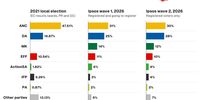
ANC support is down to its lowest, measured by the largest in-house survey of political opinion – down to 30% nationally; 27% in Johannesburg and just 10% in Durban.
“The party [ANC] dominated politics, Parliament and most of the local governments in the country. This year surveys are showing a continuing decline in support for the party and no party commands strong majority support,” says Ipsos director and political analyst Mari Harris.
Her latest survey, adjusted for registered voters, has the DA at a small majority (51%) in Cape Town – a number that aligns with most surveys but which will be determined by voter turnout. Now in its final squeeze, the blue party is campaigning against votes for small parties.
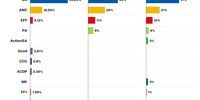
In Johannesburg, Ipsos has the DA leading the ANC (30% vs the ANC at 27%).
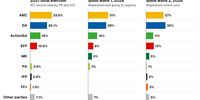
Three major stories of the election campaign’s surveys are the continued decline of the ANC, the growth of the DA (but not as high as it wants) and the growth of MK (but stunted by Zuma’s illness and shenanigans in the party). But the meta-narrative is of fragmentation – where 546 registered parties pose a conundrum for voters and push South Africa in the steadfast direction of a coalition country.
“Looking at the pre-election surveys conducted, we will probably have new coalition governments in most of the metropolitan municipalities after the elections, and there will be many local and district councils governed by coalitions,” says Harris.
The first Ipsos Pulse of the People survey for 2026 showed 42% support for the Government of National Unity (GNU), regarded as strong. South Africans want workable coalitions, says Harris.
“Currently, two-thirds of South Africans believe different political parties should also work together on local government and municipal levels.”
Capital gains and a final squeeze
In Tshwane, the DA is at 34% support to the ANC’s 31%, according to Ipsos, a figure that tallies with all polls thus far, as Paul Berkowitz reported here. The ANC has finally found its campaigning muscle and a fresh team has taken the steering wheel – the party is in its final surge with high visibility across the country. This could stem its losses.
“In past elections, the ANC always succeeded in making real inroads during the last few weeks of campaigning before an election – and we will have to see whether they succeed in mobilising the ‘surge’ again this time,” says Harris. DM
KioskNews shows a cleaned-up reading view extracted from the publisher’s page — the original always lives on their site, not ours.