The Yom Kippur War: How Israel missed the warning signs before the surprise attack - opinion

There was a faint whiff of uncertainty in the briefing by IDF chief of staff David Elazar hours after the surprise Yom Kippur attack by Egypt and Syria in 1973.
“This is the first time Israel is fighting a defensive war,” he told the cabinet. “We know how to do it from books, but we’ve never actually done it.”
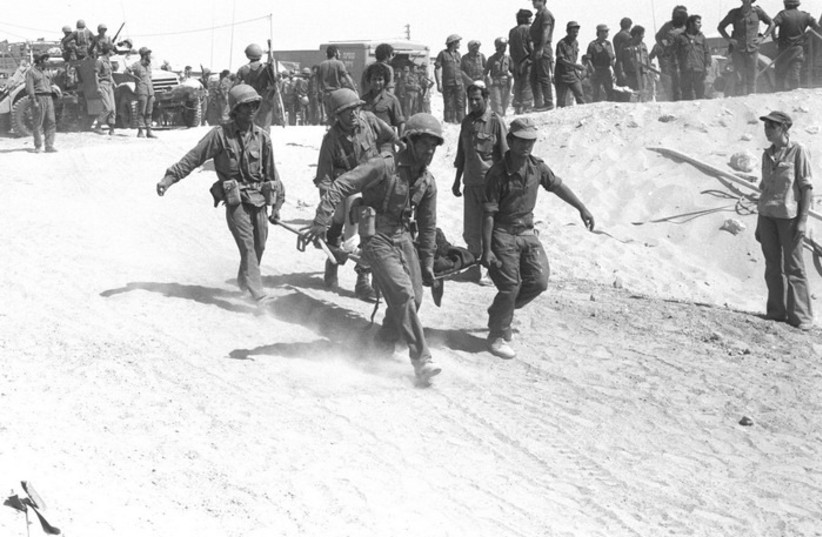
Five days later, in an assessment to defense minister Moshe Dayan, Elazar’s message was blunter. “We cannot win this war.”
Every day the army was destroying Egyptian tanks in Sinai but losing tanks as well and giving up territory. Where would it stop? What the country needed now, said Elazar, was a stable ceasefire that would enable it to rebuild the army “for 100 years.”
The Arab armies that attacked in 1973 bore little resemblance to the ones that were defeated so handily just six years before in the Six Day War. They had been retrained by more than 10,000 Soviet military advisers and rearmed with modern weapons, some of which Israel had not seen before.
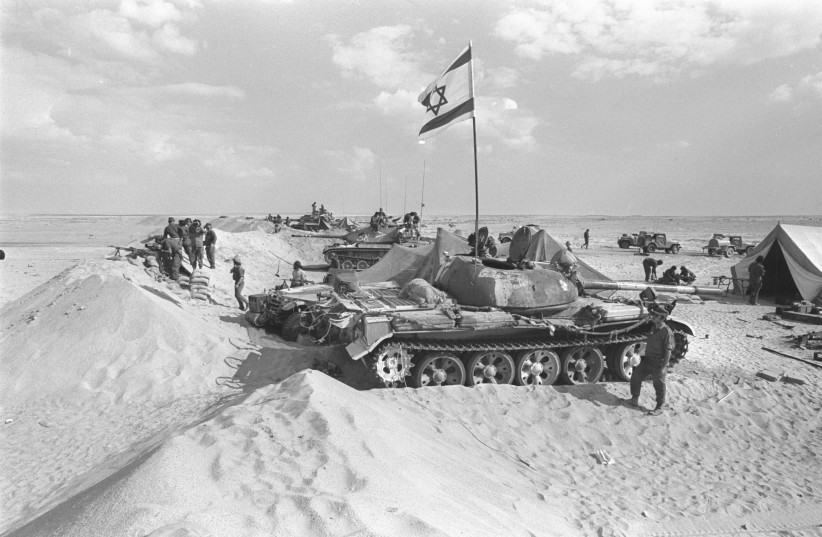
The compact Sagger anti-tank missile had turned their hitherto feeble infantry into a formidable challenge for Israel’s vaunted tank corps, and the SAM antiaircraft missile threatened, even negated, Israel’s air superiority over the battlefield.
No less important, the Arabs this time had a sagacious and daring leader in Egyptian president Anwar Sadat.
Israel’s major failure on the eve of the Yom Kippur War was self-inflicted and attributable to one person – Maj.-Gen. Eli Zeira. As head of the Military Intelligence Directorate (MID), he had permitted himself to cross the line between self-confidence and vanity.
In a similar crisis period half a year before, he was the only one on the General Staff to say there would be no war despite serious warning signs. He proved right but for the wrong reasons. He believed that Sadat did not want war because he feared its consequences.
Years later, it was learned that Sadat had stood down only at the request of Syrian president Hafez Assad, who was awaiting shipment of crucial armaments from the Soviet Union, including ground-to-air missiles.
Zeira’s seeming win, however, discouraged his superiors from challenging his judgment in the future.
In the week before Yom Kippur, thousands of Israeli troops on the front lines could see an unprecedented Arab deployment opposite them, but warnings were dismissed in the chain of command on the basis of Zeira’s bold low-danger-of-war assessment.
Reports from foreign intelligence sources (11 in September) likewise warned of serious Arab intentions to launch a war in the coming days.
Zeira continued to insist that the danger of war was low almost until the sirens sounded. Only in a death-bed interview last year (2025) at age 97 did he admit that he had been wrong.
Ironically, it was MID, during his tenure, that had come up with a device regarded as insurance for tracking any Arab decision to go to war.
In the spring of 1973, a helicopter carrying communication technicians and a commando escort flew at night into Egypt and landed near military communication hubs where the technicians inserted special taps which could be activated from Israel – reportedly from Zeira’s office. The phones being tapped were of Egyptian units that would be involved in war preparations.
The device came to be called Special Means. After tests confirmed that the taps worked, the device was shut down.
The intelligence failure that left Israel blind
AS TENSIONS built up in the week before Yom Kippur (which fell on October 6), Elazar twice asked Zeira if he had picked up anything relevant. Zeira gave Elazar to understand that the device was activated but not producing anything relevant. But the taps had not been activated. Zeira feared that activation risked exposure.
Col. Yoel Ben-Porat, head of the vital Signals Intelligence section which tapped electronic devices in the Arab world, asked for permission to mobilize 200 intelligence reservists, in view of rising tensions.
“Yoel, listen well,” said Zeira. “I don’t permit you to even think about mobilizing a fraction of a reservist. It is not intelligence’s job to drive the public crazy nor to undermine the economy.”
When the veteran intelligence officer then recommended activation of Special Means, Zeira refused.
“What do these resources exist for,” asked an exasperated Ben-Porat, “if not for situations like the one we’re facing?”
“The situations you see,” replied Zeira, “are not the ones that I see.”
Zeira had apparently not turned the device on because he was certain, as he had been in the spring, that Sadat saw war as too risky. To activate the device during this fraught period risked its discovery by the Egyptians.
Two days before Yom Kippur Dayan asked what the device was producing. Dayan could not be denied. The device was turned on for several hours, but the conversations picked up were banal.
After the war, the diary of an Egyptian soldier was found on the battlefield and turned over to intelligence analysts.
Sgt. Mahmoud Nadeh introduced himself in his fresh notebook on the shore of the Bitter Lake. “We’ll begin from the beginning. I serve as a sergeant in the armed forces. We’ll be going to war in the next few days. I’m 2.5 km. from the enemy. We’ve been told that we will be the first to cross the [Suez] Canal to free our lands and expel the enemy.”
He promised in the name of “historical truth” to keep an accurate account of events.
The notebook offered insight into the mind of a university-educated Egyptian soldier whose kind was now to be found in large numbers in the armed services alongside peasants and urban slum dwellers.
A third-year humanities student from Alexandria, he had been trained as a commando but was now attached to an amphibious armored unit that was to cross the Bitter Lake. “We are to proceed with all possible speed to the Mitla Pass after an artillery barrage of 50 minutes. I hope to emerge alive from the battle because I believe in God. There is a smile on everyone’s face, even my officer’s.”
Four days before Yom Kippur, Sgt. Yoram Krivine’s platoon took over Strongpoint 111 on the Golan ceasefire line. It was a routine rotation of units, but it struck the 21-year-old paratrooper that the soldiers being relieved seemed unusually happy about leaving. The dark basalt rocks of the igloo-like fort seemed stout enough to withstand even direct artillery hits.
The hillock on which 111 was situated offered a view across the rocky Syrian plain. Krivine could see countless artillery pieces, tanks and half-tracks nestling under camouflage netting. Opposite was Tel Kudne, a strong Syrian position on a volcanic cone. A hundred meters from 111 was one of the UN observation posts positioned along the ceasefire line.
The newcomers were briefed by an intelligence officer attached to the unit they were relieving. The officer identified the Syrian units they were facing.
“The whole Syrian Army is out there,” he said in conclusion. “I’m happy I won’t be here when the war starts.”
Warnings from the front lines
PRIME MINISTER Golda Meir’s contentious meeting with Austrian chancellor Bruno Kreisky about his decision to close down a transit camp for Jews from the Soviet Union on their way to Israel was still on her mind the next day, Wednesday, October 3, when she met with her senior military advisers.
“He didn’t even offer me a glass of water,” she said.
The meeting in the Prime Minister’s Office was described as a consultation by Moshe Dayan, who had requested it.
Though he was a military icon, Dayan related to the 75-year-old grandmother with the deference due her position.
There were reports, he said, that Egypt was bent on war, but the situation on the Syrian front was more troubling. The Syrians had deployed their most advanced SAM antiaircraft missiles not around Damascus, their capital, but covering the Golan.
“This is not a normal defensive deployment,” he noted.
If the Egyptians crossed the canal, Dayan said, they would find themselves in desert with Israeli tanks attacking them from every side. But the Syrians, with just one quick thrust, could hope to push Israel off the Golan and then be protected against counterattacks by the steep heights and the Jordan River below.
Zeira, who had called in sick, was represented by his deputy, Gen. Arye Shalev. On the Suez front, Shalev said, the Egyptian army was engaged in a large-scale military exercise.
“In my opinion,” said the MID officer, “on the basis of much material received in recent days, Egypt believes it is not yet ready to go to war. And if Egypt is not going to war, then neither is Syria.”
Elazar agreed. If Syria were thinking of attacking on its own, he said, Israel would know about it. “When a big machine begins moving, there will be leaks.”
Meir did not choose to challenge a roomful of generals counseling calm, but she remained uneasy.
Security concerns were no longer considered weighty enough by MID to be put on the agenda of the cabinet meeting scheduled for the next day, Thursday, October 4, to hear Meir’s report on her European trip. The government thus remained unaware that the possibility of war was being mooted in high places.
Nor would the bold Arab deployment be referred to at the General Staff meeting. The sole subject on its agenda – two days before Yom Kippur – was discipline, especially the need for soldiers to adhere to the military dress code.
So sanguine was the Israeli high command about the situation that no air photos of the Egyptian lines had been taken between September 25 and October 1, a week when large convoys were moving to the canal zone every night.
A scheduled photo mission on October 2 was canceled because of poor visibility. It was rescheduled for the next day, but when the plane returned, it was found that the camera shutter had failed to open. It would not be until the afternoon of the next day, Thursday, that the mission would finally be executed. It would take all night to process and analyze the photos.
Meanwhile, in Cairo, Sadat had summoned the Soviet ambassador, Vladimir Vinogradov, on October 3 to inform him that Egypt and Syria had decided to go to war against Israel in order to break the Middle East deadlock.
“What will the Soviet attitude be?” he asked.
The reply from Soviet leader Leonid Brezhnev was cool. The decision about war was for the Egyptian leadership alone to make, he said. No well wishes were offered for Arab success.
Brezhnev asked permission to land large passenger planes at an Egyptian airbase the next day to evacuate families of Soviet advisers.
Sadat did not like any part of that reply but did not make an issue of it.
Teams of Israeli photo interpreters combed through the films brought back by the reconnaissance plane all Thursday night, counting every tank and artillery piece. The photos showed a stunning Egyptian buildup the length of the canal.
“You can get a stroke just from the numbers,” said Dayan. “There are 1,100 artillery pieces compared to 802 eight days ago. You people don’t take the Arabs seriously enough.”
Elazar was still not certain there would be war and did not request mobilization, but he canceled all leaves; many frontline soldiers were scheduled to be released for Yom Kippur in the coming hours.
Leading a nation into war was not a role Meir had ever imagined for herself. But she was coping thus far with the steadiness that marked her long public career, picking up the nuances in what the military men were saying and asking relevant questions.
Responding to Meir’s closest adviser, minister Israel Galili, Elazar said he would not mobilize reserves unless there were further indications of war. Initiating mobilization could itself easily lead to escalation by the other side.
The warning that finally reached Israel
MOSSAD CHIEF Zvi Zamir was wakened at 2:30 a.m. in Tel Aviv by a call from his bureau chief, Freddy Eini, who informed him that his most important agent, Ashraf Marwan, wished to meet with Zamir in London the coming night.
Marwan was the son-in-law of former Egyptian president Gamal Abdel Nasser, and a prolific spy. Among other things, he had transmitted to Zamir a copy of Egypt’s plans for an initial attack on Israel. Zamir asked Eini to book a ticket for him on the earliest morning flight to London and arrange for security teams to accompany him on the flight and in London.
As he sat in bed mulling over the call, the phone rang again. This time it was Zeira, who rarely called him at home. He wanted to inform Zamir about the Soviets evacuating the families of their advisers and to know what Zamir made of it.
Zamir, in turn, told him of Marwan’s phone message and of his own plan to fly to London in the morning to meet him. He also told of the code word signaling war.
He didn’t want to wake Golda at this hour, so he asked Zeira to inform her of his trip in the morning. The two men disliked each other, whether for professional or personal reasons, but they managed to conduct this informative conversation civilly.
For Egyptian commanders, the absence of any sign that Israel might be aware of the coming attack was reason for either concern or comfort. Might the Israelis be planning a massive ambush? Or will they be totally surprised?
Toward midnight, scouting teams were sent across the canal at several points to report on any activity they saw. All returned before dawn with the same message: The Jews are sleeping.
One Jew wide awake was Zamir. In London, he was not fasting, and he had not heard a cantor singing the Kol Nidre prayer. But no Jew this Yom Kippur night was gripped by a greater sense of worldly portent than he was. He was meeting with Marwan in a private apartment.
“He [Sadat] is starting the war tomorrow,” said Marwan.
The attack plan was little changed from the one he had passed on to Zamir a few months before. First, an air attack on the Bar-Lev Line – 16 “forts” spaced along the eastern bank of the nearly 200-km.-long Suez Canal. Intensive shelling would follow. Then five infantry divisions would cross the canal in rubber boats, a crossing that would take two days to complete. They would establish two bridgeheads on the Sinai bank. Prefabricated pontoon bridges would then be lowered into the water and floated across.
After dark, commando units would be helicoptered deeper into Sinai to prepare ambushes for Israeli reserve units that would be on their way to the front within a day or two.
Once or twice, Marwan said he was sure that the situation was clear to the Israelis and that they were taking the necessary steps.
He sounded, in fact, like he wasn’t sure. “How can you people not see that this is war?”
The odd remark, Zamir reckoned, may have stemmed from something his sources in Cairo had told him, perhaps that Egypt was unaware of any Israeli countermeasures.
After the meeting, Zamir and Marwan’s case officer and their security detail walked 15 minutes to the apartment of the Mossad station chief in London. The Israeli Embassy was shut because of the holy day, and the only way to transmit his message – the most important Zamir would ever send – was by telephone.
Before leaving for London, he had arranged with his bureau chief, Eini, that he would compose his message as a bland, boring business letter with code words that would enable Eini to ferret out the meaning.
Zamir sat down at a table and asked for paper and a pencil. He then drafted the message about visitors who would be coming to Israel despite the holiday.
The hidden message Eini would reveal would be stunning – before the blast of the shofar marked the end of Yom Kippur this coming night, before the last invocation calling on God to open the gates of heaven and receive his people’s prayers, Israel would be at war on two fronts, with two thirds of the army – its reserves – still unmobilized.
The writer, a former reporter for The Jerusalem Post, is the author of The Yom Kippur War (Schocken), The Boats of Cherbourg (US Naval Institute Press), and The Battle for Jerusalem (Jewish Publication Society). His most recent book is Jerusalem on Earth (updated edition). abra@netvision.net.il
KioskNews shows a cleaned-up reading view extracted from the publisher’s page — the original always lives on their site, not ours.