Archaeologists discover lost temple to war god near abandoned Roman military fort in Germany

Alongside the temple’s remains, archaeologists found inscribed two votive stones, a statuette of the goddess Victoria, and additional statue fragments, at the site.
A temple dedicated to the Roman war god Mars was unearthed during excavations in Germany’s Taunus forest, the Hessian State Office for Monument Preservation announced in September.
The excavation team, led by archaeologist Dr. Kai Mückenberger and Excavation Director Manuel Pieper MA, uncovered the temple during its third excavation season at the site.
It is located near Kapersburg, one of the best-preserved Roman forts along the Upper German-Raetian Limes in Hesse. A Roman auxiliary unit, the Numerus Nidensium, was stationed there for about 150 years before abandoning the site during the Limesfall.
Alongside the temple’s remains, archaeologists found inscribed two votive stones, a statuette of the goddess Victoria, and additional statue fragments, at the site.
The discoveries provide additional insight into the presence of religion at the edge of the Roman empire.
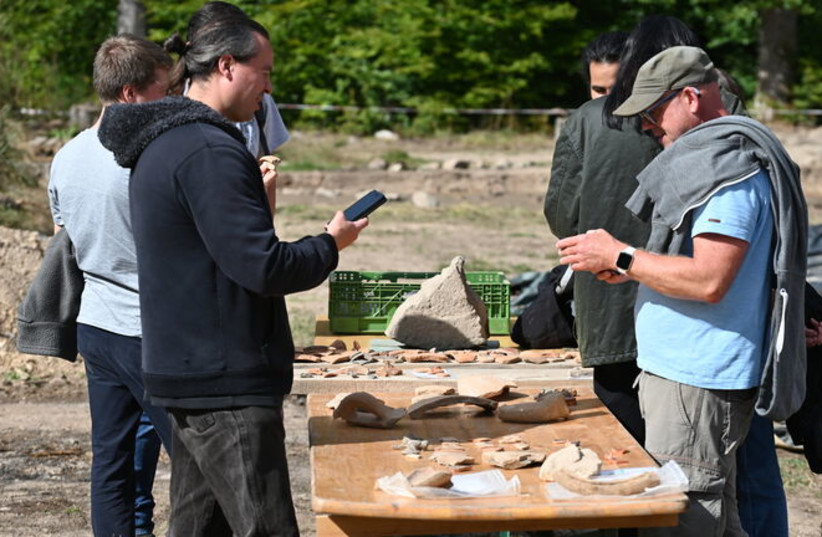
Researchers from the University of Frankfurt, led by by Prof. Dr. Markus Scholz, are analyzing the votive stones in attempt to parse their meaning. Scholz has previously helped translate a votive stone found in 2025, which is now displayed at the Wehrturm Museum in Rosbach vor der Höhe.
Evidence of later settlement found
The area of the temple also yielded an antique fibula (a clothing brooch) and fragments of handmade pottery. According to archaeologists, this marks the first archaeological evidence that the site was used after the Roman military left the site.
Both the fibula and the pottery have been linked to the Alemanni, a confederation of Germanic peoples who first appeared east of the Upper Rhine river during the third century CE before expanding outward.
The excavation has also shed light on the settlement, also known as the vicus, before it was abandoned. Extensive remains of craft activity, including a forge, were discovered.
Further, the site’s layers suggest the Romans have leveled the site as part of restructuring the settlement, later replacing it with residential buildings. Traces of Roman roads and the remains of terracing have allowed researchers to estimate the settlement’s layout and dimensions.
Incredible level of preservation
Mückenberger explained that the level of preservation is unlike anything else found in Hesse.
“Here we have layers of preservation that are unparalleled in Hesse, precisely because no agriculture has taken place here,” Mückenberger said. “The forest has preserved everything over the last centuries, maintaining it for us to such an extent that we find layers that are otherwise always gone.”
Mückenberger added that excavations at the settlement are not yet finished, hoping excavations continue in the coming year with students from the University of Frankfurt.
KioskNews shows a cleaned-up reading view extracted from the publisher’s page — the original always lives on their site, not ours.