North Korea Tests AI-Enabled Ballistic Missile That Can 'Change Flight Orbit'
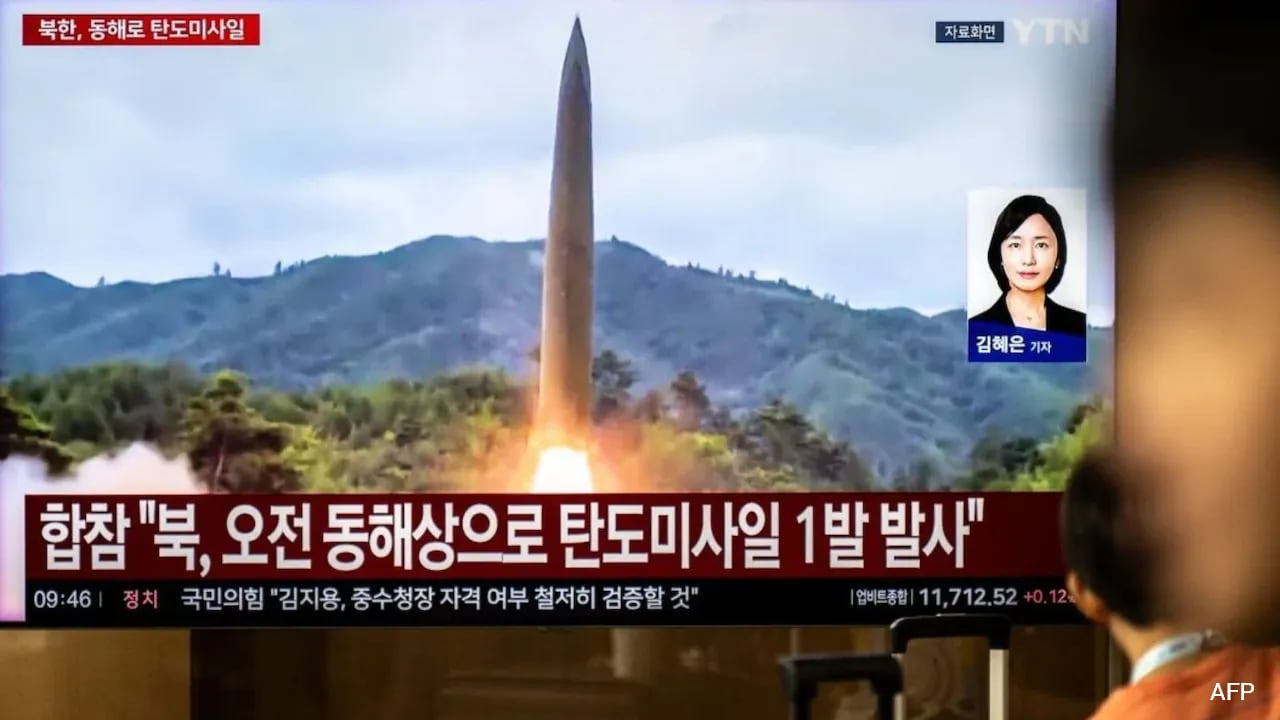
North Korea said it tested an intermediate-range strategic missile on Saturday that involved the use of AI, hours after Seoul said Pyongyang had launched a ballistic missile.
The launch took place days after Seoul's military demanded an apology from Pyongyang for a blast that wounded three South Korean soldiers in the Demilitarized Zone (DMZ) that it blamed on the North.
Pyongyang has denied responsibility for last month's explosion and called South Korea "despicable" on Friday, undercutting overtures by Seoul's civilian leadership seeking a return to dialogue.
Early Saturday, "our military detected a ballistic missile launched from the Wonsan area of North Korea toward the East Sea," Seoul's Joint Chiefs of Staff said, referring to the body of water also known as the Sea of Japan.
"South Korea, the US, and Japan are maintaining a robust defence posture through close information sharing regarding North Korean ballistic missiles," it said, adding the missile flew more than 700 kilometres (435 miles).
Hours later, Kim Yo Jong, the sister of Pyongyang's leader Kim Jong Un, said the missile fired in the morning was an "intermediate-range strategic missile".
She said the projectile is "capable of changing its flight orbit at a low altitude and AI was introduced into it", without elaborating further on the use of artificial intelligence.
She said it meant "there is no way to avoid" the missile's attack, and claimed Kim Jong Un believed "any country in the world could not have access to such technology for at least several years".
Her latest statement followed Kim Jong Un's remarks last month stressing the need to raise "the level of artificial intelligence" in the country's weapons systems.
Kim Yo Jong claimed whenever North Korea "applied the wave-like trajectory mode", South Korea "failed to track the targets from their first skip points".
Analysts say North Korea could be rapidly advancing its missile technology with Russian military support in exchange for sending troops to support its war against Ukraine.
"AI is increasingly being incorporated into military technology worldwide, and ballistic missiles are no exception," Hong Sung-pyo, senior researcher at the Seoul-based Korea Institute for Military Affairs, told AFP.
"AI can assist with target information and launch operations, while the wars in Ukraine and Iran have shown how linking AI with drones and missiles can enhance their operational effectiveness."
Hong said it was too early to conclude North Korea's claims about the missile's capabilities were accurate.
"North Korea's missile technology is not particularly advanced compared with leading military powers," he said.
"While missiles that manoeuvre in their terminal phase are difficult to intercept, that does not mean they can strike their targets with perfect accuracy."
- 'Despicable' -
Seoul and the US-led United Nations Command found that last month's explosion inside the DMZ was caused by North Korean mines laid on the South side of the border.
North Korea's military has placed mines and built anti-tank barriers along the frontier as part of efforts to permanently seal it off following leader Kim Jong Un's designation of South Korea as his country's "principal enemy" in 2024.
The mines responsible for the blast, which left three soldiers wounded, were believed to have been laid as part of Pyongyang's border fortification work, according to South Korea's defence minister Kang Shin-chul.
South Korea's dovish President Lee Jae Myung had urged Pyongyang on Thursday to return to dialogue, despite his military demanding an apology a day earlier.
Kim Yo Jong responded by calling Seoul "really despicable" on Friday and once again denied Pyongyang was behind the blasts.
She ridiculed Lee's latest overture, calling it "the climax of the farce that everyone should watch" and said the military's demand her country apologise was "quite ridiculous".
Kim also warned Pyongyang was "ready for everything" Seoul might do over the mine blast -- remarks followed the next morning by Pyongyang's missile launch.
Analysts said the launch would be viewed as a show of force in response to the South Korean government's diplomatic efforts, effectively rejecting engagement.
"Seoul called for easing tensions, but Pyongyang answered by escalating them," Yang Moo-jin, former president of the University of North Korean Studies in Seoul, told AFP.
"The message is that the North is pursuing... confrontation in response to goodwill," he added.
(Except for the headline, this story has not been edited by NDTV staff and is published from a syndicated feed.)
KioskNews shows a cleaned-up reading view extracted from the publisher’s page — the original always lives on their site, not ours.