Greening must be part of Ghana’s development, not an afterthought – Prof Naana Jane

Vice President Prof Jane Naana Opoku-Agyemang has urged Ghana to make greening an integral part of urban development rather than treating it as an afterthought.
She said the rapid growth of towns and cities must be matched with greater attention to trees, gardens and green spaces.
“Greening should therefore not be something we consider after development; greening should be part of development itself,” she said.

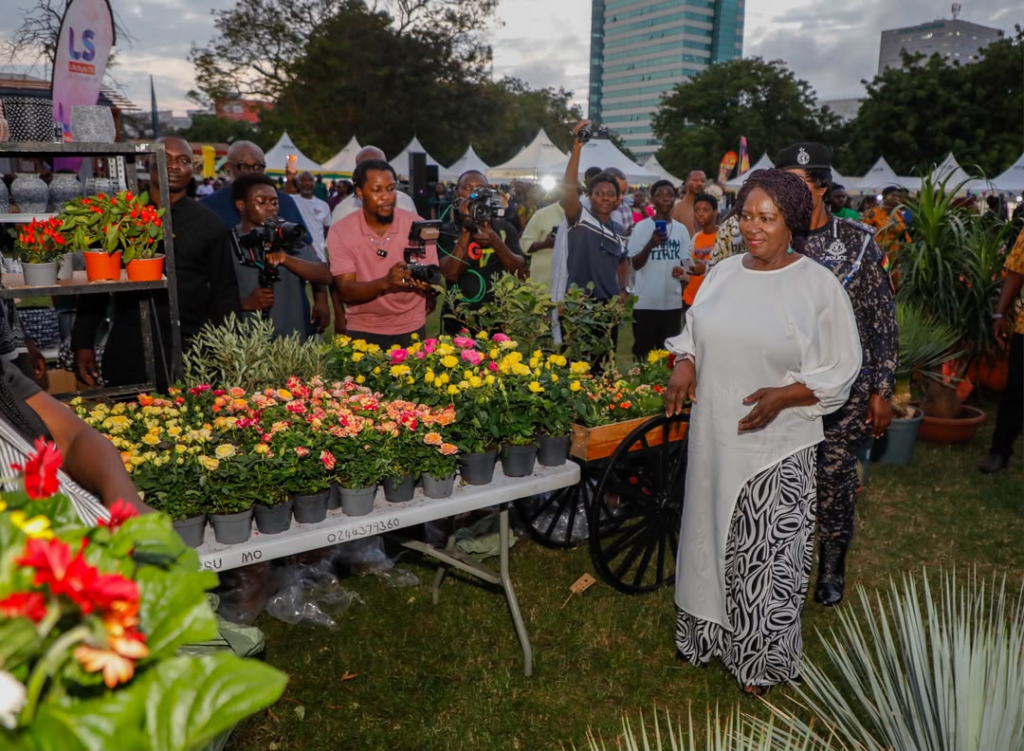
Speaking on Saturday at the opening of the 14th Ghana Garden and Flower Show, Prof Jane Naana said the recent floods should serve as a reminder of the consequences of neglecting the environment.
She said the country must address the plastics and household waste choking drains and waterways while also creating greener communities.
“That conversation must not end when the floodwaters recede. Keeping Ghana clean and making Ghana greener are part of the same responsibility,” she said.
According to the Vice President, green spaces do more than improve the environment. They can also create demand for local skills and businesses.

“Green spaces improve where we live and work, while creating demand for Ghanaian skills and businesses,” she said.
She urged local authorities, developers and businesses to help create demand for green spaces, while Ghanaian producers are equipped to meet that demand and pursue export opportunities.
Prof Jane Naana also highlighted the economic potential of horticulture, saying the sector has an entire economy built around its beauty.
“Behind what we see are growers, skills, services, markets, and livelihoods,” she said.

She called for greater support for enterprises in the sector to become sustainable businesses capable of creating jobs, supplying larger markets and competing beyond Ghana.
The Vice President said this would require attention to the entire horticultural value chain, including transport, storage, quality standards, finance and access to markets.
“Since we are serious about green business, we must pay attention to the entire chain, from production to finance, and how products reach the market,” she said.
She said existing government programmes provide a foundation for expanding the sector.
Under the Feed Ghana Programme, vegetables are among the priority crops, with opportunities for support in irrigation, improved inputs, greenhouse production, and better market access.
She also pointed to the establishment of farmer service centres across the country, which are intended to bring services closer to producers, including export support, inputs, machinery, and market linkages.
Prof Jane Naana said horticulture also presents opportunities for young people by combining agriculture, technology, creativity and enterprise.
“The opportunity is not only to encourage young people to grow more, but also to help them to see the businesses they can build around their produce,” she said.
She further urged stakeholders to strengthen quality standards, financing and market access to help Ghanaian horticultural businesses compete internationally.

“Training institutions can develop the skills the sector needs. Financial institutions can support viable enterprises. The private sector can develop markets, and movements such as this one can continue bringing the industry together and making its possibilities visible,” she said.
She said the question for the country should be how to make Ghana greener while creating businesses and livelihoods.
“A greener Ghana begins with how we understand and care for the environment around us,” Prof Jane Naana said.

DISCLAIMER: The Views, Comments, Opinions, Contributions and Statements made by Readers and Contributors on this platform do not necessarily represent the views or policy of Multimedia Group Limited.
Tags:
DISCLAIMER: The Views, Comments, Opinions, Contributions and Statements made by Readers and Contributors on this platform do not necessarily represent the views or policy of Multimedia Group Limited.
KioskNews shows a cleaned-up reading view extracted from the publisher’s page — the original always lives on their site, not ours.