Where ancient religious traditions meet modern architecture and technology
Explore pagodas, stupas and high-tech multimedia displays at Fo Guang Shan Buddha Museum
By Shane O’Reilly / Contributing reporter


Within Kaohsiung’s Dashu District (大樹區), Fo Guang Shan Buddha Museum (佛光山佛陀紀念館) serves as both a major religious destination and a popular attraction for visitors.
Some come to this 100-hectare complex for a weekend’s worth of exploration and education, while others see it as a Buddhist community hub and a site of pilgrimage.
Attracting around 10 million visitors a year, the site’s defining feature is its seamless confluence of architectural syncretism that reflects both the religion’s global reach and cultural impact.
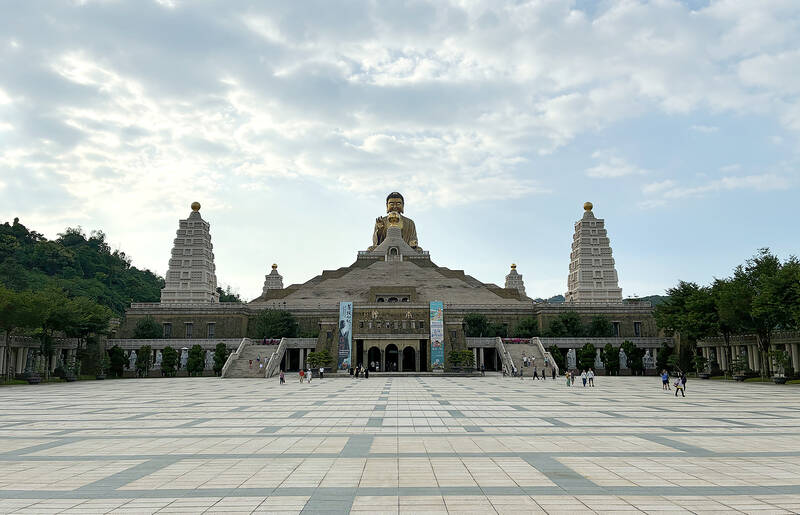
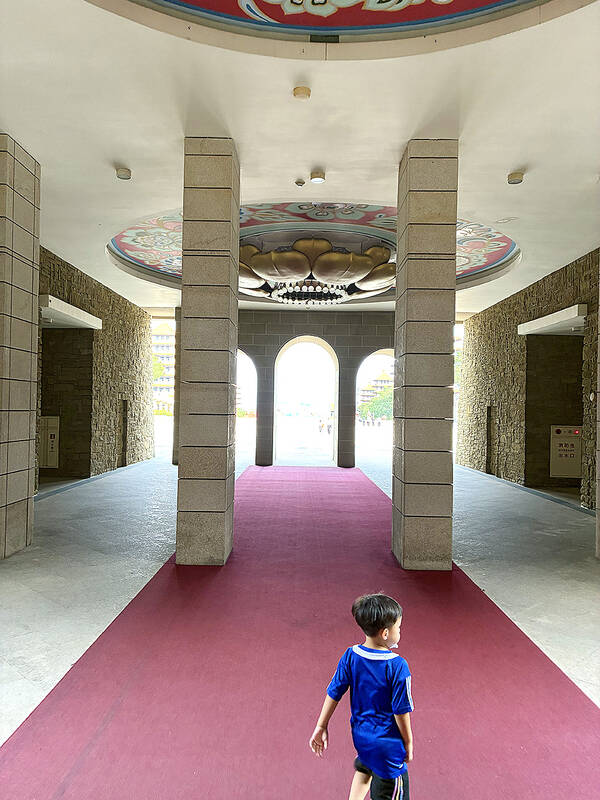
The concourse before the Main Hall.
Photo: Shane O’Reilly
ENSHRINING A SACRED RELIC
In 1998, Buddhist Master Hsing Yun (星雲法師), founder of the Taiwan-based Fo Guang Shan monastic order, took a trip to India.
While there, he met the elderly Lama Kunga Dorje Rinpoche.
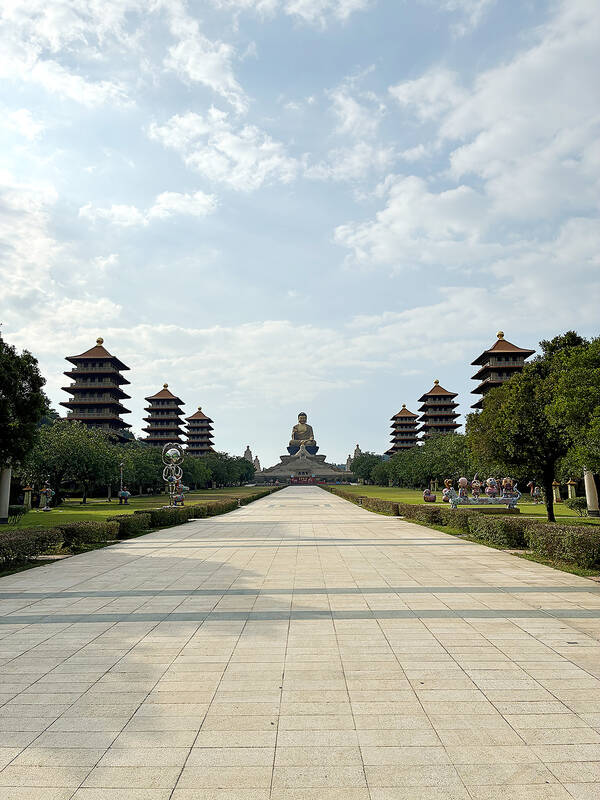
A view of the Great Path and the Main Hall.
Photo: Shane O’Reilly
Impressed with the work of Hsing Yun’s organization, the Tibetan entrusted the Buddha tooth relic he had protected for 30 years to the visiting monk. It was, and still is, one of the world’s few authenticated tooth relics of Sakyamuni Buddha, the founder of Buddhism, who lived approximately 2,500 years ago.
Rinpoche’s wish was for the relic to be forever enshrined in Taiwan.
By then, Hsing Yun had already spent 30 years developing a 30-hectare site in Kaohsiung, transforming untamed land covered in bamboo and dense vegetation into his organization’s original monastery. And so began an ambitious project of expansion and modernization, purpose-built to enshrine this priceless artifact. In 2011, the complex, including the new Buddha Museum, officially opened its doors to the public.
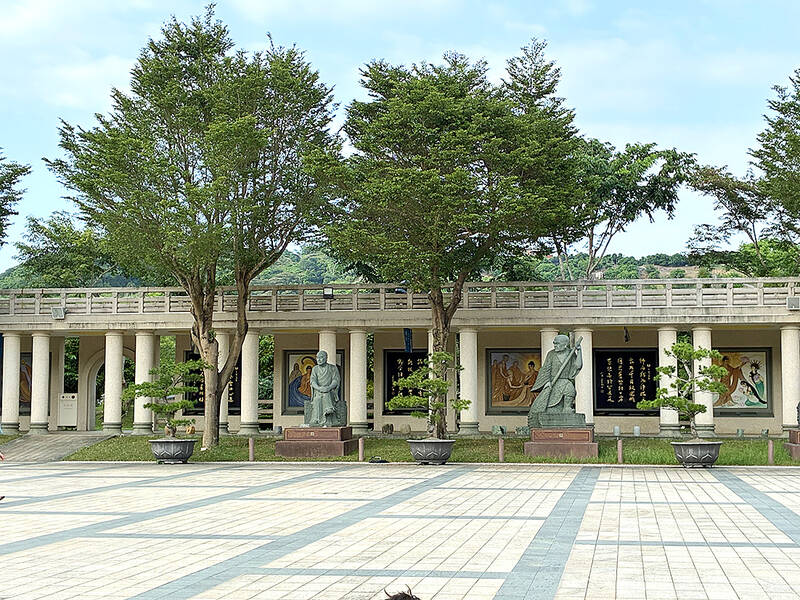
The bas-relief and colonnaded artwork that lines the concourse.
Photo: Shane O’Reilly
EXPLORING THE GROUNDS
Most people make a beeline for the grand sprawl of the Buddha Museum complex, which accounts for approximately half of the vast campus.
But the site actually comprises three interconnected areas, creating a trifecta that represents what is known as the three gems, jewels or pillars of Buddhism.
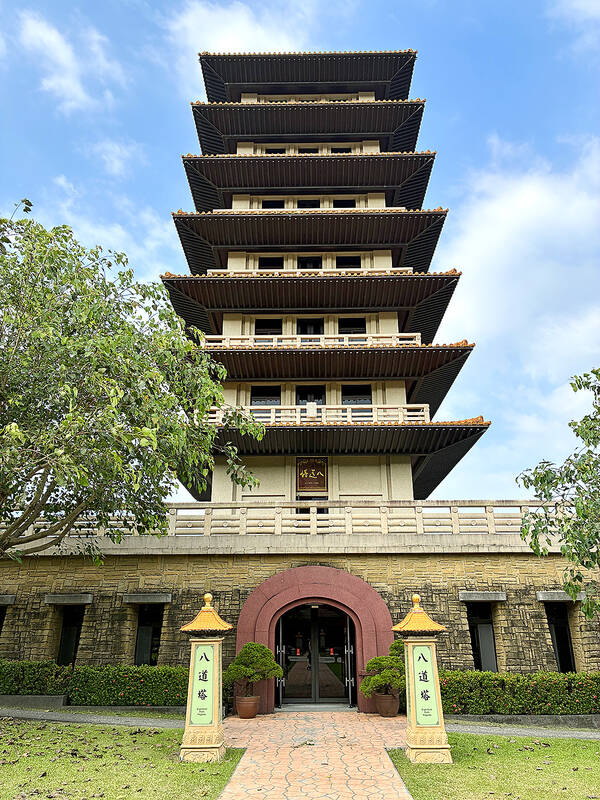
One of the eight pagodas along the Great Path, each containing interactive educational displays and installations.
Photo: Shane O’Reilly
The Buddha Museum represents the Buddha (the teacher), the Sutra Repository represents the Dharma (the teachings), and the original monastery represents the Sangha (the community of monastics).
Veering left at the Front Hall (禮敬大廳), another avenue winds around to the Sutra Repository, which houses Buddhist teachings and ancient scriptures while offering panoramic hilltop views.
Nearby, the original monastery building features the Main Shrine (大雄寶殿), a 36-meter-tall Buddha statue and the decorated tunnels and figurines of the Pure Land Cave.
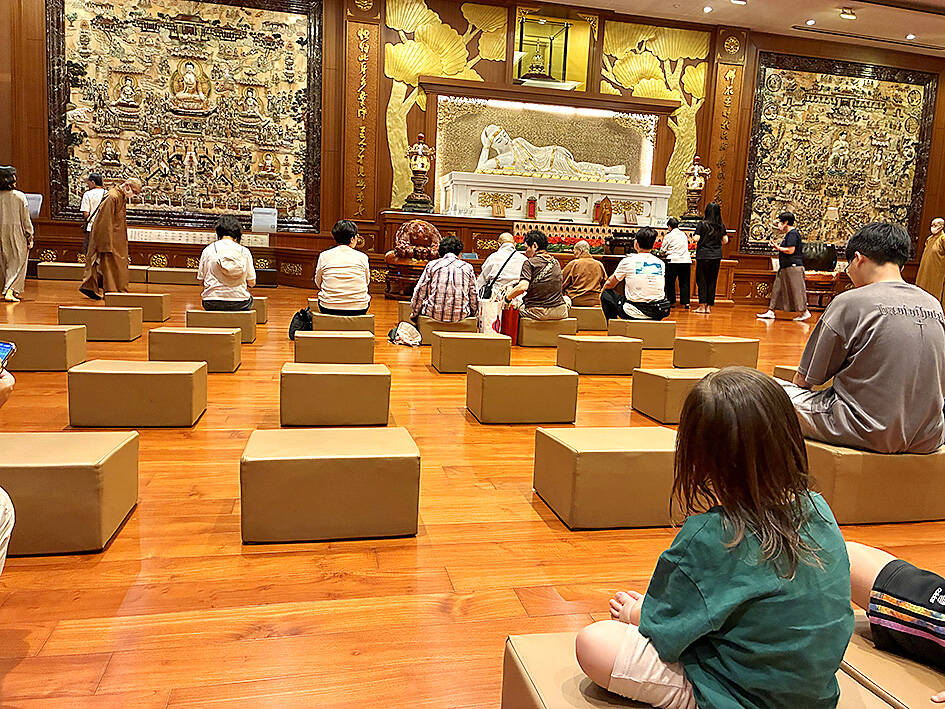
The Jade Buddha Shrine houses the reclining Jade Buddha and the holy relic.
Photo: Shane O’Reilly
THE BUDDHA MUSEUM
When following the more direct and certainly more popular Buddha Museum route, visitors must first pass through the gleaming Front Hall, which houses buffet eateries and jewelry and souvenir shops.
On the opposite side, they emerge onto the Great Path (成佛大道), which paves the way to the palatial Main Hall.
Inside the Main Hall.
Photo: Shane O’Reilly
This picturesque boulevard is lined with red bougainvillea and Bodhi trees, dotted around eight 28-meter-tall Tibetan pagodas hemmed by long border walls of bas-relief artwork.
From the Eightfold Path Pagoda to the One Teaching Pagoda, each encapsulates a site-specific interactive educational experience with displays and installations.
The pale sandstone esplanade eventually opens onto the Grand Photo Terrace (萬人照相台) and the Bodhi Wisdom Concourse (菩提廣場).
Towering in the distance, the Fo Guang Big Buddha stands 108 meters tall from the base of its lotus-shaped pedestal to the top of its head.
Before it, the Main Hall looms, its four Indian-inspired stupas projecting upward. Inside is a slick interior of polished granite and marble surfaces, high ceilings, engraved columns and a maze of contemporary multimedia spaces.
The basement hosts an impressive archive of objects donated by people from around the world, while the first three floors feature shrine rooms, interactive exhibitions, multiple galleries and an auditorium seating 2,000 people.
On the first floor lies the Jade Buddha Shrine (玉佛殿), where above the central white jade statue reclining on one arm, a stupa-shaped crystal reliquary houses the precious tooth relic.
Behind the Main Hall, a small terrace offers the closest vantage point to the great golden Buddha. A towering presence, it provides a fitting end to a spiritual, architectural and artistic journey.
For your information
IF YOU GO
The Fo Guang Shan Buddha Museum is located at 1, Tongling Rd, Dashu District, Kaohsiung City (佛光山佛陀紀念館, 高雄市大樹區統嶺路1號). It is open to the public six days a week from 9am to 6pm. Parking and admission are free. All food and drink services within the Front Hall are vegetarian or vegan and rely heavily on buffet-style dining. For more information, visit www.fgsbmc.org.tw/en/index.aspx.
KioskNews shows a cleaned-up reading view extracted from the publisher’s page — the original always lives on their site, not ours.