BOOK EXCERPT: Stoep stories in Victoria West — Where the Karoo’s quiet streets keep history alive
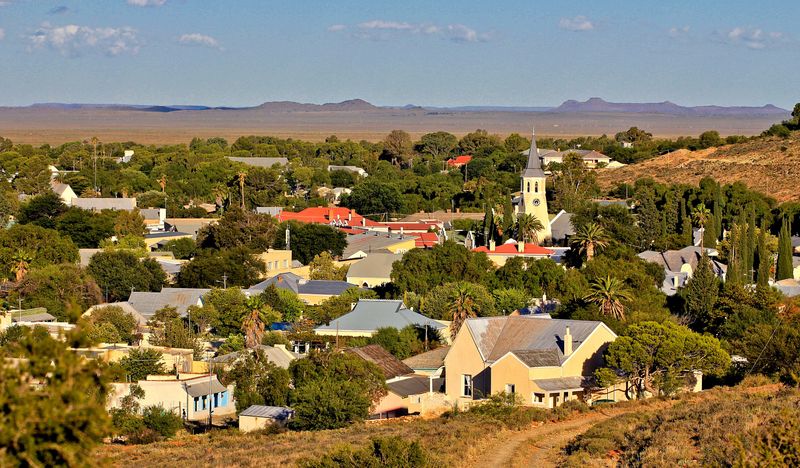
Victoria West stands at the crossroads of the N12, the R63 and Time itself.
Today, we find ourselves under a whipping windsock a few kilometres outside a town that is blessed with a hundred-year biography written by the historian, Eric Rosenthal. I bought it at a country book fair years ago and am now using it as a reference. One Hundred Years of Victoria West is only 100 pages long.
From what Rosenthal tells us, and the info we gleaned from the local museum, I can time-travel back 66 years to the Wool Boom era, when a pound of the fluffy stuff got you an English pound in return. Farmers in the Karoo were suddenly richer than they had ever been before.
The Victoria West Aerodrome (and don’t you just love that word?) had international status by now. Dakotas from Cape Town would refuel here on their way up to Joburg and, eventually, London.
You could shake the dust off your pumps, gather up your skirts, march right up the stairs and ascend into the heavens from the Victoria West Aerodrome.
In 1932 Imperial Airways, the forerunner of the modern British Airways (also called BOAC somewhere along the timeline) recognised Victoria West as a refuelling aerodrome for their new London-Cape Town services.
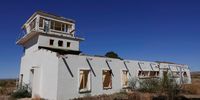
Old clippings will tell you that the bloke from Bester’s Garage in town had to occasionally climb up the little flagpole here beside us and replace the old windsock with a new one. A daunting task, by all accounts.
For an isolated little village in the middle of a Karoo nowhere – which is a serious nowhere – Victoria West punched well above its weight.
Take, for instance, its most famous neighbourhood son: Petrus Hendrik Hugo of Pampoenpoort, AKA “Dutch” or “Khaki” Hugo.
Hugo joined the Royal Air Force at the start of World War 2 and won himself the Distinguished Flying Order, Distinguished Flying Cross (UK), Distinguished Flying Cross (USA) and the French Croix de Guerre. He was credited with 22 aerial kills and involved in the sinking of 20 enemy ships in his time.
The people of Victoria West raised no less than £4,000 (R500,000 in today’s money) under the Petrus Hugo Spitfire Fund and bought their air ace hero his own aircraft, appropriately dubbed “Karroo”.
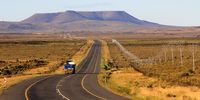
Unfortunately, Hugo was later shot down over the English Channel. He was rescued but, by all accounts, there is a Spitfire called “Karroo” lying somewhere on the seabed off Dover these days.
The landmark tragedy of Victoria West, however, is the flood of 27 February 1871, which claimed the lives of 62 people. A bride died while trying on her wedding dress; whole families at dinner were swept away; most of a roomful of revellers at Quirk’s Hotel succumbed while a Mrs Jacobsohn and her children floated off to safety on a featherbed.
Eric Rosenthal quotes a Mr Johannes van Heerden: “There was a carpenter by the name of Jan Janse, who saved many lives. He was over six foot tall and very powerful, so that he could carry people on his back.”
Another hero of the flood was Johannes Buyskes, the postal rider who bore the mails from Cape Town to the diamond fields via Victoria West. He saved many lives that night. As a token of gratitude, some of the Victoria West women cut their hair and fashioned a fob-watch chain for him with the shorn locks.
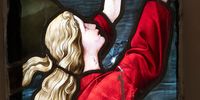
Visit the local Anglican church and you’ll see a couple of stained-glass windows commemorating the flooding of Victoria West.
The early 1870s brought big waters, but the next decade also saw many thousands of adventurers, prospectors, miners, ne’er do wells, remittance men, cutthroats, thieves, passing snake oil salesmen and some remarkably heroic characters drifting through Victoria West.
Almost to a man, they were on their way up to the diamond fields of Kimberley and later, to the goldfields of Joburg. The ones who left The Diamond Way and made Vic West their home established hotels, a turf club, later a bioscope and, according to records, Pagel’s Circus even made a turn here.
But back to the windsock and the Victoria West Aerodrome.
In 1953, with all the wool boom money around and a refreshed sense of belonging to the world at large, Vic West built new Art Deco airport buildings.
This, say the records at the local museum, was about the time that flying passengers began to see elegant air hostesses on board, serving cocktails and such. And there was always lots of leg room.
But one thing hasn’t changed. There have never been airfield lights, so when there’s an emergency night landing everyone with a car is involved. You are expected to park on the side of the runway with your lights on so a safe landing can be made.
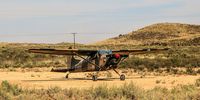
We once arranged to interview Dr Johan Lochner, the local GP and pilot, at this airfield. He arrived and opened one of the hangars, revealing two gliders and a couple of classic old cars in various stages of repair. He also showed us his 1968 Cessna traildragger that he once used to fly up to nearby Vosburg, where he also had a small practice.
This rather overworked country doctor’s therapy was flight. He glanced upwards and his face lit up as he told us about the fluffy clouds, slightly domed above and dark below.
“These are the perfect ones for flying and especially for gliding, as there are thermals among them,” he said.
The doctor gazed up at the skies with yearning in his eyes, and we knew it would not be long before he was back in the clouds again – in his happy place. DM
For more Karoo stories, try the Karoo Quartet (a perfect Christmas four-volume gift at R960) or Klein Karoo Magic at R400 – both including SA courier. Contact Julie at julie@karoospace.co.za
KioskNews shows a cleaned-up reading view extracted from the publisher’s page — the original always lives on their site, not ours.