Three firms dominate the memory market. Is CXMT about to change that?
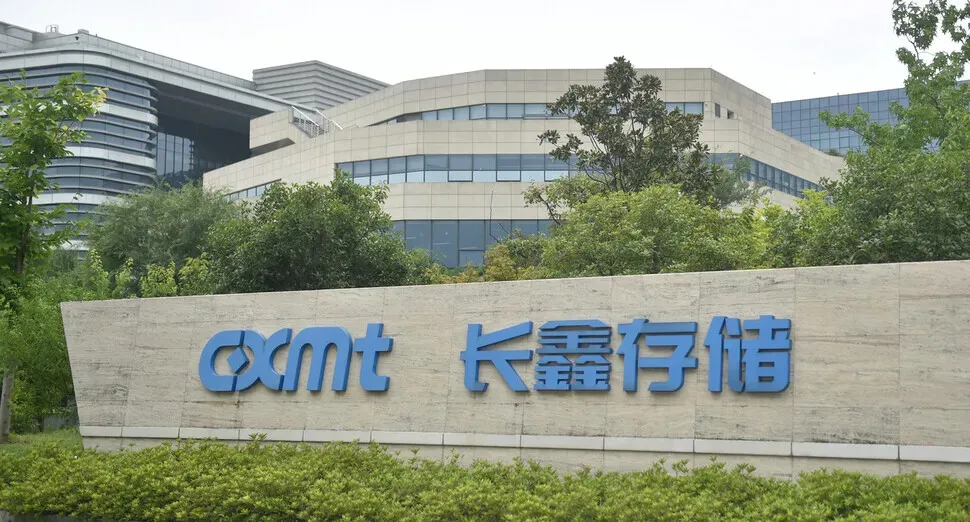
CXMT’s headquarters in Hefei, China. (Reuters/Yonhap)
On July 27, Changxin Memory Technologies (CXMT), China’s largest manufacturer of dynamic random-access memory, or DRAM, debuted on the Shanghai Stock Exchange’s tech-heavy Star Market. Its highly anticipated listing saw the company’s share price shoot up as much as 476% during intraday trading compared to its initial public offering price.
CXMT’s market cap skyrocketed to 3.14 trillion yuan, surpassing the Industrial and Commercial Bank of China for the country’s top spot, underscoring the growing threat posed by the Chinese semiconductor sector.
Beijing’s policy for the semiconductor industry has undergone a major shift in the wake of its trade dispute with Washington, with CXMT’s IPO as the result of the change. The Chinese government had previously sought to produce world-class chipmakers through policy support favoring leading companies.
Amid its trade dispute with the US, China shifted gears to focus on reconnecting the semiconductor ecosystem, which was disrupted by US export regulations, and developing leading companies under a market-centric approach.
Utter trainwreck
China’s attempt at state-led semiconductor development was an unmitigated failure. Beijing’s flagship support policy in this regard is the China Integrated Circuit Industry Investment Fund, or the “Big Fund,” a massive government-led initiative aimed at raising chip self-sufficiency. At the time, the country sought to build the world’s leading capacity in the sector, confident that it could continue to rely on global supply chains.
Launched in 2014, the fund was worth around US$21 billion in its first phase and US$29 billion in its second in 2019, providing a massive financial boost to chipmakers. Leading Chinese semiconductor companies such as SMIC, Yangtze Memory Technologies Co. (YMTC), CXMT and HiSilicon were major recipients of the fund.
A prime example of the policy’s failure is the fraud scandal at Wuhan Hongxin Semiconductor Manufacturing Company, aka HSMC. In 2017, the company, later exposed as a scam by people with no background in chips, announced plans to invest around US$18.5 billion to set up 14- and 7-nanometer manufacturing processes to produce 30,000 memory chips per month.
HSMC poached Chiang Shang-yi from his role as chief operating officer at TSMC, the world’s largest contract chipmaker and semiconductor foundry, named him CEO, and acquired ASML’s state-of-the-art deep ultraviolet lithography equipment backed by a government credit guarantee. The combination of TSMC expertise and ASML’s cutting-edge machinery seemed like a surefire formula for success.
A little over two years later, in late 2019, HSMC was hit with a lawsuit for failing to pay 51 million yuan in construction costs as the company’s corporate corruption and structural fraud were exposed. Its unused ASML equipment sat dormant in a warehouse after it was pledged as collateral to banks by the scammers immediately after their purchase.
An investigation found that the company’s semiconductor plant needed further construction or operations would be impossible. Chiang resigned in mid-2020, blasting his experience as “a nightmare.” In the end, at least US$2.3 billion in public funds are known to have vanished into thin air.
Tsinghua Unigroup, once a symbol of China’s semiconductor ambitions, had ridden the industry’s momentum so far as to announce plans to acquire Micron. By 2020, however, it had defaulted.
This led to numerous allegations of corruption and misconduct. Xiao Yaqing, who shaped industrial policies as the minister of industry and information technology, was placed under investigation, and the Big Fund’s general manager Ding Wenwu was also placed under a probe.
Zhao Weiguo, Tsinghua Unigroup’s former chairperson, was handed the death sentence with reprieve — a two-year suspended sentence in which the convicted, instead of being executed, faces life in prison or a fixed-term prison sentence if they do not commit any crimes or meet certain requirements during the suspension period.
In essence, China’s push to become a semiconductor powerhouse was reduced to a pipe dream.
Following that colossal corruption scandal, China strictly limited the central government’s indiscriminate distribution of subsidies and froze support from local governments. The third installment of the Big Fund, which launched in 2024, focused on areas where supply chains had been disrupted by US export restrictions: lithography equipment, advanced materials, and high-bandwidth memory (HBM).
Leading companies went public, as they were required to undergo public oversight.
CXMT’s model combines Western technology crucial to the semiconductor industry with long-term investment from local governments. After graduating from Tsinghua University’s physics department, Zhu Yiming, the founder of CXMT, started studying in the US. There, he became enamored with the innovation of Silicon Valley, which prompted him to shift tracks to electronic engineering and jump into the semiconductor industry.
After working at an American cybersecurity company as the project lead for memory chip development, he established GigaDevice in Silicon Valley.
GigaDevice grew to become the world’s third-largest manufacturer of NOR flash, which consumes more power than NAND flash but offers faster read speeds, making it widely used in cell phones. The company then successfully listed on the Shanghai Stock Exchange in 2016.
For the sake of boosting China’s DRAM self-reliance, Zhu partnered with the Hefei municipal government to launch “Project 506,” a manufacturing project.
Semiconductor manufacturing is both capital- and technology-intensive, requiring massive upfront investment and the ability to absorb losses over an extended period before production processes stabilize. That makes it difficult for private venture capital firms, which typically operate on shorter investment horizons, to provide the patient capital the industry requires. In Hefei, the city government stepped in, contributing 13.5 billion yuan, or 75% of the project’s initial capital.
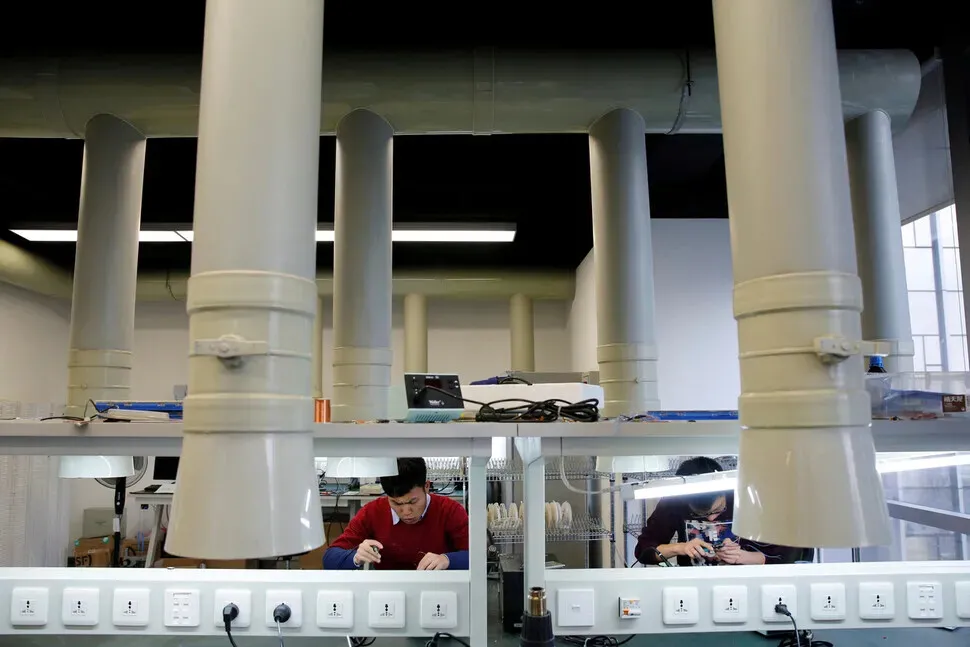
Workers at the Beijing research center of Tsinghua Unigroup, on Feb. 29, 2016. (Reuters/Yonhap)
The Hefei model
Hefei is responsible for various success stories: by investing 17.5 billion yuan in the display company BOE Technology during the 2007 financial crisis, it helped BOE grow into China’s largest display manufacturer; it also led to the turnaround of electric vehicle startup NIO, which was on the verge of bankruptcy in 2020, by injecting 7 billion yuan.
In the Hefei model, the municipal government does more than provide mere administrative support: it acts as an early-stage anchor investor by absorbing risk and attracting relevant materials, components and equipment companies to foster the entire regional industrial cluster.
The process of acquiring memory semiconductor technology was also different. Fujian Jinhua Integrated Circuit Co., a major rival, crumbled after being hit with a US business suspension order for allegedly misappropriating Micron’s trade secrets.
CXMT evaded any potential legal hazards and navigated its way through the patent thicket by acquiring patents originating from bankrupt German memory maker Qimonda. Before it folded, Qimonda was the world’s second-largest DRAM company and possessed its own unique architecture.
After officially announcing it would sell DDR4 in 2019, CXMT ramped up its wafer processing capacity from 40,000 wafers per month in 2020 to 250,000 wafers per month by 2025. Its share of the global DRAM market leapt from 3% in 2025 to 8% in 2026.
As prices soared due to global memory shortages, CXMT posted a profit exceeding 10 trillion won. The global memory boom provided CXMT with a foundation for further investment.
US restrictions on semiconductor exports to China also pushed China to strive harder for domestic production. In particular, the percentage of semiconductor equipment produced domestically in China went from under 10% to over 30%.
When supplies of semiconductor equipment were cut, China sacrificed performance to mandate the use of domestically produced equipment. Chinese companies pounced on outdated equipment that should have been phased out long ago in an era of free trade before carrying out massive overhauls by mixing and matching parts.
After the conflict between the US and China effectively forced Chinese engineers out of leading global equipment companies in the US, many of those very same engineers returned to China to spearhead technological development.
Losses resulting from lower yield rates were offset by government subsidies. Growth in quantity soon led to growth in quality.
Chinese semiconductor production equipment companies that are by no means household names — Naura Technology, AMEC, SMEE — are now growing rapidly. China has also reportedly developed lithography equipment, which is essential for manufacturing cutting-edge semiconductors, up to the deep ultraviolet (DUV) level. While it remains uncertain whether China will reach the extreme ultraviolet (EUV) level, it has reached a point where it is capable of producing 7-nanometer semiconductors.
At this current stage, there is no need to become overly concerned with China’s semiconductor capabilities. CXMT has made a striking stock market debut, but its DRAM mass production yield falls short of that of Samsung Electronics and SK Hynix.
Yield directly affects production costs. In other words, DRAM with the same performance is more expensive than that produced by Korean memory companies.
Regarding HBM, Korean companies make HBM4 while China is yet to even manufacture HBM3. Korea still outpaces China in terms of technology by at least four years. China uses DUV machines to manufacture chips sized at 7 nm and lower, but its ability to mass-produce those products is severely lacking. There is no reason to use chips or equipment made in China if one wishes to remain competitive in the global market.
Nevertheless, we should focus on the fact that China is pursuing its national strategic goal of semiconductor self-reliance. Starting with outdated technology that cannot currently generate any profit and working one’s way step by step is a strategy that seems to defy common sense.
However, China has a massive domestic market, a strong manufacturing sector, and, above all else, is an authoritarian state capable of concentrating national resources on specific sectors.
If Korea wants to retain control…
It is important to acknowledge that the Chinese semiconductor industry has entered a unique orbit that exists outside the global semiconductor ecosystem. A considerable amount of time has passed since the global memory market was dominated by the three pillars of Samsung Electronics, SK Hynix and Micron. The nature of memory semiconductors made it difficult for latecomers to join the fray, so the market was divided up between the three companies, which then also responded to the market landscape.
That, in turn, led to bureaucratization and conservative shifts in corporate culture. The fact that Samsung Electronics, which used to be the indisputable frontrunner in the sector, has been overtaken by SK Hynix can be attributed, to a certain degree, to a complacent corporate culture.
The Korean memory industry has only one way in which it could retain control of the sector and stay ahead of China: setting off at a bold pace to expand both the sophistication of its technology and the reach of its ecosystem.
KioskNews shows a cleaned-up reading view extracted from the publisher’s page — the original always lives on their site, not ours.