Why everyone wants a piece of the Lopez group’s Energy Development Corp.
Three foreign groups have sought different stakes in the same Lopez asset: an Indonesian tycoon has made an unsolicited US$5 billion offer to buy it outright, another Indonesian conglomerate has entered a joint venture to build with its geothermal know-how, and this September, a new investor paid P25.77 billion for nearly a fifth of its parent company, First Gen Corporation, at P36 a share, just P1 above the price First Philippine Holdings (FPH) had recently rejected as inadequate.
What they are circling is Energy Development Corporation or EDC, which turns 50 this 2026 and draws electricity out of hot water and steam trapped beneath the volcanic rock of Leyte, Negros, Bicol and Mindanao, generating power around the clock whether or not the sun shines or the wind blows, without needing fuel deliveries from anywhere. (READ: The company the Lopezes gave up Meralco for: EDC, from oil crisis child to takeover target)
The Lopez group, through First Gen, bought EDC from the government in 2007 and has spent the 19 years since learning how deep the asset actually goes.

What 50 years underground buys
“We have invested more than P200 billion through the years to build approximately 1,300 megawatts (MW) of reliable baseload capacity,” Francis Giles Puno, president and chief operating officer of First Gen and of its parent First Philippine Holdings (FPH), told shareholders at the group’s annual meeting on Friday, September 25.
But money alone is not the barrier to entry. The knowledge is.
Solar and wind developers can measure much of their resource before construction begins, while geothermal developers have to drill into the earth to prove what is actually there, deciding where to sink an expensive exploration well before knowing exactly what they will find, learning how a reservoir behaves as pressure changes across decades, and figuring out how to keep mineral deposits from damaging the wells and pipes that carry geothermal fluids. Enough wrong decisions can shorten the productive life of a field.
The Lopezes understood early what they had bought. Three years after the acquisition, Federico “Piki” Lopez told First Gen shareholders in the company’s 2010 annual report that the group was “prepared to go global and take this geothermal power development expertise, built on EDC’s ’35-year head start,’ into parts of the world that have only begun to tap their existing reserves.” Puno, writing as president in the same report, described EDC as having “existing steam concessions and a great technical platform supported by its scientists and engineers.”
That 35-year head start is the same clock that reaches 50 this year.
EDC has been doing this since the 1970s, across generations of geologists, reservoir engineers and drillers who learned the craft from the people before them, but not all of that accumulated capability remains housed inside EDC today. Part of it migrated into another branch of the Lopez group through ThermaPrime Drilling Corporation, incorporated in December 2010 and, by its own account, “staffed by many of the same people who comprised the original PNOC (Philippine National Oil Company)-EDC drilling team.” It sits not under EDC or under First Gen but beside them, owned by First Balfour, the group’s construction arm, which FPH owns outright. The drilling knowledge that had accumulated inside EDC was replicated elsewhere in the group and became a business of its own.
Puno highlighted ThermaPrime in his September 25 report to FPH shareholders. “Major infrastructure and renewable energy development demand specialized capabilities built over decades,” he said. “Through First Balfour and ThermaPrime, FPH has developed the engineering, construction and drilling expertise to take on increasingly complex projects.” ThermaPrime, he said, “brings equally specialized capabilities to geothermal development. Its people and equipment helped EDC accelerate its drilling program, completing close to 30 wells over the past 3 years.”
That intensive program has now ended, and the numbers show it. Activity moderated this year, Puno said, with ThermaPrime’s revenues declining 49% to P1.4 billion and net income falling 45% to P276 million.
But the rigs have found work elsewhere. ThermaPrime completed a 4-year program for SM Investments-owned Philippine Geothermal Production Company, drilling 12 production wells and 3 multilateral injection wells. In July, Maibarara Geothermal Inc., the Yuchengco-led venture of PetroGreen Energy, ACEN, and PNOC Renewables, awarded it a 2026-2027 exploratory campaign: 3 firm wells and one contingent well in Batangas and Laguna, to depths of 2,100 to 3,000 meters, with drilling running from October through May 2027.
Puno told shareholders he expects the drilling expertise to be sold beyond the group’s own projects. “The value of these capabilities extends beyond the projects they serve today,” he said, with ThermaPrime “exploring opportunities to bring its geothermal drilling expertise to Japan, Taiwan and Indonesia.”
Puno described a business the company keeps spending on rather than harvesting. “We continue to learn invaluable lessons and reinvest significant resources to maintain, expand, and strengthen our unique leadership position in geothermal,” he said, “including the forthcoming re-envisioning and redevelopment of Leyte.”
The capability built around EDC over half a century is therefore broader than the plants and steam fields sitting on EDC’s books: it includes knowledge about where to drill, how to manage a reservoir and how to keep drawing power from it over decades, while some of the specialized drilling and well-engineering capability that grew out of the old EDC has already become a separate business elsewhere in the Lopez group.
Buy it, or build with it
The US$5 billion offer was not the first time an Indonesian group came looking.

More than a year earlier, a different Indonesian house had approached the Lopezes with a different proposition. Sinar Mas, the conglomerate controlled by the Widjaja family with interests running from palm oil to paper mills to telecommunications, did not make an offer for EDC. It signed a joint venture with it, bringing into Indonesia the geothermal capability the company had spent decades building in the Philippines.
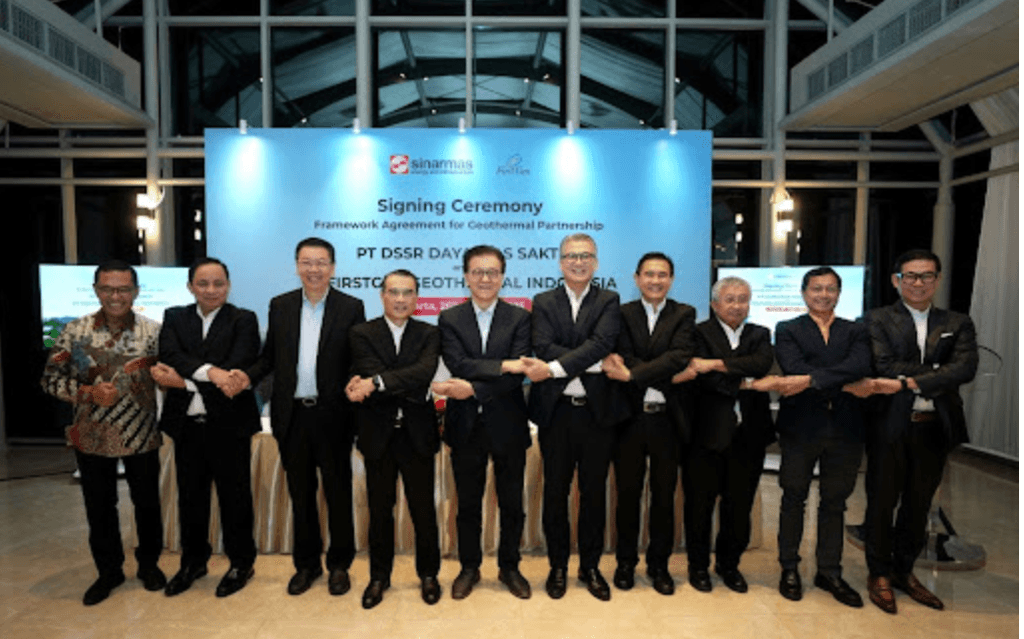
The two sides signed an initial agreement in August 2025 and formalized the partnership in Jakarta that October, pairing PT FirstGen Geothermal Indonesia with PT DSSR Daya Mas Sakti, a unit of the Sinar Mas energy company PT Dian Swastatika Sentosa. The 50-50 joint venture targets roughly 440 megawatts across 6 fields in West Java, Flores, Jambi, West Sumatra and Central Sulawesi. By March this year, EDC said the partners were looking at spending about $30 million for the exploration phase alone and hoped to begin drilling at least one well later in 2026.
Indonesia holds about 40% of the world’s geothermal reserves, according to EDC, or some 24 gigawatts. Yet only about a tenth of that potential has been developed.
What it does not have in the same measure is 50 years of EDC’s practice.
“We are bringing close to 50 years of geothermal experience and expertise to Indonesia,” Jerome Cainglet, EDC’s president and chief operating officer, said when the partnership was announced. “At the same time, we know that there is also a lot that we can learn there, which we may use in the Philippines.”
His counterpart was equally explicit about what the Indonesian side hoped to gain. “Our goal is to strengthen national capacity in geothermal development and to fully harness the country’s natural potential for clean energy,” said Lokita Prasetya, president-director of PT DSSR Daya Mas Sakti.
Puno described the same partnership to his own shareholders on September 25: the group is “bringing our expertise to Indonesia through opportunities jointly pursued with the Sinar Mas Group.”

Sinar Mas is paying to use what EDC knows, while ThermaPrime sells another part of the geothermal capability developed around EDC to outside customers. Neither requires the Lopez group to sell EDC itself.
Then came July 2026, and a different Indonesian tycoon.
PT Barito Renewables Energy, controlled by Prajogo Pangestu, made an unsolicited, indicative and non-binding proposal to acquire EDC for an equity value of approximately $5 billion, subject to due diligence, transaction documents and regulatory and corporate approvals. First Gen said at the time that there had been no discussions between the parties, no agreements signed and no advisers appointed.

The offer came while the Lopez cousins were in the middle of a public fight over control of its companies, other parts of the corporate structure were confronting their own liquidity needs, and ABS-CBN was trying to raise billions in fresh capital.
There is also a limit to how simply the Lopezes can treat EDC as theirs to sell. First Gen controls EDC with 65% of the votes but has only a 45.8% economic interest, while Philippines Renewable Energy Holdings Corporation or PREHC— the consortium through which Macquarie-managed funds and Singapore’s GIC invested in EDC in 2017—owns 34.9% of its voting stock. The structure gives First Gen control despite holding less than half of EDC’s economic upside, but it leaves another large financial investor with substantial money at stake in any change of ownership.
Then on September 21, First Gen ended the takeover speculation, telling the Philippine Stock Exchange: it “confirms that there are currently no plans to divest itself of EDC, and there are no firms, other than PT Barito Renewables Tbk, looking to potentially acquire EDC.”
First Gen’s own investment plans also show where it intends to put capital next. Puno said the company could spend as much as P160 billion over the next 5 years, including around P70 billion for geothermal exploration and expansion and more than P60 billion for hydropower, with the balance going into solar and other opportunities.
More capital is going into geothermal than into the pumped-storage hydro projects the company recently bought into.
The math behind keeping EDC is visible in First Gen’s own books. In the first half of 2026, EDC generated P29.88 billion of First Gen’s P41.15 billion in consolidated revenue, representing 72.6% of the total. Having sold 60% of its natural gas business to Enrique Razon’s Prime Infrastructure, and with its Wawa and Pakil pumped-storage hydro projects not scheduled to come online until 2030 or 2031, First Gen would be left holding a portfolio whose returns arrive largely at the end of the decade. EDC is what pays the bills today. (READ: The business case of the Lopez-Razon gas and hydro deals)
- Part 1 | Debt, discipline, and daring: Inside the Lopez Group’s high-risk bets
- Part 2 | The Lopezes, presidents, and the cost of dissent
- Part 3 | Lopez vs Lopez: The secrecy fight behind the Razon power deals
It is also earning more. EDC’s net income contribution to First Gen rose 73.5% to P3.69 billion in the first 6 months of 2026, up from P2.12 billion a year earlier. First Gen attributed the increase to higher average selling prices, improved generation across its steam fields, and battery energy storage systems that began coming online from September to December 2025.
Put those pieces together and the strategic choice becomes clear: Barito wants to own EDC, Sinar Mas wants to build alongside it, and external developers can hire ThermaPrime for the most specialized parts of the drilling. The Lopez group does not have to sell EDC to monetize what 5 decades of geothermal development built.
What the new shareholder bought
The interest in the Lopez geothermal business has also extended one corporate level above EDC.
On September 10, KKR, the American private equity firm that had held a stake in First Gen for 6 years, sold its entire holding of 715.86 million shares (19.99%) to Angsana Finance Limited, a Cayman-incorporated entity owned by Gateway Holdings Limited and managed by Singapore-based Gateway Partners, at P36 a share.
That transaction followed a formal rejection on August 15, when FPH notified the stock exchange it had turned down KKR’s proposal to acquire part of FPH’s holding and launch a voluntary tender offer for First Gen’s public float at P35 a share. “After careful deliberation and consideration,” the filing read, “FPH has determined that KKR’s proposal does not represent FGEN’s true value.” Angsana paid P36 for KKR’s block less than a month later.
Asked by Rappler at the September 25 FPH stockholders’ meeting what governance rights Angsana acquired with those shares, Puno said there was none.
“Because KKR acquired its [common shares equivalent to] 19.9% stake in First Gen directly from the secondary market, no shareholder agreement was established with FPH,” Puno said. “Consequently, Angsana did not obtain any special or contractual governance rights through its purchase of KKR’s holdings, maintaining only the standard statutory rights granted to minority shareholders under the Revised Corporation Code of the Philippines.”
The 19.9% is smaller than it looks. That total accounts only for First Gen’s common shares. Measured against First Gen’s total issued capital, which includes the voting preferred shares that FPH owns outright, Angsana’s stake comes to 14.06%.
Gateway has not publicly explained what it sees in First Gen or what it ultimately expects from its P25.77 billion outlay. The purchase by itself does not establish that Angsana expects any transaction involving EDC. But underneath those shares sits a portfolio that Puno says is now 92% renewable, built around what he called “hard to replicate assets”, with EDC at its center and an unsolicited offer already putting an approximately $5-billion equity value on the geothermal subsidiary.
What 50 years is worth
For most of its corporate life, EDC created value primarily by converting underground heat into megawatts for the Philippine grid.
But 50 years later, that accumulated know-how are creating value in several ways at once: as a cash engine that First Gen wants to keep and expand, as an acquisition target commanding multibillion-dollar benchmarks from foreign suitors, as an exportable development capability in Indonesia with Sinar Mas, and through ThermaPrime, as specialized drilling and well-engineering services that can be sold across the industry.
First Gen has already shown it is willing to sell a major asset when doing so advances its strategy. In 2025, it sold 60% of the natural gas business it had spent decades pioneering to Prime Infrastructure, releasing capital as the company shifted toward a portfolio that is now overwhelmingly renewable. At the same time, it is preparing the comprehensive redevelopment of its flagship Leyte geothermal complex and continuing to pour billions into new wells.
Its public position on EDC, despite Barito’s $5-billion approach, is unequivocal: EDC, for now, is staying.
When the Lopez group bought EDC from the government 19 years ago, the debt burden during the 2008 global financial crisis was so severe that the family famously had to surrender its controlling stake in Meralco to Manuel V. Pangilinan just to protect its balance sheet.
What they preserved was more than power plants and steam fields. They acquired an ecosystem of knowledge that had been developing since the 1970s, then spent the next 19 years adding to it. Part of that capability remains embedded in EDC’s fields, engineers and reservoir expertise, part has migrated into ThermaPrime as an independent drilling arm, and part is now being deployed across Indonesia’s volcanic belts.
In 2010, Piki Lopez wrote that the group was prepared to take EDC’s expertise into parts of the world that had only begun to tap their geothermal reserves. Sixteen years later, Sinar Mas is building with that expertise in Indonesia, Barito has put a US$5-billion equity value on owning EDC, and First Gen is putting billions more into geothermal while saying it has no plans to sell.
The knowledge, its capital allocations suggest, is worth more kept than sold. – Rappler.com
Lala Rimando wrote about Philippine business, and managed newsrooms, including Newsbreak, ABS-CBN, Rappler, and Forbes, for over 25 years. She’s now based in La Union, taking care of her mom with dementia, and working on the multimedia biography of the late John Gokongwei.
KioskNews shows a cleaned-up reading view extracted from the publisher’s page — the original always lives on their site, not ours.