To fly or not to fly: Chinese mechanic reports short-lived GE engine blades in Boeing 787
A Chinese aviation specialist has reported that some high-pressure turbine blades in US-made GE Aerospace engines powering Boeing 787 aircraft have suffered unexpectedly early damage, leaving airlines with a difficult choice: replace the engines or continue flying under strict inspection requirements.
The findings raise questions about the reliability of American aerospace products amid growing scrutiny of US manufacturing quality. According to the study, cracks can develop in some blades within about 1,000 flight cycles, potentially causing pieces of metal to break away.
“The airline’s Boeing 787 fleet recorded five engine removals caused by defects in Phase 2/2+ HPT blades,” Xia Xiaofeng, the author of the study, wrote. “All involved material loss between cooling holes on the blades’ convex surfaces.”
The 787 aircraft has two engine suppliers to choose from: General Electric GEnx-1B and Rolls-Royce Trent 1000.
A flight cycle refers to one complete take-off and landing. Early blade damage does not necessarily make an engine unsafe to operate, but airlines must monitor its progression and arrange replacements before defects exceed permitted limits, adding to maintenance costs and operational pressures.
The findings come as American aviation manufacturers face persistent questions over quality control and safety. Two fatal Boeing 737 Max crashes in Indonesia and Ethiopia in 2018 and 2019 killed 346 people and led to the aircraft’s worldwide grounding.
The two B737 Max crashes were related to MCAS, the software, and the door blowout was because four bolts were left off at Boeing’s factory. The FAA order is a manufacturing issue that could lead to wing fatigue cracks. The Air India incident is still under investigation.
In January 2024, a door plug blew out of an Alaska Airlines 737 Max 9 during flight. US investigators later attributed the incident to inadequate training, guidance and oversight of factory workers at Boeing.
Scrutiny has also extended to Boeing’s 787 Dreamliner. In August, the US Federal Aviation Administration issued an airworthiness directive requiring inspections of certain 787 aircraft.
The aircraft came under renewed scrutiny after an Air India Boeing 787-8 crashed shortly after taking off from Ahmedabad on June 12, 2025, killing 260 people, including 241 on board. The cause of the Air India Boeing 787 crash remains under investigation.
02:40
Air India plane bound for London crashes moments after take off in Ahmedabad
The research, written by Xia of Xiamen Airlines, was published in the September issue of the Chinese aviation industry journal Aviation Maintenance & Engineering. It examined first-stage high-pressure turbine blades in the Phase 2 and Phase 2+ configurations of GE’s GEnx-1B engines, drawing on global fleet data and maintenance experience from an unnamed Chinese airline.
Although the blades incorporate cooling improvements over earlier designs, their reliability in service has fallen short of expectations, with some experiencing premature deterioration, according to the paper.
High-pressure turbine blades operate under extreme temperatures and mechanical stress. They have heat-resistant coatings and internal cooling passages to withstand these conditions.
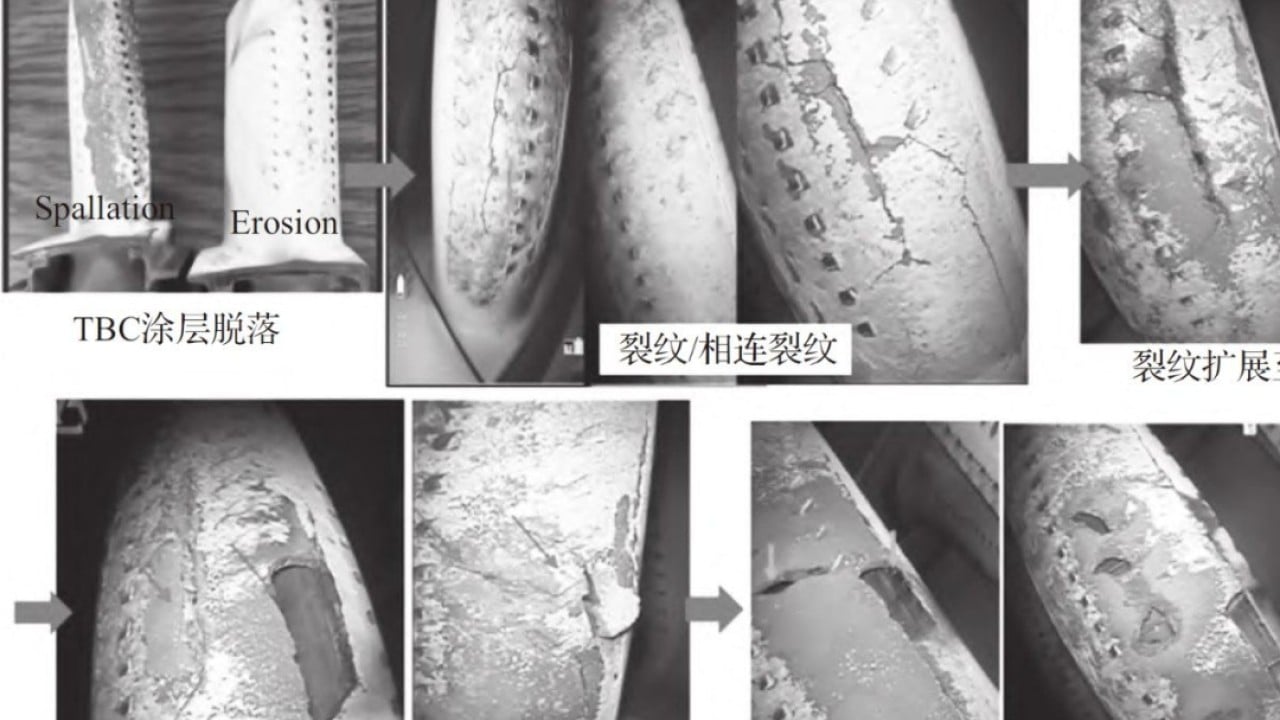
“Within about 1,000 cycles of installation, the blades often develop radial cracks,” Xia wrote. “These cracks typically appear between the first and second, or second and third, rows of cooling holes on their convex surfaces.”
The cracks can spread and connect, eventually causing pieces of metal to break away.
“According to GE’s analysis, the cause of the defect is thermal fatigue,” Xia wrote. “This is a form of low-cycle fatigue closely associated with stress concentrations caused by the geometry of the affected area.”
The study also identified other types of damage, including deterioration of thermal barrier coatings along the blades’ trailing edges, which can expose the underlying metal to oxidation and further damage.
Cracking and lifting of the blade-root platform have also been observed in high-thrust GEnx variants, causing three engine removals across the global fleet.
The paper detailed how one Chinese airline managed a damaged engine, identified only as 956XXX, after a borescope inspection found material missing between two sets of cooling holes when its turbine blades had completed 1,818 flight cycles.
Under the applicable aircraft maintenance manual, the engine would normally have had to be removed for repair within 10 additional flight cycles. The airline conducted an engineering assessment and sought GE’s approval to extend its operation.
GE initially recommended another borescope inspection within 10 cycles.
“A follow-up borescope inspection after eight cycles confirmed no significant progression of the defects,” Xia wrote. “After the findings were reported to GE, the manufacturer approved another 30 cycles of operation.”
The airline ultimately operated the engine for only four more cycles before removing it for maintenance, after securing a spare engine and arranging the replacement. It had completed 12 additional flight cycles since the defect was first detected.
The South China Morning Post has contacted GE Aerospace for comment.
The case highlights the challenges airlines face when engine components are damaged but have not reached the limits requiring immediate removal.
Replacing an engine prematurely can incur substantial maintenance costs, require spare equipment and disrupt flight schedules. However, damage that progressed beyond permitted limits can make continued operation unacceptable.
As of August 2025, about 417 GEnx engines worldwide, accounting for 15 per cent of the global fleet, were still operating with Phase 2 or Phase 2+ turbine blades, according to GE data cited in the study.
The longest recorded time on-wing for the configuration was 4,729 flight cycles, compared with 3,683 cycles for engines operating in severe environmental conditions. The figures show variations in service performance, although the study did not establish a fixed replacement life for the blades.
As more operational data became available, GE repeatedly revised its maintenance criteria. Some relatively small areas of material loss that might previously have prompted engine removal can now be monitored through repeat inspections at intervals of 100 or 250 flight cycles, depending on the nature and severity of the damage.
The revisions have helped increase the average number of cycles accumulated before affected engines are removed, according to the paper. Some engines have also received newer blade configurations, although the study recommended continued monitoring of their long-term reliability.
Xia recommended more frequent inspections where appropriate for blades with more than 2,000 cycles, alongside closer monitoring of engine vibration, exhaust gas temperature and other operating parameters.
KioskNews shows a cleaned-up reading view extracted from the publisher’s page — the original always lives on their site, not ours.