From five-fingered trainers to the shoeless shoe: what’s with all the freaky footwear?
Until recently, a busy commuter train would be packed with people wearing low-key, unobtrusive shoes. An elegant and inoffensive pump, a sporty trainer or a polite and basic ballet flat, they were the type of shoes that said background extra rather than main character energy.
But now change is afoot. Deliberately strange designs are reaching new heights of desirability. Polarising rather than pretty, these shoes tend to be flat, a little bit orthopaedic and, according to the internet, “ugly”.
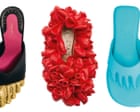
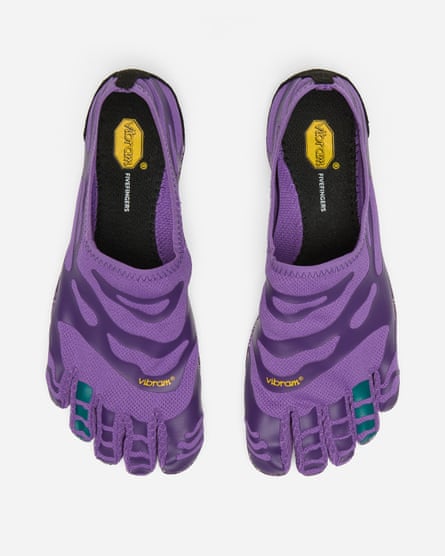
From Vibram’s glove-like FiveFingers, which punctuate each toe, to barely there mesh shoes that leave the foot looking like a boned and rolled ham at Christmas, fashion’s new favourite shoes are leaning into the ludicrous. Welcome to the new era of freaky footwear.
“We are now at a liberating place where more people can have fun with their shoes,” says Dal Chodha, a writer and lecturer at Central Saint Martins fashion school in London. He finds this trend “thrilling”, saying it “forces someone to embrace the jolt of something that feels ugly or absurd”. While previously these designs were confined to the catwalks, they are becoming more common on the streets.
According to the fashion search platform Lyst, demand for cloven hoof-like Tabi styles, designed to split the hallux (big toe) from the rest of the toes, has increased fourfold since 2022. Meanwhile, FiveFingers are up 57% year on year.
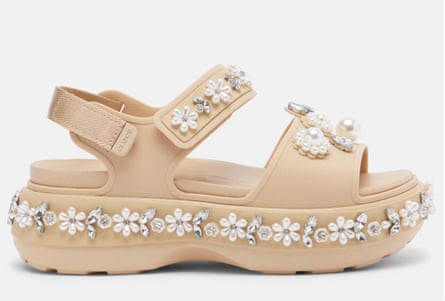
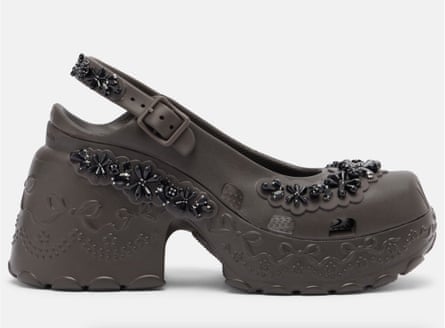
Shoes that were once reserved for taking out the bins or nipping round the corner for milk are now increasingly being worn to the office – and even weddings. Simone Rocha has created supersized Crocs and smothered them in pearls and gemstones, while Etro joins Dior and Valentino in reimagining Birkenstocks’ “anti‑fashion” cork footbed clogs.
This summer, the hype for a pair of Gardanas, £38 earthworm-coloured French gardening clogs, led to lengthy waiting lists (and not only for the green‑fingered). Celine sells a similar mossy-coloured pair for £670.
Meanwhile, on the high street everywhere from John Lewis to Zara is championing the “Frankenshoe”, such as sneakerinas, an amalgamation of a sneaker and a ballerina flat. These new cross-breeds include the snoafer, a marriage between a sneaker and a penny loafer.
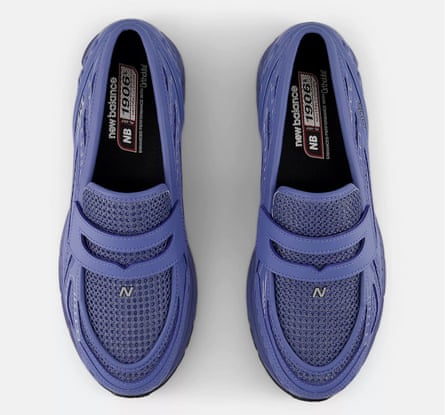
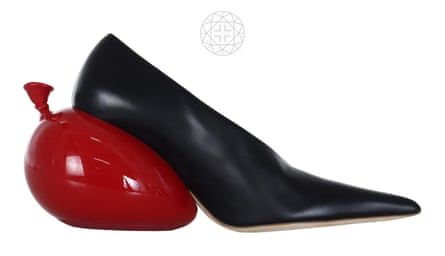
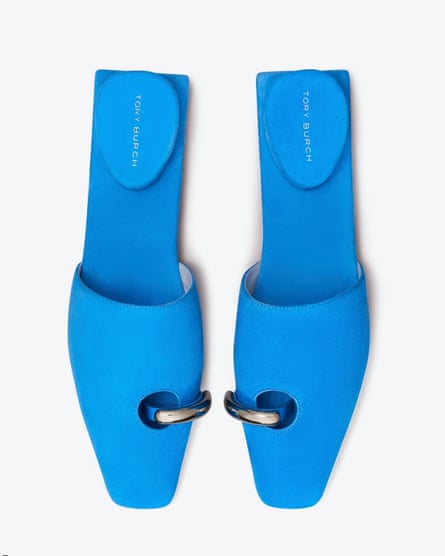
Heels haven’t completely disappeared, but they have been re-envisioned as deflated balloons and even broken eggs. In American designer Tory Burch’s latest lineup, she inverted the heel itself, creating the illusion of a flat mule while simultaneously elevating the wearer. A stubby “nipple heel” measuring half an inch is now the sought-after height.
Valerie Steele, chief curator of the Museum at the Fashion Institute of Technology in New York and author of Fetish: Fashion, Sex & Power, says society has a long history of strange shoes. She points to medieval poulaines, a shoe with an elongated toe that showed the wearer’s social ranking. Some were so long they had to be fastened to the knee to prevent tripping. Chopines, towering platform shoes worn by women from the 15th century, were also used to denote status, while in ancient Greece sex workers are reputed to have worn sandals with “Follow me” carved into the soles. Steele says today’s purposely strange designs let the wearer “play with elements of ugliness”, allowing someone to make a fashion statement without committing to a whole look. “Shoes are far away from your face, so you can experiment without looking ugly,” she says.
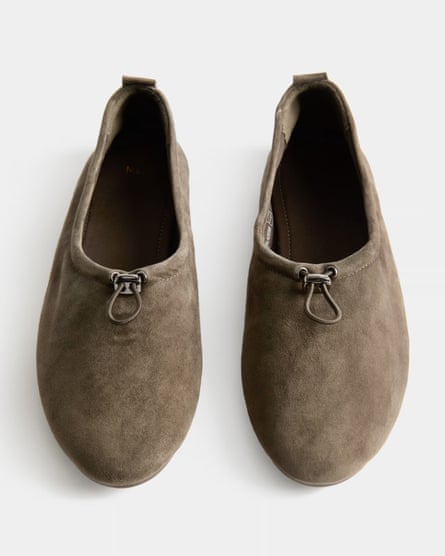
Chodha, who as a teenager wore Nike Air Rift trainers featuring a split-toe design, now favours a “potato” shoe. As the name suggests, this style of footwear isn’t dissimilar to a freshly dug maris piper. Even M&S has got behind the spud style. A £45 bulbous, soft suede pair has become one of its fastest-selling options for autumn.
For some, provocation is part of the appeal. “Anyone who is resisting standard forms of beauty or propriety or practicality in their choice of footwear is in some way embracing a punk spirit,” Chodha says. They also offer an opportunity to “challenge what and why we think something is ugly”.
Barbara Janeczek, curator manager at Lyst, says designs are becoming more extreme as “fashion has an incredible ability to normalise the previously unwearable”. She describes today’s iterations as “exposing, dividing or framing the foot in ways we’re not used to seeing”.
Tiffany Hsu, chief buying and group fashion venture officer at the luxury e-tailer Mytheresa, prefers the term “talking point shoes” rather than ugly, explaining that the style is “designed to create a reaction and bring something unexpected to a look”. Lars Byrresen Petersen, founder of a popular shoe meme account @ LarsLaLa, favours the word “extreme”. Some of his most liked posts are where he has compared shoes to condoms and mops.
The popularity of the trend can be pegged to the “wrong shoe theory”, a term coined by stylist Allison Bornstein in 2023. This styling trick involves purposely wearing an unexpected shoe (think a kitten heel with tracksuit bottoms, or flip-flops with tailored trousers) to make a look more interesting. Bornstein says a shoe that is a little “off” works because “it signals that there is some intention and choice, and therefore it gives your look personality”.
Some view the trend as a backlash against the uniform pageantry of the Maga aesthetic. Republicans love a nude pointy-toe stiletto almost as much as the presenters of Fox News. “When politically there is a big right swing, you have a lot of people that through their clothing want to say, ‘I’m not that,’” Steele says. A freaky shoe can be like a “secret masonic handshake”, she adds.
after newsletter promotion
The hoof-type Tabi shoe was first thrust into the spotlight in the 1980s, when Martin Margiela featured the subversive riff on a 15th-century Japanese sock design in his debut collection. Now the Tabi-ification extends to trainers, ballet flats and Mary Janes across various brands. Byrresen Petersen, who has been wearing the style “every day for the past 10 years”, isn’t thrilled about their new universal appeal. “People who aren’t familiar with the shoe’s history are just wearing them for the shock value,” he says.
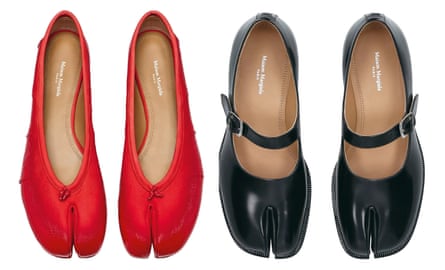
While some freaky shoes conceal the foot, it’s the toe‑bearing styles that are really captivating fashion. Similar to Hollywood’s naked dressing trend, they offer a quick flash of foot or even a full-frontal view of each toe. It’s a trend as divisive as Curtsy’s toe separator inspired heels– where each toe is embraced in its own thong strap.
Steele says feet and shoes have long been fetishised, as the outline of a foot can be compared to a miniature version of the human body. Toes can be squeezed together to create “cleavage”, while the round curve of the heel is considered similar to the bum. Steele says it was once thought to be “erotic” to wear a slingback. “You were letting your ‘butt’ hang out!”
It’s a trend growing against the backdrop of the mainstreaming of foot fetishes. The photo-sharing site Wikifeet, which ranks celebrities’ feet for their beauty, gets nearly 20m views a month. (Rihanna and Margot Robbie score five stars while Michelle Yeoh currently sits at a one.) Selling foot pics has become a lucrative side hustle for many, including the singer Lily Allen, who shares hers on OnlyFans, a subscription-based site most commonly featuring porn. Allen, who posts under the username FTSE500, has said she makes more money from #feetpics than she does from Spotify streaming. On social media, the phrase “No free feet pics” plays into the idea, with users carefully cropping photos so their exposed toes aren’t on display.
While “potato shoes” are prevalent in menswear, toe-framing styles are less so. Saint Laurent recently horrified viewers when it sent male models down the catwalk wearing transparent PVC Oxford brogues. When Alexander Skarsgård wore them on the red carpet, they quickly became clouded with condensed perspiration. “I asked myself, ‘Why torture women with plastic shoes, but not men?’” Anthony Vaccarello, who helmed the brand at the time, remarked on the idea behind them.
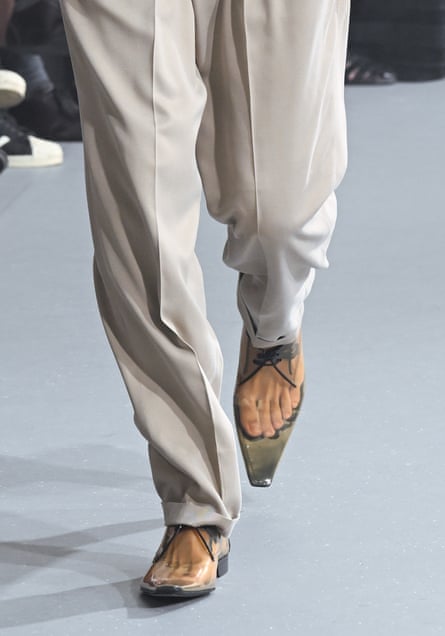
Steele points out that masculinity has been historically associated with heavy boots: “Men’s fashion generally emphasises sexuality through tightness or padding, not so much through body exposure.” Naked toes suggest vulnerability and, “Men don’t want to look vulnerable. They’d rather look armoured.”
Why are shoes getting so freaky right now? Chodha says that, like the miniskirt in the 60s, these styles are rebellious and liberating. They can be viewed as an extension of the writer Leandra Medine’s “man repeller dressing”, where the wearer prioritises their own likes and comfort over the diktats of the traditional male gaze. Others view it as a rejection of millennial “girlboss” culture, a movement that glamorised a relentless work ethic associated with spike heels and polished looks, which is now considered toxic by gen Z.
Or could it be connected to the economic moment? A recent report warned that the UK was at risk of “a lost generation”. From a lack of job opportunities to the housing crisis and increasing fears over the use of AI, many young people are deeply anxious about their future. As a result, some are embracing a “soft life”, prioritising comfort and a focus beyond the 9-5. Grounding rather than grinding – a five-finger shoe that connects the wearer with the soil beneath them fits the moment. The writer Liana Satenstein has described that particular shoe as “an orgasmic exhale for the foot”.
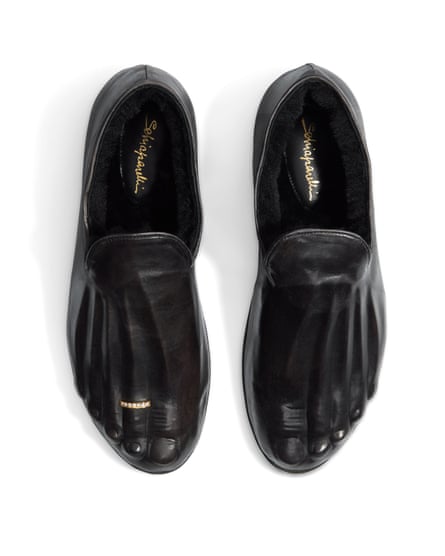
“There’s a sort of jouissance to the walk young people walk,” says Chodha. “I don’t think young people are marching or stomping, because, of course, they all feel so disengaged with the world.” While their predecessors furiously click-clacked around in skyscraper heels, today’s twentysomethings are more likely to be found padding around slowly with a matcha in hand. Chodha says that the heeled stomp “feels out of step with the time”.
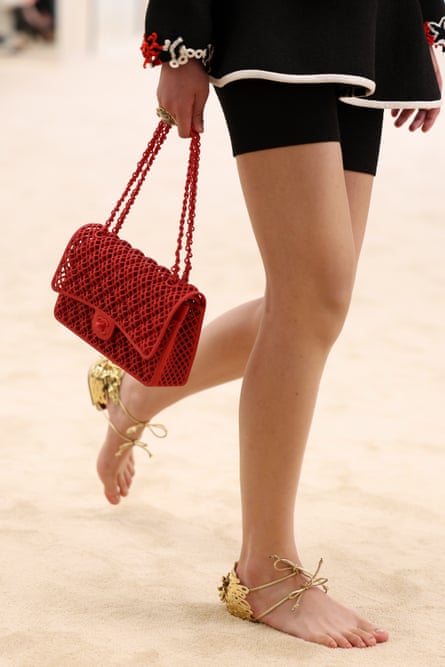
Where next? “Once everyone gets comfortable with the weird thing, you have to find something weirder,” says Janeczek, who credits “fashion’s one-upmanship” for playing a role in fuelling the trend for weird shoes. Chanel has offered a pilot run of what that might look like, challenging the very definition of what constitutes a shoe. Its “shoeless shoe”, first seen during its catwalk show in Biarritz in France in April and later worn by Margaret Qualley to a London film premiere, features just a heel cap, bearing its double CC logo, leaving the bare foot to walk without any protection at all.
KioskNews shows a cleaned-up reading view extracted from the publisher’s page — the original always lives on their site, not ours.