Polish leaders join thousands at silent march in Kraków for mass shooting victims
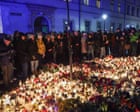
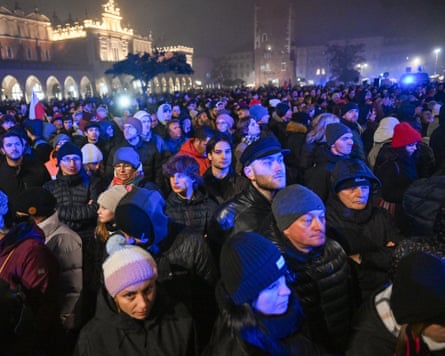
Tens of thousands of people joined a silent march in Kraków on Monday evening, led by Poland’s president and prime minister, in tribute to the victims of a mass shooting that shocked the country over the weekend.
They set off from the city’s historic market square, where the attack unfolded on Saturday afternoon. Mourners stopped at a flower-covered memorial marking the spot where the gunman opened fire from his car, killing six people and wounding 15 others.
Nationalist president Karol Nawrocki and the centrist prime minister, Donald Tusk – political rivals rarely seen side by side – led the crowd through the city alongside Kraków’s mayor, Lukasz Gibala.
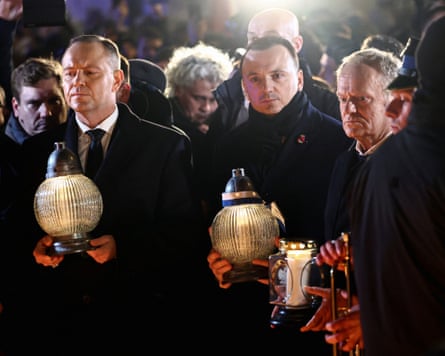
“For Poland, this is always a sign of hope: that while we may hold different views, we are still capable of cooperating, engaging in dialogue, and seeking out what unites us,” deputy prime minister Władysław Kosiniak-Kamysz told TVN24. “We are capable of showing solidarity during difficult times. Together, we can support those who need such support.”
A Polish man accused of carrying out the Kraków attack died in hospital on Monday, two days after he was critically wounded in a gunbattle with police, authorities said.
He had originally been linked to the far right but prosecutors said later that his reasons for killing nine people, including three family members, remained unclear.
The 24-year-old, dressed in military garb, allegedly opened fire with a semi-automatic rifle in Kraków’s main market square, killing six people. The bodies of his parents and a sister were found at the family home in another town.
Two police officers, who were seriously wounded in the chase, shot the man at an intersection near the market square. After three operations, the suspect was declared dead, regional authorities said.
Prosecutors identified the man as Michał Oksiński, 24, from the south-eastern town of Ostrowiec Świętokrzyski.
Authorities had previously said the man had been “fascinated by far-right ideologies” and Tusk called the shooting – the deadliest in the country since the fall of communism in 1989 – an act of “terrorism”.
But at a press conference on Monday, prosecutors said there was no evidence tying the suspect to any particular political bent.
“We do not have findings that we could, in a responsible way, categorically state that he was inspired by any particular ideology,” national prosecutor’s office spokesperson Przemysław Nowak said.
“It is far too early to comment on the motives ... We have not found any obvious symbols that are generally associated with a particular political movement, whether far right or far left. ”
An interior ministry spokeswoman told Polish radio that the “many emblems and patches” on Oksiński’s clothing were being analysed as part of the investigation.
The six people killed in the Kraków shooting spree included an Austrian woman and a British man, according to authorities, while the 15 wounded included Austrian, British, German, Portuguese and Russian nationals.
The injured were in a “stable” condition on Monday, authorities said.
While Oksiński’s motives are unclear, investigators are treating the shooting spree as a terrorist incident. He had no prior criminal record, according to investigators cited by Polish media.
Along with his father, the suspect was a member of a shooting club. Investigators seized 11 firearms during the search.
His grandmother said Oksiński had obtained a gun licence this year, according to Polish media.
Following the shooting, the interior ministry announced a review of the conditions for granting gun licences, with the licence-holder’s medical records to be updated regularly.
Poland has seen a sharp uptick in the number of firearms permits. In 2025, more than 50,000 new licences were awarded, bringing the total to 411,000, according to the police.
KioskNews shows a cleaned-up reading view extracted from the publisher’s page — the original always lives on their site, not ours.