Spider-Man 2099 has a Día de Muertos secret in his origin story
There may not be another superhero who is more globally renowned or imitated than Spider-Man (sorry, Superman and Batman, but you can sit this one out).
In my neighborhood’s main square, there is a man who regularly dresses up as Spider-Man and web-thwips his way into photos for a few pesos. Driving around Mexico, I’ve seen motorcyclists wearing Spider-Man-themed helmets. There’s even an official spinoff Spider-Man character, nicknamed Arácnido Jr., who hails from Mexico City and has a luchador father.
Just learned that Marvel has a Mexican Spider-Man named Arácnido Jr. who is the son of a luchador & protects Mexico City. He appeared in one of the “Spider-Verse” comics & was created by Enrique Puig & Francisco Herrera. He’s been around since 2015. Can’t believe I didn’t know 🇲🇽 https://t.co/h38pTyT9m8
— Carlos Aguilar (@Carlos_Film) August 2, 2020
It’s not just Mexicans who love El Hombre Araña, though. Right now, Spider-Man is at an all-time commercial high.
“Spider-Man: Brand New Day” has been the most commercially successful blockbuster of the year so far. As of writing, the movie has generated more than US $923 million globally, beating out “Toy Story 5” and “The Odyssey” as the highest-grossing film of 2026, to date. In July, the movie’s star cast members even visited Mexico City to promote the film.

A futuristic webslinger with Mexican roots
Add to that a newly reinvigorated generation of Spider-Man fanatics with the children’s animated series “Spidey and His Amazing Friends” — a show that currently ranks as the third-most-watched show for kids between ages 2 and 5 (including my son, who is obsessed), with billions of streaming hours on Disney+.
Across every metric, Peter Parker is a tried-and-true hit.
Becoming a kid again: How Mexico has unleashed my inner childhood superhero
But what about Marvel Comics’ other Spider-Man? The one who lives in a futuristic 2099 version of New York City (creatively renamed Nueva York) and is of Mexican Irish descent? I’m talking about Miguel O’Hara.
Created by Marvel in 1992 as part of a larger effort to refresh the brand and reconfigure its legendary characters with a larger “Marvel 2099” wave of alternate-universe storylines, O’Hara is a geneticist working for a mega-wealthy corporation, Alchemax. Rather than being bitten by a radioactive spider as the original Parker is, O’Hara is researching the by-then-archaic Spider-Man of former New York City (fourth-wall meta stuff, I know) and attempting to replicate that Spider-Man’s powers for the greedy Alchemax corporation, a private entity that happens to govern the United States through its wealth and militant force.
The unusual origin of the Day of the Dead suit
Like any true superhero origin story, O’Hara is unexpectedly turned into Spider-Man 2099 when a villainous Alchemax colleague throws O’Hara into the mutation machine that is conveniently set to the original Spider-Man’s specifications. O’Hara gets zapped. He transforms. He learns how to wield his powers and manage his personal relationships across hundreds of issues. The usual.
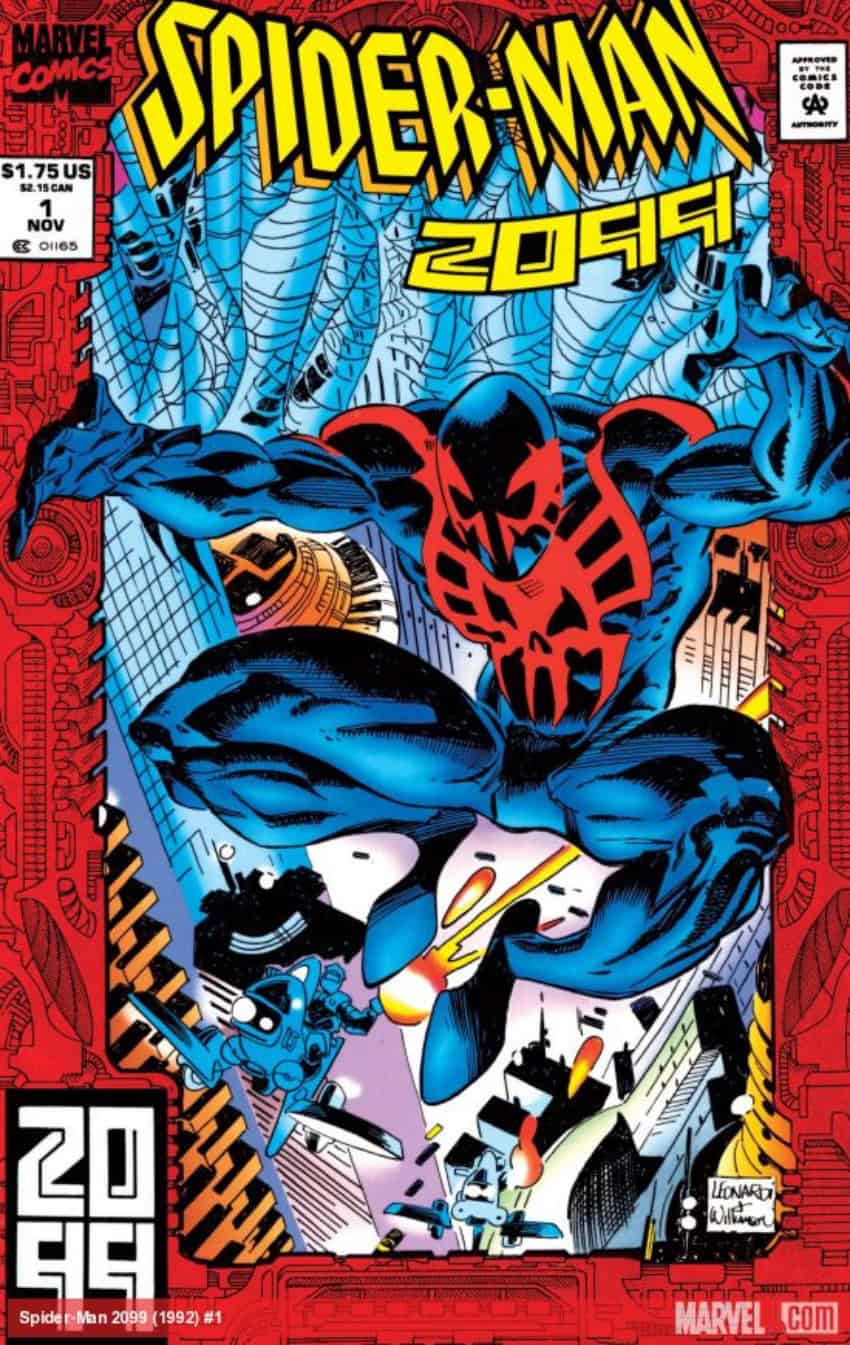
Here’s the unusual part, though: O’Hara — or rather, his alter ego Spider-Man 2099 — is equipped with a Day of the Dead costume rather than a traditional Spider-Man onesie.
Early on, the comics (created by Peter David and Rick Leonardi) establish that not only is O’Hara of Mexican descent, but that he took a trip down to Mexico City for a “The Jetsons”-style Day of the Dead.
There are multiple allusions to it in the opening issues of the series, with a backstory that goes something like this: A pre-superpowers O’Hara returns to his mother’s homeland south of the border (her name is Conchata, and she also appears as a character early on). There, he attends a festive Day of the Dead celebration. In this dystopian future, there is a special fabric referred to as “UMF” — or Unstable Molecule Fabric, as explained in the series — that is both indestructible and highly versatile, something O’Hara deems necessary for the rowdy Día de Muertos crowds and festivities in 2099.
Dystopian fashion and geometric design
I know all of this because I ordered a 1,384-page omnibus of “Spider-Man 2099” and have been reading it for weeks.
“Only thing I own made from UMF is this death’s head costume I brought when I went to Mexico last year for the Day of the Dead festival,” O’Hara says in issue No. 2. In the background, silhouettes of festivalgoers dressed as skeletons and demons wander as he recalls: “Festival can get pretty wild. I wanted something extra sturdy.”
The suit itself is futuristically cool, for lack of a better description, though not overly Day of the Dead-themed. It features a bright red skull-like design at the center of the chest, which extends into stripes that flare down and outward in the opposite direction, wrapping around the shoulder in a shape that loosely resembles a spider’s many legs with a geometrically balanced aesthetic. The base of the suit retains a much deeper shade of blue than the original webslinger.
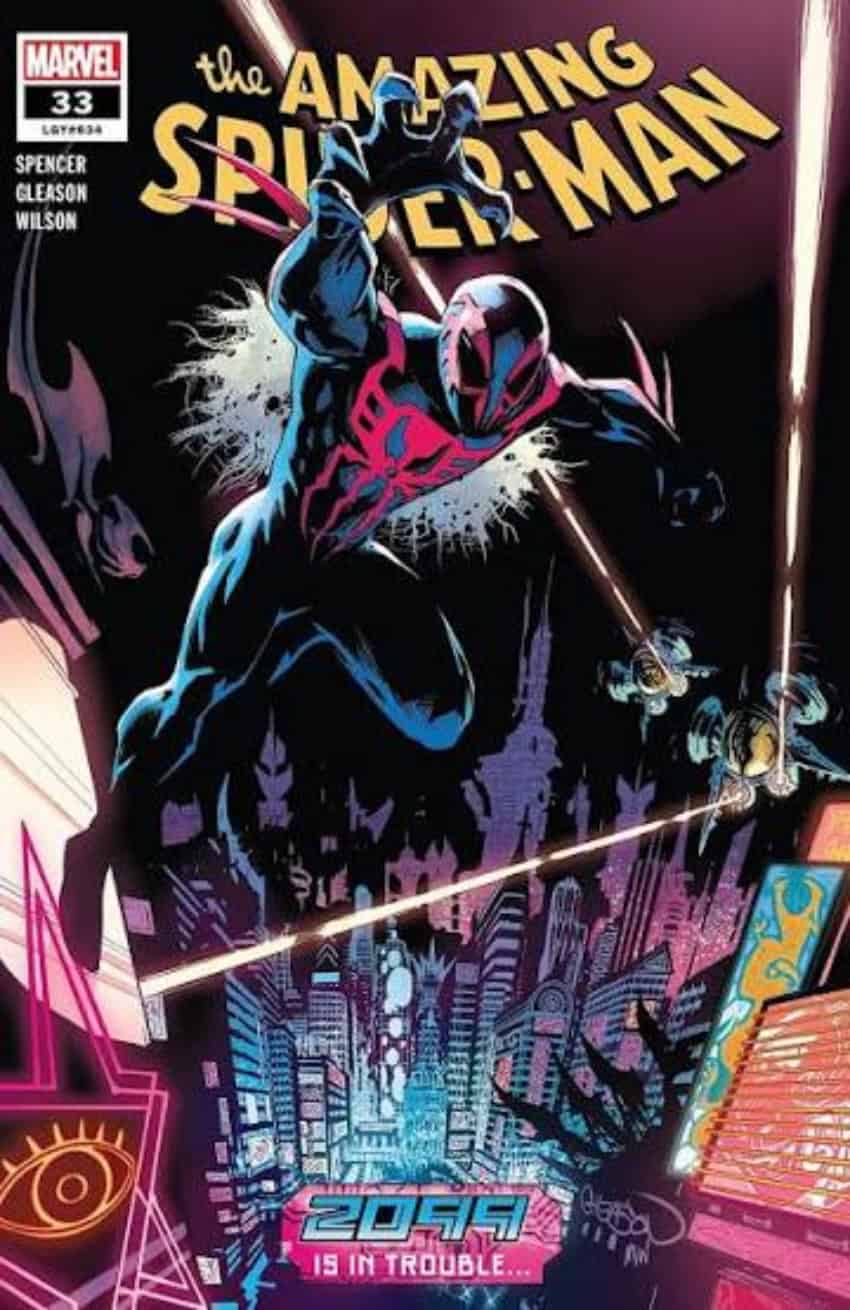
In all, it retains the essence of Spider-Man’s original garb, with subtle nods to Day of the Dead aesthetics.
Reincarnation and honoring the fallen heroes
O’Hara’s suit and abilities are rounded out with razor-edged retractable talons for climbing surfaces and annihilating his foes, and spikes protruding from his forearms, which seem to be a menacing suit accessory. Though not overtly Mexican or Day of the Dead in its presentation, if you squint, you can sense minor inspirations from Mexico’s Indigenous past and geometric design work.
Simple, but striking. Creative, but balanced.
The Day of the Dead theme does, however, emerge in the storyline — with additional references to Mexico, and even an entire issue titled “Day of the Dead.” In it, O’Hara takes a trip to Mexico City, where he battles zombies who have been mass-reincarnated by Fernando Morgez, a Mexican character who had hoped to revive his late sister, Anita, but brought back more than he anticipated.
Mexico’s Day of the Dead is a series undercurrent
The idea of life and death, reincarnation and honoring the deceased is an undercurrent throughout the entire series. In the 2099 timeline, the Avengers are more myth than reality, with previously indestructible characters like Thor and Peter Parker’s Spider-Man being remembered as deceased gods who are revered and worshiped by cultish hordes of followers.
That is, the world’s heroes of yesterday have fallen, and the living must find ways to cope with that remaining void.
In that sense, the series certainly has touches of Mexico’s Day of the Dead — a remembrance of those who are no longer physically present, but perhaps offer spiritual hope and a connection to, if not preservation of, the past.
Alan Chazaro is the author of “These Spaceships Weren’t Built For Us” (Tia Chucha Press, 2026), “Notes from the Eastern Span of the Bay Bridge” (Ghost City Press, 2021), “Piñata Theory” (Black Lawrence Press, 2020), and “This Is Not a Frank Ocean Cover Album” (Black Lawrence Press, 2019). He is a graduate of June Jordan’s Poetry for the People program at UC Berkeley and was selected as a Lawrence Ferlinghetti Poetry Fellow at the University of San Francisco. His work can be found in NPR, The Guardian, SLAM, GQ, L.A. Times, and more. He is currently based in Veracruz.
KioskNews shows a cleaned-up reading view extracted from the publisher’s page — the original always lives on their site, not ours.