Trump rolls out the red carpet for Xi despite U.S.-China tensions
Washington — President Trump is offering a warm welcome to Chinese President Xi Jinping this week as the U.S. tries to choke China's supply of semiconductor chips for artificial intelligence advancement, as the two countries determine whether their fragile truce on tariffs will continue, and as concerns mount about China's relationships with Iran and Russia.
Xi's visit to the White House, the first in more than a decade, will feature a state arrival ceremony Wednesday, with Mr. Trump taking part, along with U.S. military personnel. Thursday will bring a formal meeting of the two presidents and a state dinner. Xi's wife, Peng Liyuan, is joining the trip.
Mr. Trump and Xi last met in May, when Xi welcomed the U.S. president for a state visit in Beijing.
What to expect on the schedule
On Wednesday evening, Mr. Trump is welcoming Xi and his wife at Joint Base Andrews, a rare instance of a sitting president leaving the White House and greeting a foreign leader on the tarmac. Mr. Trump and past presidents typically await foreign leaders at the White House.
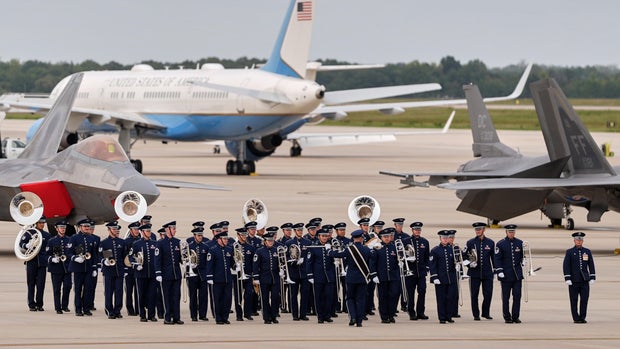
On Thursday morning, the president and first lady Melania Trump will host an arrival ceremony for Xi and his wife on the White House South Lawn. The White House says the ceremony will feature nearly 500 service members from all branches of the U.S. military.
The U.S. and Chinese flags will be displayed on the South Portico, according to the White House. The U.S. Marine Band will play the anthems of both the U.S. and China, the White House says. Then, both Mr. Trump and Xi are expected to speak.
The arrival ceremony is also expected to have a military flyover with a B-2 Spirit bomber and four F-22s.
The presidents' spouses are expected to visit the Smithsonian National Museum of Asian Art on Thursday while Mr. Trump and Xi meet. A state dinner will be Thursday evening.
On Friday, the couples will have tea at the White House before heading to the National Archives. The visit will then conclude.
China experts say not to expect many big policy achievements
China experts say to not expect many tangible policy outcomes from the meeting. James Lewis, a distinguished fellow with the Tech Policy Program at the Center for European Policy Analysis, said there "isn't much of a formal agenda" for the two leaders.
"I'm not anticipating very much — I don't think anyone is," Lewis said. "Because this is largely for show. And it's largely a discussion between two very cautious and two very suspicious leaders."
"I don't think there's too much hope for policy achievements," said Jake Werner, director of the East Asia Program at the Quincy Institute for Responsible Statecraft.
"Probably more than anything, Trump loves a show," Werner added. "He loves to put on a show. And secondarily, he thinks he has a relationship with Xi Jinping, who he thinks is a big, strong man, and he values those sorts of relationships. And then I think … he has a desire to make sure that China doesn't use the power that it demonstrated that it has last year when it cut the U.S. off of rare-earth elements, and American factories started shutting down."
Mr. Trump has often praised Xi and cast his warm personal relationship with the Chinese leader as an asset. During his visit to Beijing earlier this year, Mr. Trump called Xi a "great leader" and said the two men have always been able to work out their disagreements.
As for the disagreements that could dominate this week's visit: This is the meeting of the three "Ts," as Lewis put it — trade, tech and Taiwan.
What Trump and Xi may discuss on tariffs and trade
On trade, the U.S. and China will have to decide whether to extend a truce on tariffs that expires on Nov. 10.
That deal, struck in Busan, South Korea, in October, lowered tariffs levied by both countries and paused restrictions on Chinese exports of rare earth minerals. It also said China would continue to buy large quantities of U.S. soybeans, a pledge China has failed to keep.
The truce allowed the two countries to climb down from a tit-for-tat trade war that sent U.S. and Chinese tariffs to more than 100% at one point in spring 2025.
Treasury Secretary Scott Bessent, who met with Chinese Vice Premier He Lifeng over the weekend, said the Chinese have proposed a "bigger deal" on trade between the U.S. and China, beyond the trade truce brokered in Busan, South Korea, in October.
Bessent said Mr. Trump and Xi may meet "up to four times" this year, so they're open to different approaches. Thursday will be their second meeting.
"We're open to the idea of just continuing the Busan arrangement, or examining the bigger deal," Bessent told reporters Wednesday. "We're fine with both, and we're going to do what's best for the American people."
On Fox News Monday, U.S. Trade Representative Jamieson Greer said there will be an announcement establishing a U.S.-China "Board of Trade," which will determine a "relatively small subset of goods" that the two countries agree they should protect from trade disputes. That may include things like low-tech consumer goods and some agricultural products, Greer said. The idea of such a board was discussed when Mr. Trump and Xi met in May.
Trump and Xi may discuss artificial intelligence
Amid growing public pressure for the U.S. government to implement more safeguards around advanced artificial intelligence, Bessent shared over the weekend that the U.S. has proposed a new "notification system" alerting AI incidents that affect national security. He made the announcement following a meeting with Chinese Vice Premier He Lifeng.
"We want a shared vision of common goals and common threats," Bessent said, according to the Associated Press. "We think that just like any cross-border activity, that moving from opaque to more transparency between the No. 1 and the No. 2 AI powers in the world is very important."
It's not yet clear if Mr. Trump is on board with that idea. His most-voiced concern about AI is the need for the U.S. to beat China, and he has spoken out against the idea of reining in the speed of AI research. He slowed and altered an executive order allowing the government to voluntarily review the latest frontier AI models before they are released.
Lewis said Xi wants access to advanced computer chips and to be able to sell memory chips to the U.S. Nvidia, one of the leading designers of the chips that power AI models, is currently prohibited from selling its most advanced products in China, though Mr. Trump has allowed it to sell its H200 chips to "approved customers."
There is also growing concern that Chinese AI developers are using a method called "distillation" to train Chinese AI models based on U.S. frontier models, according to the federal government's Cybersecurity and Infrastructure Security Agency.
AI is on the Trump-Xi agenda, a White House official told reporters on a call Friday on the condition of anonymity, although the person didn't elaborate. A reporter asked the White House official if the president will have a substantive call with Xi about AI safety, and if Mr. Trump is prepared to extend or renew the existing semiconductor chip-related licenses with China.
"Those are both on the agenda, both AI and the current 'Busan' truce, and we'll know more once the two leaders meet," the White House official said.
Taiwan is a key issue for Xi
Beijing is looking to reclaim Taiwan and wants the U.S. to stay out of the way, Lewis said. The U.S. has a multibillion-dollar deal to sell arms to Taiwan, and "the Chinese hate that," Lewis said.
When Mr. Trump visited Beijing in May, Chinese state media reported that Xi warned Mr. Trump of potential "clashes and even conflicts" if the Taiwan issue isn't "handled properly." Xi has said China's "reunification" with Taiwan is "unstoppable," and the Trump administration has given little indication it wants to intervene, despite decades of U.S. support for Taiwan's autonomy.
"Xi has very definite goals with Taiwan and hopefully Trump won't misspeak and make any kind of concessions," Lewis said.
Taiwan is far and away the world's largest producer of semiconductor chips, one of the many issues at play should Beijing move to take control of the island of more than 23 million people. Advanced chip technology is critical for AI. Mr. Trump has sought to bring more semiconductor chip manufacturing to the United States.
Will Trump talk about Iran?
It's not clear whether Mr. Trump will press Xi on any Chinese entities' involvement in the war with Iran.
Last week, Mr. Trump dismissed a report from the Wall Street Journal that Chinese entities provided Iran with satellite imagery of a base used by U.S. soldiers before an Iranian strike killed three U.S. soldiers and wounded four others in Jordan. Instead, Mr. Trump offered a nod of appreciation for Xi.
"I think he's behaved reasonably well, and we behave reasonably well," Mr. Trump said of Xi regarding Iran.
China's trade relationship with Russia is also drawing scrutiny amid the Russian invasion of Ukraine. Last week, Mr. Trump signed a bipartisan bill that calls for hefty tariffs on the largest importers of Russian oil — a list that China tops.
Some members of Congress are concerned about the visit
Republican Sen. Roger Wicker, chairman of the Senate Armed Services Committee, said Tuesday that the red carpet shouldn't be rolled out for Xi. And he rattled off a long list of things that trouble him about China and the Chinese Communist Party.
"Quite frankly, had the White House asked me for advice, I would have suggested the president not invite Xi Jinping to Washington for such a lavish welcome here in the United States of America based on all of the troubling issues we have with President Xi and the Chinese Communist Party," Wicker said on the Senate floor Tuesday.
Democrats, too, are urging Mr. Trump to think twice.
"What China is doing in Iran should be stopped," Sen. Richard Blumenthal of Connecticut told reporters Wednesday. "The president should not be feting and praising Xi. He should be telling him, 'Knock it off!' ... I can't go into the details, but it certainly is significant enough and possibly increasing that the president should be drawing a line here."
On Wednesday, Democratic Rep. Ro Khanna, the top Democrat on the House Select Committee on the Chinese Communist Party, is convening a virtual hearing calling for an agreement between the U.S. and China to pace the development of advanced AI. Suggesting that Democrats will win back the House in November, Khanna promised action if and when that happens.
"The American people are deeply concerned about the future of AI and the potential risks," Khanna said in a statement. "We urgently need an agreement with China on basic inspections and safety standards. We have convened the world's leading experts to testify on what agreement is possible. After multiple requests to OpenAI and Anthropic, they haven't committed to testifying. Going forward, we will use all options to compel their appearance once we are in the majority."
Still, one reason for optimism, Werner said, is that the U.S. isn't on a trajectory toward major conflict with China.
"He is, in some sense, better aligned with American public opinion now than the Washington geopolitical hawks are," Werner said. "Because Americans now by clear majorities say that … rather than trying to restrict China's power, we should be figuring out ways to cooperate with it. There's a lot of fear about the possibilities of a conflict. There's a lot of awareness that if we get back into an economic war with China that's going to dramatically exacerbate all these existing economic problems we're facing."
KioskNews shows a cleaned-up reading view extracted from the publisher’s page — the original always lives on their site, not ours.