As mega-hit Into the Woods wows the West End, what’s the secret weapon of this Sondheim spectacular?
For a minute I worry that Aideen Malone might return her Olivier award. “It’s funny that I won an award for it, because I would say Into the Woods is one of the most unfinished pieces I have ever done,” declares the lighting designer. “There was a lot of detail we never got a chance to finish. We ran out of time – big time!”
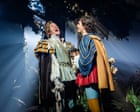
Luckily, the judges and audiences disagreed. If you want to see enchantment, take yourself to Stephen Sondheim’s musical set in the twisted world of fairytale. Cinderella, Red Riding Hood and others bounce into the forest, which shimmers in a weave of powdery, gleaming branches and light angling through all the trees. Now transferred to the West End from London’s Bridge theatre, it’s a breathtaking piece of design for a seriously playful musical.
“This is a stunning piece, but it’s a monster,” Malone declares. “There was a lot of problem-solving.” From a lighting point of view, it is “about the passing of time, day and night. The woods are very luscious and inviting initially, and then become darker and more mysterious.” As tales old and new collide, and characters stumble far beyond their happy ever afters, design signposts the journey. After the initial quest into the woods, the characters return to find that arcadia has collapsed into “destruction and wasteland”.
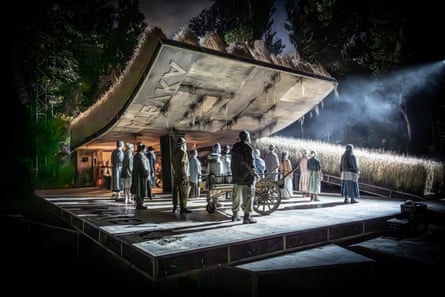
Rangy and witty, the Irish designer arrives for our interview convinced that I’ll be chatting to all the “absolutely stunning” creatives behind Into the Woods; Jordan Fein (director), Tom Scutt (set) and Roland Horvath (video). “It’s a great team effort,” she insists. She previously sent light through Scutt’s wheat fields in their Olivier-winning Fiddler on the Roof. Into the Woods offers a series of smoke and mirror surprises, for which Malone uncages a whole spectrum of smoke and haze: “A fog that’s quite dense but rises, and then a cool fog that stays low on the ground.” Light pierces the layers, especially when characters experience an epiphany (Red Riding Hood plucked from the wolf’s belly, Jack dismounting the beanstalk).
What was her own career-setting epiphany? “Was I a little theatre kid?” she considers. “Not really.” A Dublin pantomime at an impressionable age was a turning point, while at her all-girls secondary school, the annual musical cast the tall Malone as swaggering blokes in Oklahoma! and The King and I. Acting beckoned – but her degree at Dublin Trinity and then Goldsmiths in London also covered backstage roles. “I fell upon lighting, and was definitely more comfortable with not being on the stage, collaborating with the whole team. I enjoyed how lighting is very technical and creative at the same time. I haven’t looked back since.”
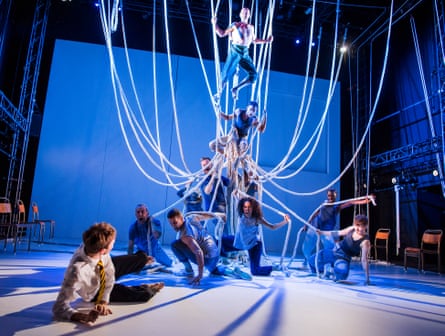
Her career in lighting began on the fringe and working on dance shows. She toured with dancer and choreographer Akram Khan, enjoying how dance let her “play with beautiful bodies in space. It’s very sculptural. Often you don’t need to worry about the faces, and you can play with angle.”
Theatre then became her home turf. Do all directors understand lighting? “Not to name any names,” she grins, “but some are very visual, and some aren’t.” She prefers “somebody with nerves of steel who is prepared to try stuff” – like Sally Cookson, with whom she devised hit shows such as Jane Eyre and A Monster Calls. “Devised work is nerve-racking,” says Malone, “because you don’t know what you’ve got till the last week of rehearsals. You have to figure it out once you’re in the space.” Their 2016 Peter Pan at the National was touch and go, she admits: “But we always get there for press night.”
The pandemic prompted a long-contemplated masters in light and lighting at University College London. “I thought I knew a lot about colour,” Malone says, “but I learned so much about the detail of a light source, which makes a huge difference when you’re lighting skin tones.” This fascination carries back into her stage work. “Two people in daylight might look the same, but put them under theatre light and they’re quite different. One person needs 1% more magenta, and one needs 1% less. It’s a challenge.”
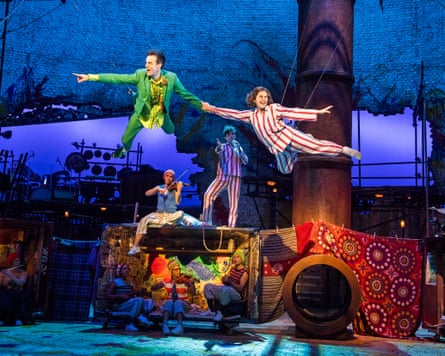
Malone has always been drawn to “the cool and warm natural colours of daylight” – a favourite venue is the Open Air theatre in London’s Regent’s Park, where she and Scutt designed Carousel and Fiddler. She also embraces projects blending architectural and theatrical knowhow, such as Sadler’s Wells East, which opened last year. A neon sign above the entrance proclaims: “You are welcome” – but glowing lighting through the building must sustain that welcome from morning to night.
Although she is broadening her work, theatre retains its essential appeal for her. “You have a work light on and the space looks flat – then you put a spotlight on and it’s transformed. It’s a bit of magic.”
KioskNews shows a cleaned-up reading view extracted from the publisher’s page — the original always lives on their site, not ours.