MTBPS 2026: Opposition calls Godongwana’s fuel levy cuts ‘a scam’ as GNU offers muted support
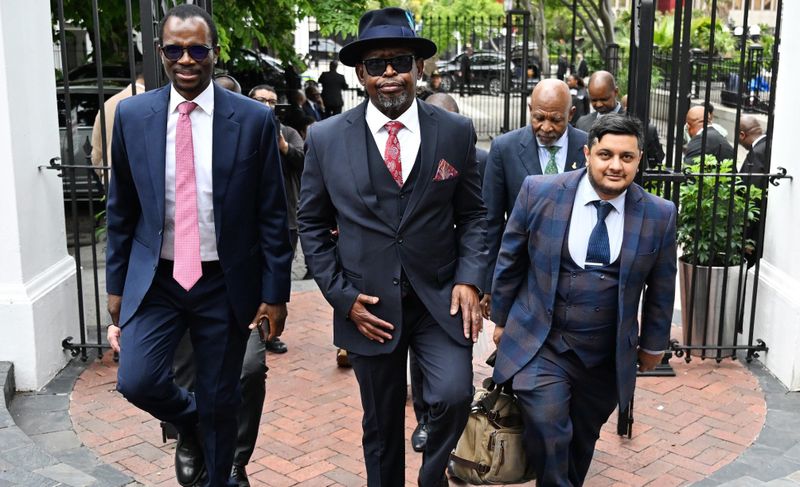
It was always going to be tricky for Finance Minister Enoch Godongwana to deliver the Medium-Term Budget Policy Statement (MTBPS) just two weeks before the 4 November municipal elections.
And so he combined a message of municipal financial discipline with public-focused funding: cutting the fuel levy to lower petrol and diesel prices until January 2027, alongside additional funding for the Madlanga Commission (R365.87-million), the defence force’s Operation Prosper with the police against gangsterism and illegal mining (R823.1-million) and R3.8-billion for 3,500 social workers to boost the fight against gender-based violence and femicide.
The MTBPS highlighted the direct cost of the 30 June deadline set by the March and March group for foreign nationals to leave South Africa, with R304-million allocated to the Department of Home Affairs to cover unforeseen spending on large-scale repatriations and deportations. Home Affairs will receive a further R1.2-billion through special appropriations legislation to fund Border Management Authority operations.
Of those special appropriations, which total R6.9-billion, the lion’s share – R4.4-billion – goes to the South African Revenue Service (SARS). Parliament receives R918-million to complete its rebuilding following the January 2022 blaze and for public participation, while the Defence Ministry receives R280-million for retired members’ health services.
‘Election ploy’
Cosatu said it was “deeply disappointed”, describing the MTBPS as a missed opportunity despite some positive spending, including R810-million for working police cars.
“As an overall package, it fails to respond decisively to the dire crises facing the working class and the economy, our 43.8% unemployment rate and stagnant economic growth.”
MK Party MP Thulani Shongwe described the fuel levy cuts as “a scam” and “cynical electioneering”, adding that a budget that did not address job creation or land was a deception.
EFF spokesperson Sinawo Thambo dismissed the fuel levy cuts as an “election ploy” and urged the public to remain sceptical, arguing that “there is nothing that shows us there is [economic] stimulus”.
ActionSA MP Alan Beesley said he was disappointed the fuel levy cuts were not greater given the impact of petrol prices on consumers, but welcomed the money allocated to the tax authority.

Build One South Africa leader Mmusi Maimane noted that while a fuel levy cut is an attractive move in an election year, it will not get the economy growing fast enough.
Government partners’ reaction
For the senior partner in the Government of National Unity (GNU), ANC Secretary-General Fikile Mbalula welcomed the fuel levy cuts as putting money back into working families’ pockets, and commended the MTBPS for signalling a check on spiralling government debt.
The other GNU partners were more restrained.
Freedom Front Plus MP Wouter Wessels said it was a “positive” MTBPS, given the state of South Africa, although the fuel levy cut was too little, too late.
United Democratic Movement (UDM) Chief Whip Nqabayomzi Kwankwa said, “A better balance sheet does not translate into a better life for South Africans.”
Rise Mzansi leader Songezo Zibi said he was “happy, but not thrilled”. While Zibi backed the boost to infrastructure spending, he expressed disappointment that savings from curbing social grant corruption were not being allocated to combat hunger.
The DA took a different turn, pushing for urgent, faster and more far-reaching growth reforms. DA MP Kingsley Wakelin said, “National Treasury has laid the foundation for growth. Now the rest of government must deliver the bold reforms that create the growth itself.”
Long-term reforms
The MTBPS also signalled extensive public finance legislation reforms.
Aimed at addressing “weak financial and operational management in many municipalities”, proposed amendments to the Municipal Finance Management Act include giving the National Treasury a say in the appointments of chief financial officers and making officials, political office-bearers and board directors personally liable for unauthorised, irregular, fruitless and wasteful expenditure.
Public comment on the amendment legislation is possible until 29 July 2027, and the National Treasury aims to table the Bill in Parliament later in the year.
The National Treasury director-general, Duncan Pieterse, told Daily Maverick the legislative changes “create the investigative responsibility” to ensure that maladministration and financial irregularities are investigated. National Treasury would use its existing investigative capacity and refer cases to law enforcement and prosecution services.

Meanwhile, the Public Finance Management Act would be amended to include the fiscal anchor, or approved fiscal plan for each newly elected administration, alongside Zondo Commission recommendations to clarify the roles of accounting officers and boards, strengthen action against misconduct, and to reinforce governance and accountability. Again, the Bill is expected in Parliament in 2027.
The MTBPS made clear that allocations will no longer be transferred without measurable performance outcomes. This is illustrated by the smart meter grant programme to improve municipal billing, which has so far installed 247,206 meters across 28 municipalities and raised R361-million in additional revenue.
Given that consumers owed municipalities a total of R484.5-billion as of June 2026 – and with Eskom recently informing MPs that councils owe the utility more than R120-billion – the logic behind the government’s drive for smart meter billing programmes becomes obvious.
Godongwana was adamant that municipal financial reform went beyond governance to how grants and rand-and-cents allocations must be handled, saying:
“Every rand transferred to municipalities must translate into visible improvements in people’s daily lives. Communities should have reliable water, functioning sanitation, well-maintained roads and safe, well-lit public spaces.”
A review of municipal funding found most councils had enough money for day-to-day operations, but spent too much on running costs, which leads to insufficient funding for long-term infrastructure investment and maintenance. The review would be finalised by the end of the year, resulting in recommendations for “a practical funding model”, the minister added.
For President Cyril Ramaphosa, the MTBPS was a “stabilising story” for economic growth, showing how his administration got to grips with debt and deficit. He added that more allocations would be made in the February 2027 Budget. DM
KioskNews shows a cleaned-up reading view extracted from the publisher’s page — the original always lives on their site, not ours.