The urban Filipino is tired, cash-strapped, and sick of the ‘resilience’ excuse
Already have Rappler+?
to listen to groundbreaking journalism.

Alyssa Arizabal/Rappler
Nearly half of urban Filipinos surveyed in a study reject the romanticized narrative of resilience, as crises beyond their control leave them with little choice but to endure
AT A GLANCE
- A significant portion of urban Filipinos, particularly younger respondents, are rejecting the romanticized narrative of 'Filipino resilience' in the face of ongoing crises, with 48% overall and 64% among those aged 18 to 24 expressing this sentiment.
- Despite high resilience scores among those facing greater hardships, many Filipinos are struggling financially, with 44% lacking sufficient savings and 46% having taken out loans for essentials, indicating a growing reliance on credit.
- The study calls for accountability from the government and institutions, as well as immediate actions from businesses to support consumers, such as price freezes and promotional offers, to help alleviate economic pressures.
This is AI-generated. Read the article for full context. Report any errors.
MANILA, Philippines – For years, every calamity and crisis has been followed by a familiar consolation. Filipinos are resilient. Whatever happens, they find a way, pick themselves up, and keep going.
“Bagyo ka lang; Pinoy kami.” (You’re just a storm; we’re Filipinos.)
But many Filipinos are now rejecting that romanticized view. Nearly half (48%) of urban Filipinos surveyed by research firm Organic Intelligence said they rejected the romanticized narrative of “Filipino resilience,” according to its Pinoy, Kaya Pa Ba? study released in October.
The sentiment was strongest among younger respondents aged 18 to 24, of whom 64% rejected the narrative. In Mindanao, the figure reached 59%, compared with 38% in Metro Manila.
That said, at what point does enshrining the resilience of Filipinos for enduring hardship become an excuse for allowing that hardship to continue?

“We are not rejecting resilience per se. What we are rejecting is the necessity of it amid all of these crises. Why is that the default coping?” said Jason Ligot, Organic Intelligence group account director for development communication and communication design, in a press briefing on Friday, October 23.
“We should be holding government and institutions to account. And then second, why is the onus always on me?” he added.
Curiously, resilience was higher among groups facing greater hardship.
Mindanao respondents scored 86 out of 100 on the Resilience Index, compared with 80 in Luzon outside Metro Manila. Those aged 45 to 54 scored 87, against 77 among younger adults. Researchers said lower-income respondents also tended to score higher.
So how do these high scores square with the growing rejection of the resilience narrative?
Ligot suggested that those facing the greatest hardships may be drawing more heavily on their psychological reserves because they have little choice.
Although 69% of Filipinos maintained an optimistic financial outlook, 44% lacked enough savings to survive three months without work. Another 45% said inflation had drained them to the point of losing their drive to get ahead.
The Philippines may have officially reached upper-middle-income status in July, but that does not mean ordinary families have the financial security to weather another crisis. At the Zero Poverty PH 2030 forum on October 16, World Bank economist Sharon Faye Piza warned that many households remain vulnerable to economic shocks that could push them back into poverty, calling for better-paying jobs and stronger social protection.

Loaning to live
The study also found that Filipinos are also borrowing just to get by.
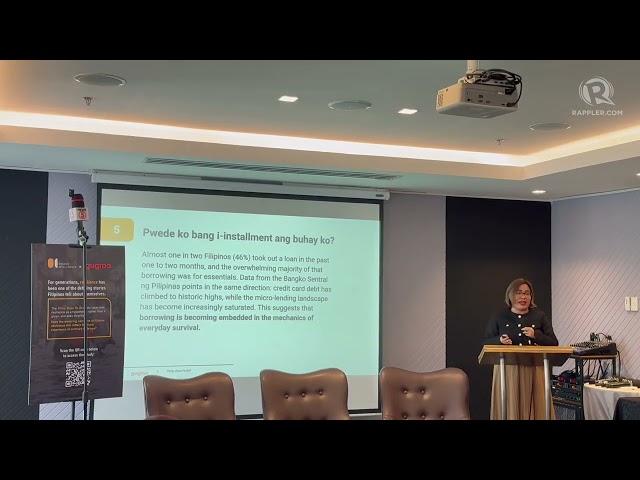
The survey found that 46% had taken out a loan in the preceding one to two months, with 42% of all respondents borrowing for essentials, including food and transportation.
Official banking data similarly show a broader expansion in consumer credit. Outstanding consumer loans reached P2.84 trillion in August, up 17% from a year earlier, according to the Bangko Sentral ng Pilipinas (BSP). Credit card receivables alone climbed 23.8%.
More worryingly, there are signs of growing repayment difficulties. Non-performing consumer loans grew nearly 20% from a year earlier, and the share of bad debt climbed to 5.67% of all consumer loans, according to BSP data.
So what can be done?
Of course, there are big problems to fix. The study calls for holding the government accountable, addressing the economic pressures on households, and building more free public spaces where Filipinos can relax for free. But these changes will take time.
But businesses can act more immediately to help struggling consumers and earn their loyalty along the way. Asked what would make them feel a brand was genuinely on their side, 27% of respondents chose a price freeze, the most popular response. Smaller or tingi sizes followed at 16%, free shipping at 14%, and promotional bundles at 12%.
“It has to be tangible,” said Sheila Mangila, Organic Intelligence group account director for marketing intelligence. “It’s about material conditions that will really help them survive the everyday.” – Rappler.com
The study surveyed 800 Filipinos in urban areas aged 18 to 65 through an online panel in May 2026. Its findings may not fully capture perspectives of rural or digitally disconnected Filipinos.
KioskNews shows a cleaned-up reading view extracted from the publisher’s page — the original always lives on their site, not ours.