Stellar discovery: Israeli researchers may have found faintest supernova ever recorded
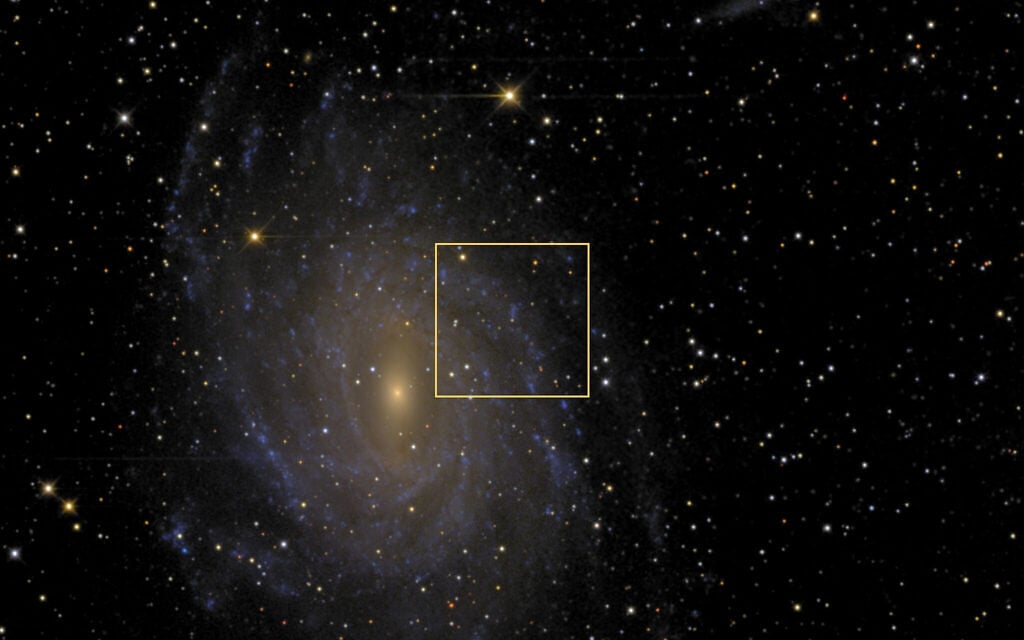
An international team of astronomers led by the Weizmann Institute of Science has discovered what is possibly the faintest supernova ever recorded, a stellar explosion that challenges long-held assumptions about how dying stars behave.
The researchers tracked the explosion of a dying star 30 million light-years away, which faded far more slowly than scientists predicted.
The study will help scientists develop software for space observation while creating “handy tools” that can eventually be adapted into everyday technologies to further the study of space on Earth, lead author Erez Zimmerman, a Weizmann doctoral student, told The Times of Israel.
0:00 / 0:00
Promoted: Z3 Project Conference 2026

Using BlackGEM, an advanced telescope operating in Chile that scans the southern sky, Prof. Avishay Gal-Yam’s team discovered the supernova, known as SN 2024vjm.
The team published the research in Nature Astronomy on Thursday.
Get The Times of Israel's Daily Edition by email and never miss our top stories
By signing up, you agree to the terms
‘A bright spot of light’ from 30 million light-years away
Two years ago, when Prof. Paul Groot of Radboud University in the Netherlands, leader of an international consortium of astrophysicists, observed a bright light from BlackGEM that wasn’t there the previous night, he alerted other astronomers around the world.

“The sudden appearance of a bright spot of light 30 million light-years away made us suspect it was a supernova,” Zimmerman said.
Zimmerman said that when an ordinary supernova explodes, it hurls a cloud of gas into space that expands at about 10,000 kilometers (6,200 miles) per second.
“But this cloud was moving at only 3,000 kilometers (1,864 miles) per second,” he said. “We were perplexed.”
When Zimmerman showed the calibration to a professor, he was asked, “Are you sure this is not a mistake?”
“It was that kind of discovery,” he said.
Looking for a distant explosion
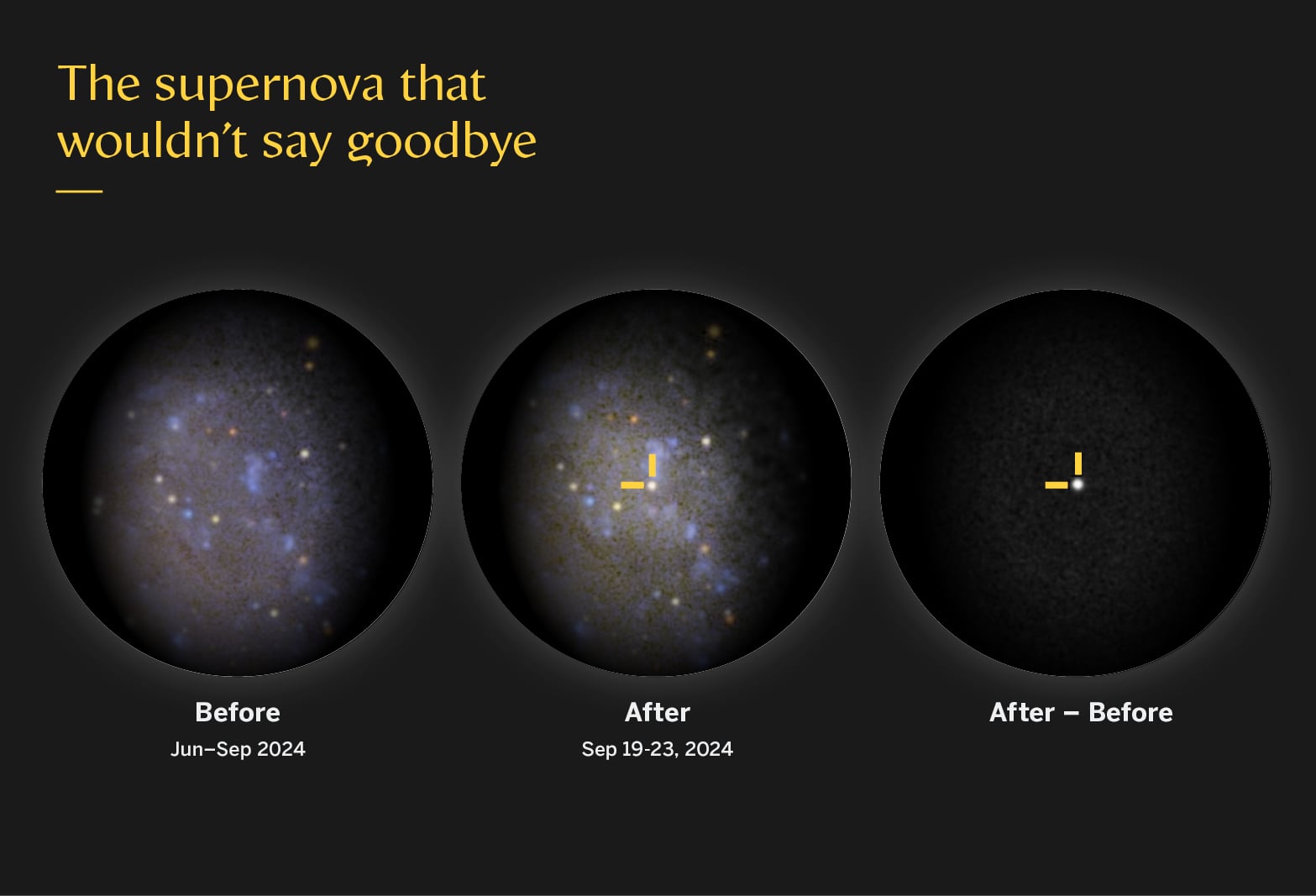
The scientists then turned to images released by Europe’s Euclid space telescope, which orbits 1 million miles from Earth, that included an earlier view of the same galaxy in the southern sky taken 11 months before the explosion. Even when the scientists zoomed in on the exact spot, they saw nothing.
“This revealed to us that the explosion did not involve a bright star,” Zimmerman said. “Instead, it may have originated in a system consisting of a white dwarf and a faint companion star, or perhaps a pair of white dwarfs.”
A white dwarf is about the same size as Earth, yet it is 1 million times denser than the Sun.
“The glowing cloud grew by roughly 260 million kilometers [160 million miles] each day,” Zimmerman said. “It is still expanding and will not stop expanding for thousands of years.”

No lab, just light
Unlike in other fields where “you have a laboratory and you can create an experiment, in astrophysics, except for very rare occasions, the only thing that comes out of the stars is light,” Zimmerman said. “And the good thing about light is that it contains a lot of information.”
The scientists monitored the supernova for almost a year, repeatedly measuring its spectrum and brightness.
“Because the explosion was so faint, we expected it to fade and disappear quickly, as predicted by a physical principle more than 30 years old known as the Phillips relation,” Zimmerman said. “Instead, the faint supernova continued to shine for 70 days, which is a remarkably long time.”
Zimmerman said there was radioactive nickel trapped inside the cloud that generated heat and radiation, causing it to glow. But as the cloud expanded, it eventually became thin enough for the radiation to “escape,” and the supernova faded.
To measure the amount of the radioactive nickel, the researchers used a mathematical formula known as the Katz integral, developed in the 2010s by Weizmann astrophysicist Prof. Boaz Katz, which helped determine how much radioactive fuel powered the blast.
Zimmerman said the study will help researchers continue measuring distant explosions to provide new insights into where and how the elements that make up planets — and life itself — come from.
“Astronomy is done with research groups around the world,” Zimmerman said. “We are studying it for people to be able to crack the riddle and know what’s out there in the stars. We’re doing this to expand human knowledge and also to benefit humankind.”
Animal lovers, this one's for you

In 1935, Rabbi Max Shorenstein left Denmark to pursue his lifelong dream: building a zoo in Tel Aviv and teaching children to love animals. The Tel Aviv Zoo became one of the city’s greatest attractions, but envy, greed, and corruption drove Shorenstein from the paradise he created.
The film 'There Are No Lions in Tel Aviv' is available to screen November 19-26 for members of our reader support group, The Times of Israel Community. Join the Community today to support our work and watch our DocuNation series of outstanding Israeli documentary films.
I want to watch I want to watch Already a member? Sign in to stop seeing this
KioskNews shows a cleaned-up reading view extracted from the publisher’s page — the original always lives on their site, not ours.