Chinese research ship near the Batanes sparks undersea cable concerns in Manila
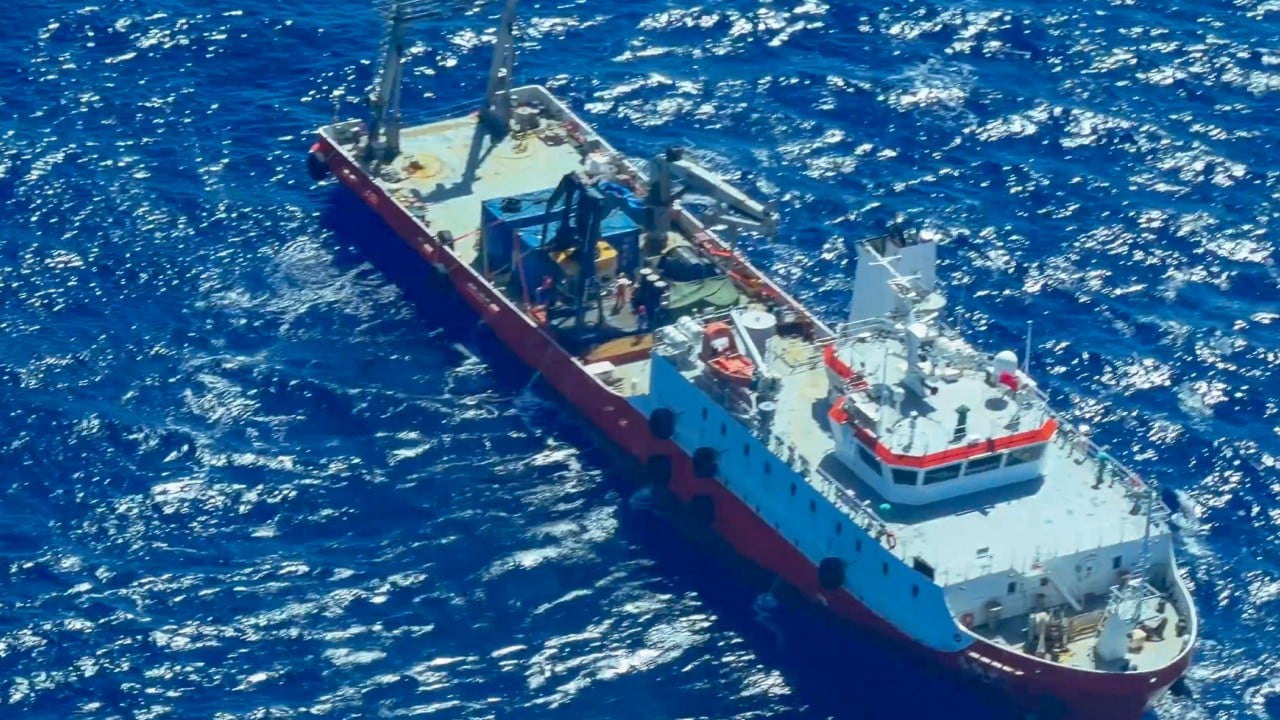
A Chinese civilian research vessel has spent more than a week conducting operations in waters off the Philippines’ Batanes Islands, an area that has become a new geopolitical battleground as Beijing ramps up pressure against Manila-Tokyo delimitation efforts.
Data recorded via the vessel’s Automatic Identification System (AIS) for September, tracked by MarineTraffic, revealed that the Jia Hai Ke 7 research ship departed from Xiamen on China’s southeastern coast on September 19, arrived near Itbayat in the province of Batanes on September 22, and remained in the area through to at least Tuesday.
The Philippine coastguard confirmed the ship’s presence on Monday. Coastguard spokesman Jay Tarriela said the vessel was around 38 nautical miles (70km) northwest of Itbayat and displaying behaviour inconsistent with innocent passage.
“Rather than steaming on a steady course and speed, Jia Hai Ke 7 has been loitering and holding position in the same area – the movement pattern of a vessel conducting marine scientific research (MSR), not transit,” Tarriela said on social media.
The Batanes Islands are an archipelago located between Taiwan and the northernmost tip of the Philippine island of Luzon.
The vessel’s presence has stirred concerns in Manila over critical subsea telecommunications cables traversing the seabed of the Luzon Strait, which connect Southeast Asia to North America and northeast Asia.
Philippine aerial patrols issued three radio challenges demanding that the ship declare its mission and cease unauthorised surveys, but received no response.
The deployment comes amid heightened friction over the Batanes Islands.
Some Chinese scholars argued in June that the islands were a natural geographical extension of Taiwan and therefore fell under Chinese sovereignty. The assertion is not officially endorsed by Beijing.
The ship’s deployment has also raised concerns over China’s use of research vessels to assert claims, map seabed terrain for potential military applications, and gather intelligence on undersea infrastructure in disputed waters.
Beijing’s concerns about the area have heightened following Manila and Tokyo’s decision in May to launch formal negotiations on delimiting their overlapping exclusive economic zones and continental shelves.
Beijing denounced the bilateral initiative as unlawful and void, arguing that the waters form part of Chinese maritime zones projected from Taiwan.
Beijing sees Taiwan as part of China to be reunited by force if necessary. Most countries, including the US, Japan and the Philippines, do not recognise Taiwan as an independent state.
The Chinese embassy in Manila defended the research vessel’s presence, stating that it was “operating within waters under Chinese jurisdiction”.
The state-run Global Times said the Jia Hai Ke 7 was conducting “legitimate and lawful” offshore marine geological surveys and scientific investigations in waters under Chinese jurisdiction.
“By forcibly overstretching the concept of security and militarising civilian research, the Philippines not only interferes with China’s normal navigation and scientific operations, but also deliberately stokes regional tension,” the newspaper said.
According to the China Classification Society, the 70-metre (230-foot) vessel is China’s first privately owned research ship equipped with a Dynamic Positioning Class 2 (DP2) system, tailored for precision station-keeping and offshore marine geological surveys.
It was built for Zhuhai Jiahai Marine Technology Co and entered service in April last year.
The incident marks the latest in a pattern of Chinese research vessel deployments to sensitive maritime areas that have generated controversy across the region.
03:31
China and the Philippines trade accusations after clash in South China Sea
These operations typically involve research activities inside the exclusive economic zones and contested waters near Taiwan, the Philippines and Japan.
Since May, mainland Chinese research vessels have appeared in waters east of Taiwan on multiple occasions, raising alarms in Taipei.
Last month, the Philippine Coast Guard accused another Chinese survey vessel, the Haiyang Dizhi 10, of conducting “illegal” operations for 25 days within the Philippine exclusive economic zone, including the territorial sea of Scarborough Shoal. The disputed shoal, known as Huangyan Island in China and Panatag Shoal in the Philippines, has become a frequent maritime flashpoint in South China Sea disputes between Beijing and Manila.
Manila also said the Haiyang Dizhi 10 occasionally switched off its AIS transponder in what it described as an attempt to evade detection.
KioskNews shows a cleaned-up reading view extracted from the publisher’s page — the original always lives on their site, not ours.