Huawei steps up Tau chip roll-out, with Mate XT 2 on track for 1 million sales
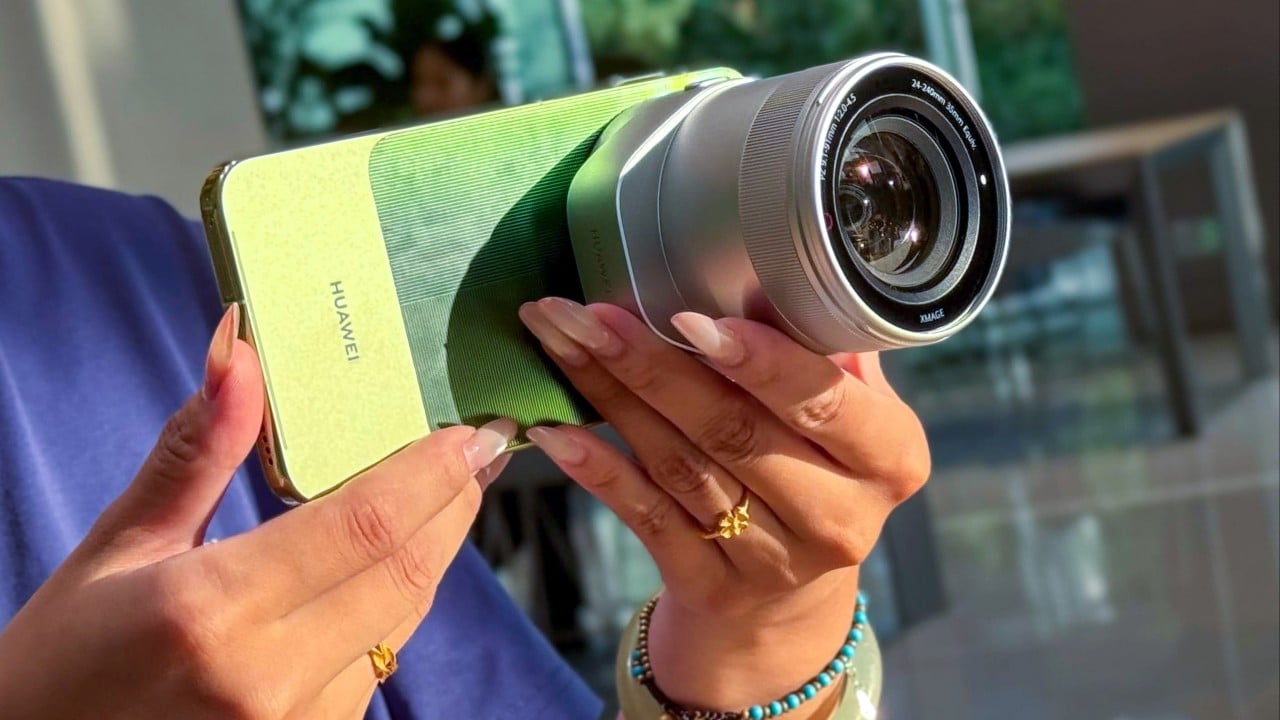
Huawei Technologies is making rapid progress in rolling out a new breed of advanced chip based on its self-developed Tau Scaling Law, with the Chinese company set to adopt the processors across the newly released Mate 90 smartphone series.
The roll-out marks another step forward in the Chinese tech giant’s push to overcome stringent US export curbs, which has seen Huawei rewire its smartphone business to run on home-grown technology.
Speaking at a press briefing on Tuesday, Huawei consumer business chief Richard Yu Chengdong said the company had already shipped about 100,000 Mate XT 2 trifold phones since the model’s release on September 12.
The new handset – the first to integrate mobile processors adopting the LogicFolding architecture based on Huawei’s Tau Scaling Law chip design principle – is on track to surpass 1 million in total sales, and Huawei plans to launch the phone in markets across Asia-Pacific, the Middle East and potentially Europe, according to Yu.
The Mate 90 series, which Huawei unveiled on Thursday, will also deploy Kirin chips based on the Tau chip design, which the company developed to bypass US tech sanctions and overcome China’s lack of cutting-edge chip manufacturing facilities.
“Technologies like extreme ultraviolet lithography certainly are valuable to deliver advanced semiconductors … but China does not have that,” said Yu. “That’s why Huawei develops LogicFolding and the Tau Scaling Law to try to mitigate the gap.”
On Thursday, Huawei unveiled the line-up for its new flagship Mate 90 series of handsets, which all feature Kirin chips based on the company’s Tau design.
The Kirin 9050 Pro chipset – Huawei’s most advanced processor, which is also used in the Mate XT 2 – will power the series’ top-of-the-line models: the Mate 90 RS Ultimate Design and Pro Max Premium Edition. A slightly less powerful system, the Kirin 9050, will be deployed on the Mate 90 Pro Max.
Both chipsets adopt Huawei’s LogicFolding architecture.
The Tau Scaling Law and its LogicFolding chip architecture allow Huawei to build more powerful processors without needing to access advanced lithography machines. The approach focuses on shortening signal paths and ultimately packing more transistors into a smaller space.
The architecture boosts computing power and data transfer by reducing critical path latency by 30 per cent, according to Huawei.
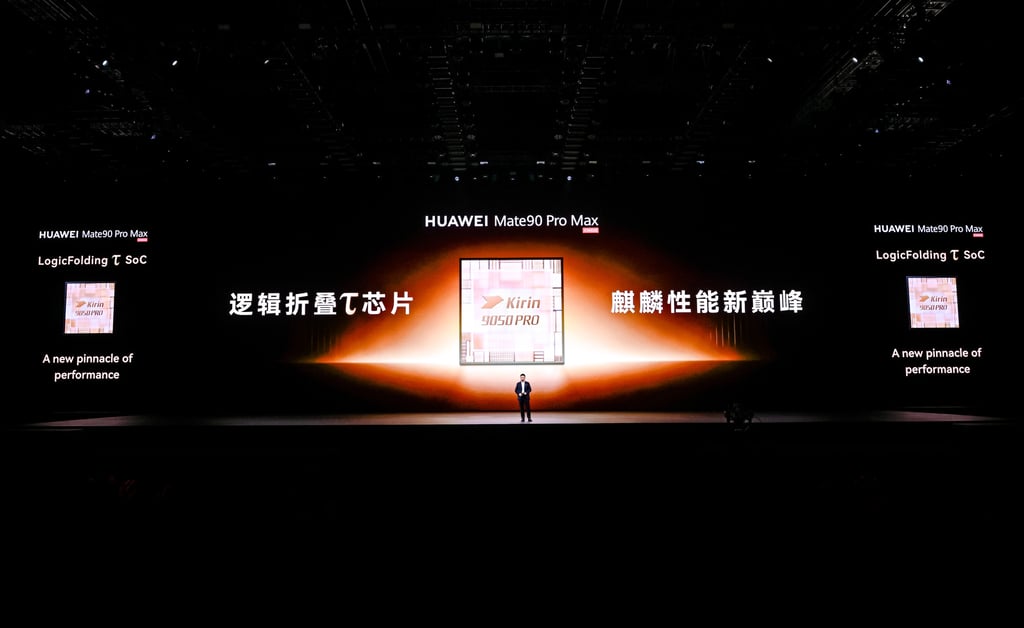
The Mate 90 Pro Max Premium Edition boasts a 31 per cent performance improvement over last year’s Mate 80 Pro Max, according to the company, largely thanks to the new model’s use of the Kirin 9050 Pro.
The Kirin 9050 Pro outperforms Apple’s 3-nanometre A17 Pro chip, despite being produced using technology equivalent to a 7-nanometre process node, according to a recent report by Bernstein.
The new chip meant that Huawei was now just three years behind Apple in terms of chip technology, down from roughly four years during the previous generation, the report said.
The Mate 90 Pro is equipped with the Kirin 9035, while the base model Mate 90 is powered by the Kirin 9030. The two chips are both based on the Tau Scaling Law but they adopt an older architecture rather than LogicFolding.
Despite being tight, Huawei’s semiconductor capacity was currently sufficient to meet the company’s shipping needs, Yu said. But surging memory costs have weighed on the company and overall market demand.
Huawei’s production costs have risen by more than US$200 per phone due to skyrocketing memory prices, according to Yu, adding that the crisis had hit the company harder than its rivals as it adopted higher configurations that were subject to steeper price increases.
The cost surge has dealt “a severe blow” to the company’s profitability, even after it raised retail prices, according to Yu.
“Our profitability is dropping very sharply, to be honest,” Yu said. Huawei would “inevitably” have to introduce further price rises in the future, he added, though they were unlikely to be large.
“A company cannot operate at a loss,” he said. “We have to survive and face the challenge together.”
Beyond the memory crisis, Huawei is also facing increasingly intense competition in the phone industry. Apple recently unveiled its first foldable handset – the iPhone Duo – entering a segment that Huawei currently dominates in China.
“We’re actually very pleased to see the launch of iPhone Duo from our American peer,” Yu said.
Huawei’s Pura X Max, featuring a similar passport-style design to the iPhone Duo, saw a 76 per cent surge in sales after Apple introduced its foldable handset, according to Yu. The model has now surpassed 1.4 million in sales since its launch in April. Apple’s iPhone Duo will not hit store shelves until October 23.
“Healthy competition can motivate more users to opt for the foldable products,” Yu said.
KioskNews shows a cleaned-up reading view extracted from the publisher’s page — the original always lives on their site, not ours.