AFTER THE BELL: Premier Group’s Tulbagh factory closure threatens its social licence to operate
In my experience, there are many ways to win the battle for public opinion.
You and I have just lived through one of those big moments where various people who believe various things have all been shouting at each other for exactly that. To try to influence what you and I think of them.
While there are few certainties in life, I think that one of them might be that unaudited interim results are not a good way to try to change minds. No matter how interested you might be in such a document, the fact is, it is not going to work.
Which is why I find it odd that so many bigger corporates will try to explain things in the dry language of the “Commentary” section of such reports.
What it tells me is that the real constituency of the people who manage the company is not public opinion at all. It is shareholders.
I completely get that, they are the people who really matter for a CEO.
‘Licence to operate’
But in the longer run, a company only really exists and succeeds if it is given what analysts call a “licence to operate” by society. They don’t mean a formal legal licence. They mean that society accepts them and buys their services.
Many of us may not like Elon Musk (whose name, aptly, consists of two four-letter words), but we would probably accept Starlink because he has, just, kept his social licence to operate.
The legal problems with the licence are something else.
I wonder if any of this has troubled the top brass at the Premier Group.
They released their six-monthly results today, the first since they bought the Rhodes Food Group.
And while normally they should be celebrating the nice bump in revenue this gives them, most of the attention is going to be about what they say about their factory in Tulbagh.
This is the one that has been closed after the merger with Rhodes (don’t worry, I also wondered for a second what the university had to do with it).
The Competition Commission is asking the Competition Tribunal to undo the merger based on the claim that their investigation “found that Premier and RFG (Rhodes Food Group) had failed to disclose information about the contemplated closure to the commission and the Tribunal, despite the parties having known of and discussed the option to do so before the Tribunal approved the merger”.
In their results today Premier completely disagrees, saying: “There was no contemplation of closure prior to the merger approval. As such, there have been no merger-related retrenchments, only voluntary separation agreements which were specifically allowed.”
Premier also repeats what they’ve said before, that after the merger the industry changed, international demand for canned fruit dropped and there was huge entry into the market by China. It also points to a very strong fruit harvest in Greece.
Objectively true
All of that is probably objectively true. Certainly, it can be worked out one way or another.
But now I suspect, in the tribunal hearing, should there be one, that this could all devolve to a simple finding of fact about whether Premier and Rhodes did discuss closing the factory before the merger.
The commission says this finding was the result of its investigation.
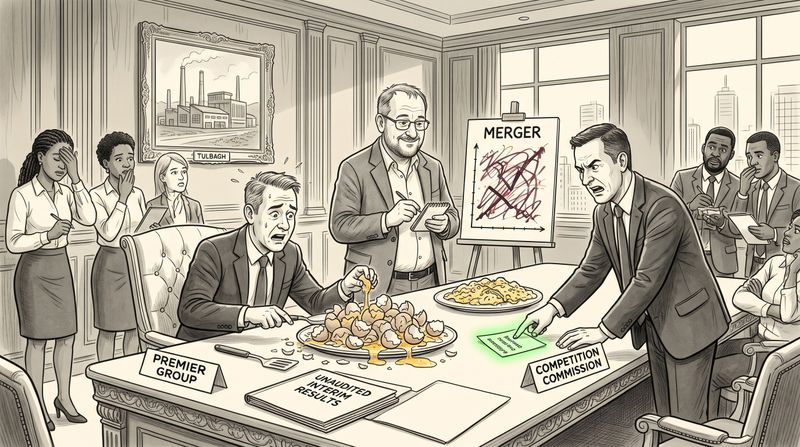
One way or another, there is going to be a lot of egg on someone’s face by the end of this.
If the commission is able to produce just one document that shows there was such a discussion, it’s game over for Premier. If it can’t produce a single document, then it will either lose, or it will need proper witness testimony in some form.
I would like to hope the commission wouldn’t have gone this far without being really, absolutely, certainly confident of its story.
And yet, we have seen times when it has made decisions and statements that turn out to not be the case.
I’ll never forget, so many years ago now, the promise that the currency manipulation case would be over quickly and that the banks would plead guilty. In the end, most of the banks fought incredibly hard and most of them won out.
But, who trusts a corporate these days?
The commission wouldn’t have evidence from every single parking lot discussion before the merger, those moments when business is really done and the real decisions are made.
I do think it’s unlikely this will end with the merger being undone. There is really no precedent for it, and you can’t, as the saying goes, recreate three eggs from an omelette.
So the worst-case scenario for them is probably some kind of fine or a new condition of the merger.
But the lasting damage will be to their reputation. To their social licence.
People won’t forget this.
And the community of Tulbagh might never forgive them, as they hunker down hope against hope for new work, and a new form of income. DM
KioskNews shows a cleaned-up reading view extracted from the publisher’s page — the original always lives on their site, not ours.